

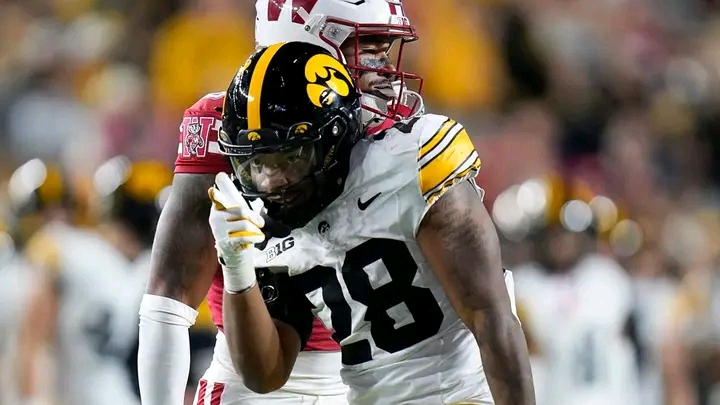
ESPN Drops Eye-Opening Verdict on Iowa Football’s 2026 Outlook — One Strength Could Dominate, But a Familiar Flaw Still Lingers. There’s a quiet storm building in Iowa City and if ESPN’s latest breakdown is any indication, the 2026 season could swing dramatically depending on one glaring factor. The Hawkeyes are loaded in one area that could carry them deep into the Big Ten race, yet a long-standing weakness still threatens to hold everything back.
As spring football winds down, the focus has already shifted toward fall camp and what promises to be a pivotal 2026 campaign for Iowa. After finishing 9-4 overall and 6-3 in conference play last season, the Hawkeyes enter the year ranked No. 19 in ESPN’s early top-25 projections. But that ranking comes with a clear message: Iowa has the pieces to rise but also the potential to stall.
At the center of that conversation is a major transition at quarterback. With a new signal-caller expected to take over either Jeremy Hecklinski or Hank Brown the offense is entering a new era. That uncertainty makes the supporting cast more important than ever, and according to ESPN analyst Adam Rittenberg, the gap between Iowa’s biggest strength and its most concerning weakness couldn’t be more obvious.
Let’s start with the good news because it’s really good.
A Backfield Built to Dominate
If there’s one position group that could define Iowa’s 2026 season, it’s running back. ESPN didn’t hesitate to call it the team’s biggest strength, and the numbers back it up.
Kamari Moulton returns after leading the Hawkeyes with 878 rushing yards in 2025. He wasn’t just productive he was consistent, grinding out tough yards and serving as the backbone of Iowa’s offense. Now, he’s not alone.
Enter Lendon “L.J.” Phillips Jr., a transfer from South Dakota who arrives with jaw-dropping credentials. Phillips led the entire FCS with 1,921 rushing yards and 19 touchdowns last season, earning All-America honors. That kind of production doesn’t just translate it demands attention.
And it doesn’t stop there.
Xavier Williams and Nathan McNeil are also back in the mix after flashing serious potential last season. While neither posted headline-grabbing stats, both showed explosive ability in limited opportunities. With a full offseason to develop, they add depth and versatility to an already dangerous unit.
Put it all together, and Iowa may very well have one of the most complete running back groups in the country.

More importantly, this ground game could be the safety net Iowa desperately needs. With a new quarterback stepping into the spotlight, a dominant rushing attack can ease the pressure, control the tempo, and keep defenses guessing.
The Problem That Won’t Go Away
But for all the optimism surrounding the backfield, there’s a familiar concern that continues to cast a shadow over Iowa’s offense: wide receiver.
It’s been a lingering issue for years, and heading into 2026, it still hasn’t been fully resolved.
Reece Vander Zee is one of the few bright spots. Averaging 14.6 yards per catch in 2025, he showed flashes of big-play ability, particularly on deep routes. However, injuries limited his impact, and consistency remains a question.
That’s where Evan James comes into the picture.
The Furman transfer led his previous team with 65 receptions for 796 yards last season, bringing proven production into Iowa’s receiving room. His arrival is expected to provide a reliable target for the new quarterback something the Hawkeyes have lacked in recent years.
Another name generating buzz is Tony Diaz, a transfer from UT Rio Grande Valley. Coaches and insiders have reportedly been impressed with his performance during spring practices, and early signs suggest he could quickly climb the depth chart.
Still, potential doesn’t equal production at least not yet.
Even with tight end DJ Vonnahme expected to play a major role in the passing game, Iowa needs its wide receivers to step up in a big way. Without a legitimate outside threat, defenses will continue to stack the box, making life harder for the running backs and limiting the offense’s overall ceiling.
Why This Balance Matters More Than Ever
The contrast between Iowa’s strengths and weaknesses isn’t just a talking point it could define their entire season.
A dominant running game can win you games. But in today’s college football landscape, it’s rarely enough to carry a team through a full schedule, especially in a competitive conference like the Big Ten.
Defenses are too fast. Too adaptable. Too prepared.
If Iowa becomes predictable leaning too heavily on the run without a credible passing threat it won’t take long for opponents to adjust. And once that happens, even the most talented backfield can be neutralized.
That’s why the development of the wide receiver group isn’t just important it’s essential.
New Faces, New Energy
One encouraging sign for Iowa fans is the impact of the transfer portal. This offseason brought in fresh talent at key skill positions, injecting new energy into Tim Lester’s offensive system.
Spring practices have reportedly showcased a more dynamic, fluid approach one that could better utilize the team’s strengths while addressing its weaknesses.
For a program that has often been criticized for its offensive limitations, even small improvements could make a significant difference.
And with a new quarterback under center, there’s an opportunity to reshape the identity of the offense entirely.
The Quarterback Factor
Of course, everything ultimately circles back to the quarterback position.
Jeremy Hecklinski and Hank Brown are both in the mix, but neither has fully established himself as the clear-cut starter. That uncertainty adds another layer of intrigue and pressure.
Whoever wins the job will need to quickly build chemistry with a largely retooled group of receivers while also managing the expectations that come with leading a top-25 team.
The good news? They won’t have to do it alone.
With one of the nation’s top rushing attacks behind them, the quarterback’s role may be less about carrying the offense and more about complementing it. Smart decisions, accurate throws, and timely plays could be enough to unlock Iowa’s full potential.
The Road Ahead
As fall camp approaches, the storyline is clear.
Iowa has the talent to compete. The rankings reflect that. The depth chart supports it. But whether they rise above expectations or fall short will depend on how well they address their most glaring weakness.
Can the wide receivers finally break through?
Can the new quarterback find his rhythm?
And can the running game live up to its sky-high expectations?
Those questions don’t have answers yet but they will soon.
One thing is certain: the 2026 season won’t be boring in Iowa City.
With a powerhouse backfield ready to take over games and a passing attack still searching for its identity, the Hawkeyes are walking a fine line between breakthrough and frustration.
And that’s exactly what makes them one of the most fascinating teams to watch this year.
