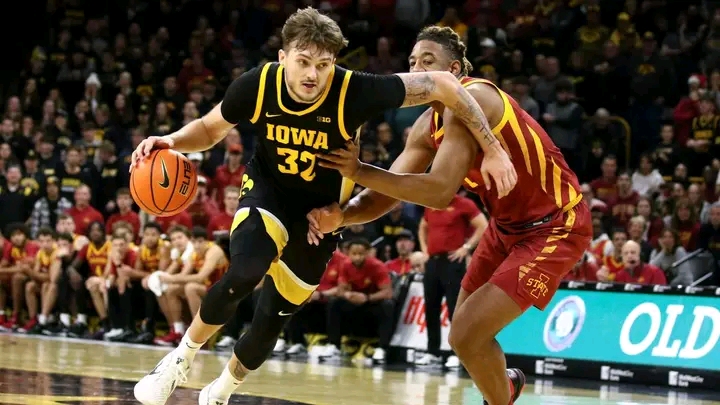
Owen Freeman’s basketball journey just took another dramatic turn, and this one sends him deep into the SEC spotlight.
The former Iowa standout has officially committed to the Auburn Tigers through the transfer portal, ending a short and injury-disrupted stint at Creighton after previously starring in the Big Ten. His move marks the second time in as many years that Freeman has entered the transfer portal, reshaping his college career once again after a promising but turbulent rise.
Freeman, a 6-foot-10, 240-pound forward/center from Moline, Illinois, first made his name at Iowa, where he quickly developed into one of the most productive young big men in the conference. As a freshman in the 2023–24 season, he earned Big Ten Freshman of the Year honors after averaging 10.6 points on an efficient 61.4% shooting from the field. He also contributed 6.6 rebounds, 1.8 blocks, and 1.2 assists per game, establishing himself as a strong interior presence on both ends of the floor.
His sophomore campaign showed even more promise before it was cut short. Freeman improved to 16.7 points per game while shooting a remarkable 63.8% from the field, along with 6.7 rebounds, 1.8 blocks, and 1.3 assists per contest. But momentum stalled when a broken finger forced him to miss significant time, limiting him to just 19 games and eventually opening the door for his first transfer.
That decision led him to Creighton, but things didn’t go as planned in Omaha. Freeman’s transition was slowed by another setback this time a knee injury suffered in the offseason. The injury disrupted his rhythm and kept him out of practice for several weeks at the start of the year, making it difficult for him to find consistency or a stable role within the rotation.

Even when he returned, he was never fully able to regain the production that once made him one of the Big Ten’s most efficient big men. In the 2025–26 season at Creighton, Freeman averaged just 5.0 points and 4.0 rebounds per game while playing 11 minutes and 54 seconds per contest across 26 appearances. Although his shooting efficiency remained strong at 60.2%, his reduced minutes and limited mobility kept him from impacting games at the level he previously showed at Iowa.
Now, Auburn is betting on a healthier version of Freeman and hoping his earlier flashes of dominance reappear in the SEC.
The Tigers, led by head coach Steven Pearl in his second season, are looking to reinforce their frontcourt depth heading into the 2026 campaign. Freeman brings exactly what the program lacked last season: size, interior scoring efficiency, and defensive rim protection. His 1.8 blocks per game during his peak seasons highlight his ability to alter shots and control the paint, something Auburn has prioritized rebuilding.
For Auburn, the addition of Freeman is not just about numbers it’s about experience. Despite his young age, he has already played in two major conferences and faced different systems, coaching styles, and levels of competition. That versatility could be crucial for a team trying to stabilize its rotation and add consistency in the post.
Freeman’s efficiency has remained one of the most intriguing parts of his profile throughout his college career. Even during an injury-limited season at Creighton, he still converted over 60% of his shots, showing that his finishing ability around the rim remains intact when healthy. That skill set is expected to translate well in Auburn’s system, which often emphasizes interior scoring and physical play inside the arc.
His journey, however, also reflects the unpredictable nature of modern college basketball. In just a few seasons, Freeman has gone from a breakout freshman star at Iowa to a sophomore standout derailed by injury, to a transfer seeking a fresh start at Creighton, and now to an SEC program looking for stability and impact from a once-rising Big Ten talent.
At Iowa, his development was closely watched by fans who saw him as one of the program’s most promising young frontcourt players in recent years. His combination of size, touch around the rim, and defensive timing made him a rare two-way presence in the paint. The Big Ten Freshman of the Year recognition only reinforced expectations that he could grow into a long-term cornerstone for the Hawkeyes.
Instead, injuries shifted that trajectory.
A broken finger halted his sophomore surge, and the knee injury at Creighton prevented him from building momentum in a new environment. Those setbacks not only limited his playing time but also forced him into another difficult decision in the transfer portal, ultimately leading him to Auburn.
For Auburn fans, the hope is simple: availability and health. If Freeman can stay on the floor, his skill set fills an immediate need. A reliable post scorer who shoots efficiently, protects the rim, and brings size at 6-foot-10 is not easy to find in today’s transfer market.
There is also a strategic layer to this addition. In modern college basketball, roster construction often hinges on portal acquisitions who can contribute immediately. Freeman’s experience in both the Big Ten and Big East gives Auburn a player who has already been tested in high-level environments, even if injuries have slowed his consistency.
Still, questions remain about durability. Over the past two seasons, Freeman has battled both upper and lower body injuries that have interrupted his development. Auburn’s coaching staff will likely prioritize managing his minutes and ensuring he remains healthy through a full season.
If that happens, the Tigers could be adding one of the more underrated frontcourt pieces in the SEC transfer cycle.
Looking back, Freeman’s Iowa tenure remains the most productive stretch of his career. His sophomore averages of 16.7 points and 6.7 rebounds on elite shooting efficiency stand out as proof of what he can be when fully healthy and featured in an offensive system that plays to his strengths.
Now, Auburn becomes the next chapter and possibly the most important one yet.
For a player who has already experienced both breakout success and frustrating setbacks, the 2026 season offers a chance at reset. The SEC stage is bigger, the competition is tougher, and expectations will rise quickly if he finds his rhythm early.
But if Freeman can stay healthy, Auburn may have landed one of the more impactful frontcourt transfers in the portal one whose best basketball still feels like it hasn’t fully been unlocked yet.