

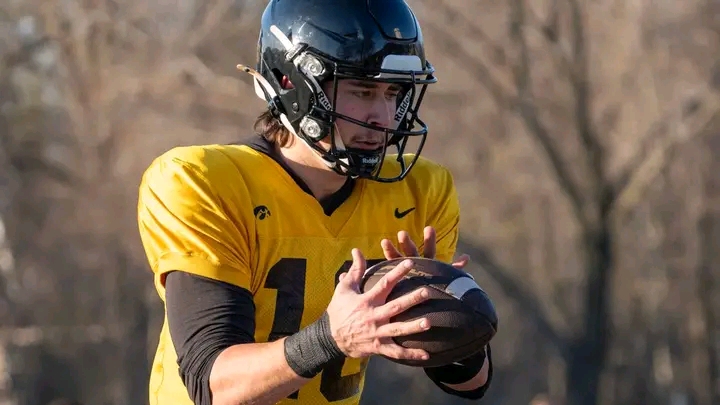
For decades, Iowa football has lived by one rule don’t beat yourself. But now, a new quarterback is testing that philosophy, and his bold approach could either unlock the Hawkeyes’ offense… or challenge everything they’ve built.
Jeremy Hecklinski isn’t your typical Iowa quarterback. While the program under head coach Kirk Ferentz has thrived on ball security, field position, and calculated decision-making, Hecklinski is bringing something different a willingness to push the ball downfield and take chances.
That aggressive mindset has already turned heads during spring practice. Coaches and observers have praised his ability to stretch the field vertically, something Iowa fans haven’t consistently seen in years. But with that upside comes an unavoidable question: how much risk is too much?
“Probably just taking less risks,” Hecklinski said. “I take a lot of risks at practice and stuff and it pays off a lot and there’s sometimes where it doesn’t, so I’m just trying to find that happy medium to where I am throwing touchdowns and not throwing interceptions.”
That balance between explosive plays and costly mistakes is quickly becoming the defining storyline of Iowa’s quarterback situation this offseason.
For years, Iowa’s formula has been clear and consistent. Protect the football. Win the field position battle. Capitalize when opportunities present themselves. It’s a system that has delivered steady success, even if it hasn’t always been flashy.
Games are often decided by defense, special teams, and limiting turnovers. Quarterbacks in this system aren’t asked to take unnecessary risks they’re expected to manage the game efficiently and avoid critical errors.
Hecklinski, however, represents a shift in style. His natural instincts lean toward attacking defenses rather than managing them. That difference is subtle on paper but massive on the field.
Spring practice has provided the first real glimpse into what that shift could look like. Reports suggest Hecklinski has consistently looked comfortable pushing the ball deep, testing coverage, and taking shots that previous Iowa quarterbacks might have passed up.
Those throws can change games instantly. A single deep completion can flip field position or put points on the board in seconds. But they also come with increased risk tight windows, defensive pressure, and the ever-present threat of interceptions.
Hecklinski is aware of that reality. He’s not ignoring the risks he’s actively trying to manage them.
“Definitely higher on good plays, I would say,” Hecklinski said when asked about his performance ratio in practice. “Not a whole lot of picks, but they happen.”
That honesty reflects a quarterback who understands the fine line he’s walking. He’s not trying to eliminate risk entirely that wouldn’t align with his strengths. Instead, he’s searching for control within that aggression.
Finding that “happy medium,” as he described it, is often what separates promising quarterbacks from reliable starters.
As spring practice moves toward its conclusion, the competition at quarterback remains wide open. Hecklinski is battling Hank Brown for the starting role, and there’s no clear frontrunner yet.
That uncertainty isn’t unusual for Iowa. The coaching staff has historically been patient when naming a starter, often waiting until fall camp to make a final decision.
This year appears no different. Despite strong performances and growing buzz, Hecklinski will likely have to continue proving himself well into the summer.
The timing of Iowa’s open practice on Saturday, April 25, adds another layer of intrigue. It offers a public glimpse into the quarterback battle and a chance for fans to see firsthand how Hecklinski’s style translates outside closed practices.
Open practices aren’t just exhibitions they’re evaluations. Every throw, decision, and reaction is scrutinized, especially in a competition this tight.
For Hecklinski, it’s another opportunity to show that his aggressive approach can be both effective and controlled.
The challenge he faces isn’t just about outperforming another quarterback it’s about fitting into a system with a long-standing identity.
Iowa’s offense isn’t built around high-risk, high-reward football. It’s built around consistency, discipline, and minimizing mistakes. That identity has been reinforced over decades under Ferentz.
So the question becomes: can Hecklinski adapt enough to fit the system while still maintaining the traits that make him unique?
There’s precedent in college football for quarterbacks reshaping offensive identities. When a player with a specific skill set proves effective, systems can evolve sometimes subtly, sometimes dramatically.
If Hecklinski demonstrates that his downfield approach leads to more points without significantly increasing turnovers, Iowa could gradually open up its offense.
But that evolution won’t happen overnight. It requires trust earned through repetition, decision-making, and results.
From a strategic standpoint, the potential benefits are obvious. Stretching the field forces defenses to adjust. Safeties can’t sit shallow. Corners have to respect vertical routes. Running lanes can open as a result.
In theory, a more aggressive passing game could complement Iowa’s traditional strengths rather than replace them.
But the risks are just as clear. Turnovers can undo everything Iowa’s system is designed to protect. A single interception in a low-scoring game can be the difference between a win and a loss.
That’s why Hecklinski’s development is being watched so closely. It’s not just about arm strength or accuracy it’s about judgment.
When to take the shot. When to check down. When to live for the next play.
Those decisions define quarterbacks, especially in systems that prioritize efficiency over explosiveness.
There’s also a psychological element at play. Quarterbacks who thrive on aggression often rely on confidence. They trust their reads, their arm, and their instincts.
But maintaining that confidence while limiting mistakes is one of the hardest challenges in football. A few bad decisions can lead to hesitation, and hesitation can be just as damaging as recklessness.
Hecklinski’s ability to stay confident while refining his decision-making will be critical moving forward.
Meanwhile, the competition with Hank Brown ensures that nothing will be handed to him. Every practice rep matters. Every throw is evaluated.
Competition often accelerates development. It forces players to sharpen their strengths and address weaknesses quickly.
For Iowa, it also provides options. If one quarterback struggles with decision-making, the coaching staff has alternatives.
As fall camp approaches, the pressure will only increase. The playbook expands. Defensive schemes become more complex. The margin for error shrinks.
That’s when the true test begins.
Spring practice offers glimpses. Fall camp provides answers.
For now, Hecklinski remains a compelling unknown a quarterback with the tools to elevate Iowa’s offense and the challenge of fitting into a system built on caution.
His own words capture the situation perfectly: a search for balance between touchdowns and interceptions, between aggression and control.
If he finds that balance, Iowa could unlock a new dimension offensively.
If he doesn’t, the Hawkeyes may stick to what they’ve always trusted playing it safe and letting defense lead the way.
Either way, one thing is clear: this isn’t just a quarterback battle. It’s a potential turning point in how Iowa football approaches offense.
And Jeremy Hecklinski is right at the center of it.
