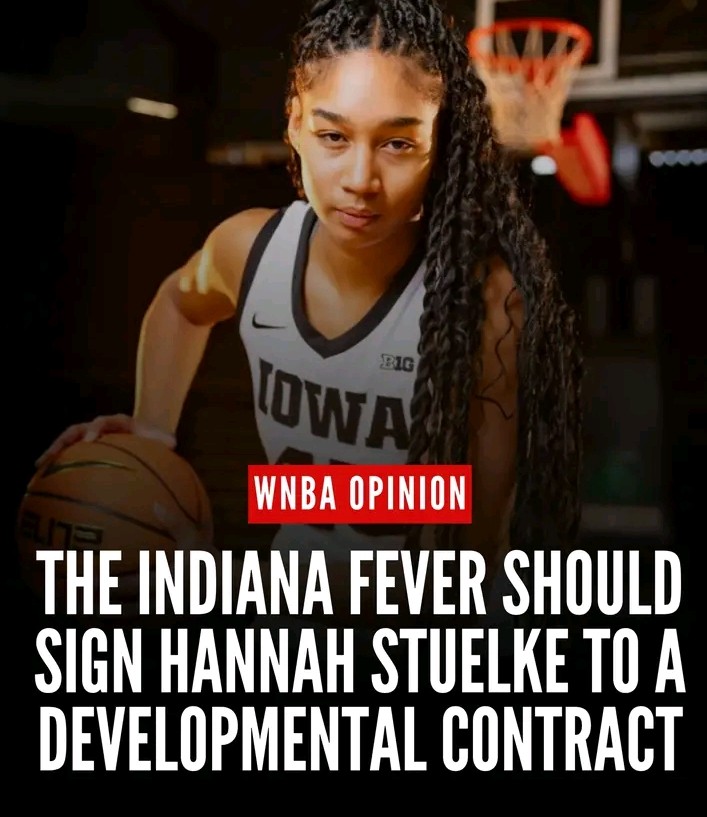
There’s a growing debate around Hannah Stuelke’s development at Iowa, and it’s not just about what she has done it’s about what she might have become under different circumstances. The conversation has now shifted toward whether a transfer portal move earlier in her career could have unlocked a more complete version of her game, especially after two seasons spent adapting to an unfamiliar role within the Hawkeyes’ system.
Stuelke, who emerged as one of Iowa’s most physically dominant frontcourt players, spent her last two seasons playing out of position in a system heavily shaped around elite guard creation. That system was anchored by Caitlin Clark, whose playmaking and scoring gravity defined Iowa’s offensive identity and stretched opposing defenses to their limits. In that environment, Stuelke often found herself adjusting her natural game to fit spacing and timing demands that didn’t always highlight her strengths.
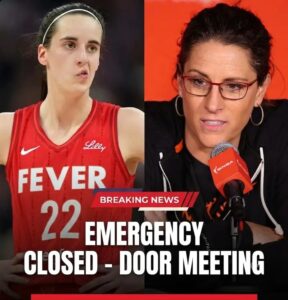
Clark, now a cornerstone of the Indiana Fever in the WNBA, leaves behind a legacy at Iowa that continues to influence how players from that era are evaluated. Her presence elevated teammates statistically and culturally, but it also created structural limitations for certain frontcourt players who had to adapt to a guard-dominant offensive rhythm. For Stuelke, that meant fewer opportunities to operate in traditional post touches and more reliance on off-ball movement and transition scoring.
The argument being raised now is not about criticism, but context. Stuelke’s skill set has always suggested she could thrive in a more balanced frontcourt system one that allows her to operate closer to the rim while also developing perimeter touch. At Iowa, those opportunities were sometimes compressed by offensive spacing that prioritized Clark’s isolation and pick-and-roll dominance.
Looking at her profile, Stuelke brings clear physical advantages. She has shown the ability to finish through contact, run the floor in transition, and punish smaller defenders in mismatches. Those traits have made her a valuable rotational piece for Iowa, but they also raise questions about what her statistical output might look like in a system designed specifically around her rather than around perimeter orchestration.
The idea of a transfer portal decision earlier in her career is now being revisited in hindsight. Critics of modern college basketball roster construction argue that players like Stuelke often remain in systems that don’t fully maximize their long-term development, especially when elite guards dominate usage rates. In contrast, the transfer portal has become a tool for players seeking role clarity, expanded responsibilities, and developmental alignment.
However, that conversation is now largely theoretical for Stuelke, as she has already committed to her path within Iowa’s program structure. Still, the discussion persists because her raw talent suggests untapped potential that may not yet be fully realized in traditional box score production.
One of the clearest areas of focus moving forward is her perimeter development. Coaches and analysts have repeatedly pointed out that a reliable 15-foot jumper would dramatically expand her offensive value. In modern women’s basketball, frontcourt players who can consistently hit mid-range shots force defenses to extend coverage, creating driving lanes and offensive spacing advantages.
Equally important is her ball-handling development. While Stuelke has shown competence in transition and short-area movement, improving her ability to handle pressure and initiate offense from the elbow or perimeter would elevate her role from finisher to dual-threat contributor. That type of growth typically requires an offseason dedicated to repetition-based skill refinement rather than system adaptation.
There is also a broader developmental narrative at play. Players transitioning out of systems led by generational guards often experience a recalibration period when adjusting to different offensive expectations. In Stuelke’s case, that means shifting from a complementary role into one that demands more self-creation and versatility.
The mention of Caitlin Clark in this conversation is not incidental. Her impact at Iowa continues to shape how teammates from her era are evaluated, particularly those whose roles were defined by spacing, timing, and defensive attention drawn by her presence. Now with the Indiana Fever, Clark’s professional trajectory further highlights how exceptional her usage rate and offensive control were during her college years.
For Stuelke, the challenge is not about replacing that dynamic but evolving beyond it. The next stage of her development depends on whether she can build a more independent offensive identity one that does not rely solely on guard-driven creation but instead complements it with mid-range consistency and expanded handle versatility.
From a coaching perspective, the investment in her development is straightforward. A player with her physical profile and finishing ability already holds rotational value. Adding a dependable 15-foot jumper and improved handle could transform her into a matchup problem at both the collegiate and professional levels.
There is also a secondary layer to this discussion: marketability. In today’s NIL-driven and media-conscious basketball landscape, players who show visible skill expansion often gain increased visibility, endorsement opportunities, and narrative appeal. A transformation from interior finisher to versatile frontcourt scorer carries both on-court and off-court value.
Still, development is never linear. A one-year improvement window, as suggested by analysts, is ambitious but not unrealistic if supported by structured training, repetition-heavy shooting work, and controlled in-game experimentation. The key is consistency repeating mechanics until they become automatic under defensive pressure.
As Iowa continues to evolve its roster identity post-Clark era, players like Stuelke represent a bridge between systems. They carry the physical tools of traditional frontcourt basketball while being shaped by modern spacing and pace demands. How that balance resolves will define not just her individual career trajectory, but also how Iowa’s next offensive structure takes shape.
For now, the conversation remains speculative but meaningful. Hannah Stuelke’s career path at Iowa has already been shaped by circumstance, system, and timing. Whether she ultimately becomes a fully expanded offensive weapon or remains a role-specific contributor will depend on the next phase of her development.
What is clear, however, is that her ceiling has not yet been fully defined.