

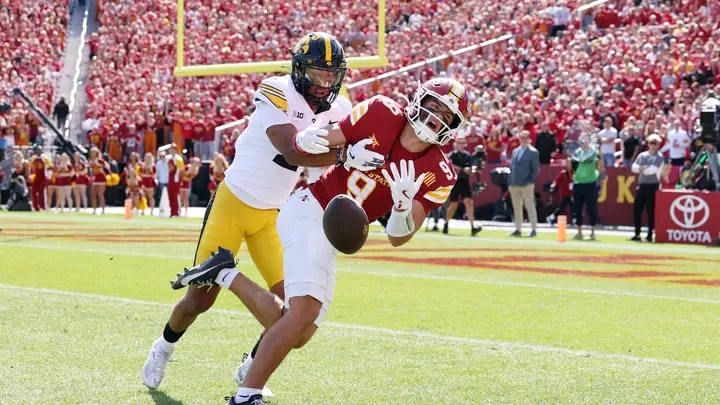
SAINTS TAKE A CHANCE ON BATTLE-TESTED IOWA CB TJ HALL AND HIS JOURNEY MIGHT BE THE REAL STORY OF THIS PICK
The New Orleans Saints didn’t just add depth to their secondary in the 2026 NFL Draft they may have quietly secured one of the toughest, most battle-tested defensive backs in the class.
With the 219th overall pick in the seventh round, the Saints selected Iowa cornerback TJ Hall, a player whose college career was anything but smooth yet ended with him playing the best football of his life.
At first glance, it’s a late-round pick. But dig deeper, and Hall’s story reveals something far more intriguing than draft position.
FROM EARLY STRUGGLES TO LATE DOMINANCE
Hall’s journey at Iowa reads like a rollercoaster and not the easy kind.
He appeared in 42 games during his Hawkeyes career, starting 18 of them. Those numbers tell part of the story, but they don’t capture the adversity he faced early on.
As a true freshman, Hall was thrown into action in a high-pressure rivalry game against Nebraska a baptism by fire that didn’t go well. He struggled in coverage, and opposing quarterbacks didn’t hesitate to target him.
Instead of easing into college football, Hall was forced to learn the hard way.
Then came 2023, when injuries interrupted his development. Just as he began to settle in, his momentum stalled again.
By 2024, Hall found himself in a frustrating cycle in the lineup one week, out the next. Consistency was elusive, and questions about his long-term role started to surface.
For many players, that combination of setbacks early struggles, injuries, and inconsistent playing time can derail a career.
For Hall, it became fuel
THE 2025 BREAKOUT THAT CHANGED EVERYTHING
Everything clicked in 2025.
Hall didn’t just improve he took over.
He emerged as Iowa’s top cornerback, locking down receivers and becoming one of the most reliable defenders on the field. His confidence showed in every snap, and his production backed it up.
He finished the season with a career-high 47 tackles, a significant number for a cornerback and a clear sign of his willingness to get involved in every phase of defense.
Coaches and media took notice, naming him third-team All-Big Ten recognition that once seemed unlikely during his earlier struggles.
More importantly, his film began to turn heads at the next level.
Scouts saw a player who had grown, adapted, and sharpened his game under pressure.
By the time the draft approached, Hall had done enough to push himself firmly into the NFL conversation.
WHAT THE SAINTS ARE GETTING
Hall isn’t entering the league as a polished, plug-and-play star. But he brings a very specific and valuable skill set one that could earn him a role sooner than expected.
At just over 6 feet tall (6’0 3/4″) and 189 pounds, he has the size teams look for in a modern defensive back. But his game is built less on physical dominance and more on technique, effort, and quickness.
His strengths jump off the tape:
- Quick, agile feet that allow him to mirror receivers effectively
- Smooth hips and balance when changing direction
- The ability to stay tight in coverage and contest catches
- Aggressive run support, something many cornerbacks shy away from
Hall plays with urgency. When the ball is in the air, he doesn’t hesitate. When it’s time to tackle, he commits fully. That physical mindset shows up consistently, especially in limiting yards after the catch.
He’s also comfortable in multiple coverage looks. Whether it’s press-man or zone, Hall has shown he can adapt and execute a key trait for a player likely to compete for a nickelback role at the next level.
THE LIMITATIONS THAT DROPPED HIM TO ROUND 7
If Hall’s effort and toughness were the only factors, he wouldn’t have lasted until pick No. 219.
The concerns are real and they explain why teams waited.
The biggest issue is long speed.
While Hall plays fast in short areas, he doesn’t have the top-end speed to consistently run stride-for-stride with deep-threat receivers. Vertical routes can create separation, and NFL offenses will test that immediately.
There are also questions about his instincts.
Scouts note that Hall often reacts rather than anticipates. He’s quick to close once the play develops, but he doesn’t always read it early enough to generate turnovers.
That shows up in his ball production or lack of it.
Despite his coverage ability, he hasn’t consistently challenged passes in the air or created takeaways, something teams value highly at the position.
Technically, there’s still work to do as well. He can lean into receivers instead of relying on footwork, and he sometimes fails to locate the ball when his back is turned opting to face-guard instead.
These aren’t fatal flaws, but they are reasons he entered the league with a prospect grade of 5.98 projecting him as an average backup or special teams contributor.
WHY THIS PICK COULD STILL PAY OFF
Here’s where things get interesting.
Late-round picks aren’t about perfection they’re about potential and fit.
And Hall fits a very specific mold that teams like the Saints value.
He’s tough. He’s coachable. And he’s already proven he can overcome adversity.
That last part matters more than it might seem.
Players who’ve faced setbacks real ones often transition better to the NFL’s demands. They know how to adjust, how to respond, and how to grind when things don’t go their way.
Hall has been through all of that.
He’s been targeted. He’s been benched. He’s been injured.
And he still found a way to finish his college career playing at a high level.
That resilience is something you can’t measure with a stopwatch.
A CLEAR PATH TO CONTRIBUTING
For Hall, the immediate path to making the roster likely runs through two areas:
Special teams and nickel defense.
His tackling ability and willingness to engage physically make him a strong candidate for special teams units often the fastest way for late-round picks to earn a spot.
Defensively, his skill set aligns with a nickelback role.
In that position, quickness, short-area speed, and physicality matter more than long speed. It’s also a role that demands versatility covering inside routes, supporting the run, and reacting quickly to developing plays.
That’s where Hall’s strengths can shine.
If he can clean up his technique and improve his anticipation, he has a realistic shot at carving out a role.
THE BIGGER PICTURE
Not every draft pick is meant to be a headline.
Some are long-term bets calculated risks on players who haven’t reached their ceiling yet.
TJ Hall is one of those bets.
He’s not the flashiest name. He wasn’t a first-round star. And he didn’t dominate from day one in college.
But he improved. He adapted. And when it mattered most, he delivered his best season.
That’s the kind of trajectory teams pay attention to.
FINAL THOUGHT
The Saints didn’t just draft a cornerback they drafted a story of persistence.
From a rough debut against Nebraska to becoming Iowa’s top defensive back, Hall’s path to the NFL has been anything but easy.
Now, he steps into a new challenge one that will test him even more than college ever did.
But if his past is any indication, counting him out would be a mistake.
Because TJ Hall has already shown he knows how to respond when the odds are against him.
And that might end up being the most valuable trait he brings to New Orleans.
