

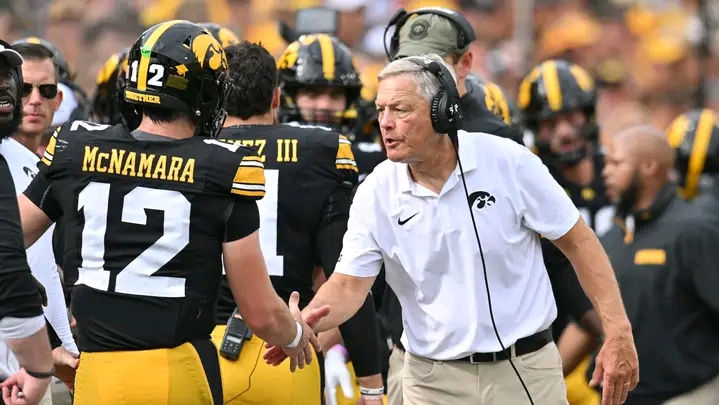
The fallout from a seemingly minor recruiting misstep has finally landedand it’s hitting Iowa Hawkeyes football harder than many expected.
In a ruling that closes a nearly two-and-a-half-year investigation, the NCAA has ordered Iowa to vacate multiple wins tied to quarterback Cade McNamara, stemming from an impermissible recruiting contact involving longtime head coach Kirk Ferentz. What once looked like a contained issue with a self-imposed suspension has now reshaped part of Iowa’s recent football history.
The ruling, delivered April 14, 2026, confirms that Iowa must vacate its 2023 victories in games where McNamara appeared. That season, the Hawkeyes went 4–1 in those contests. The NCAA determined McNamara should have been ineligible that year due to early contact violations, even though he later regained eligibility for the 2024 season.
This means Iowa’s record takes a direct hit but only partially. The Hawkeyes’ 2024 campaign, where McNamara started eight games and the team went 5–3, remains untouched. The distinction hinges entirely on eligibility status: 2023 is penalized, 2024 is not.
The decision adds a complicated layer to Ferentz’s legacy. Before the ruling, he held a 213–128 record across 27 seasons at Iowa, including an 18–9 mark during McNamara’s tenure. With four wins and one loss potentially removed, that total drops to 209–127 entering the 2026 season opener against Northern Illinois.
Yet even with the adjustment, Ferentz still stands alone atop the Big Ten’s all-time wins list having surpassed the legendary Woody Hayes and his 205 victories just last season.
How a Phone Call Sparked a Major NCAA Case
At the center of the controversy is a recruiting timeline that, on the surface, seems trivial but under NCAA rules, proved costly.
According to the NCAA’s findings, assistant coach Jon Budmayr had 13 phone calls with McNamara and/or his father before the quarterback officially entered the transfer portal. He also sent two text messages and arranged a direct call between McNamara and Ferentz on November 23, 2022.
During that call, Ferentz reportedly told the quarterback Iowa was interested and that “he would have a home there.”
The issue? McNamara didn’t enter the transfer portal until November 28 five days later. He committed to Iowa on December 1.
That sequence contact before portal entry violated NCAA recruiting rules, triggering what was classified as a Level II violation.
Iowa’s Self-Imposed Penalties Weren’t Enough
Back in August 2024, Ferentz publicly addressed the situation with unusual candor. Standing alongside Iowa athletic director Beth Goetz, he admitted fault.
“The bottom line is this I tell our players we abide by the rules. And in this specific case, I did not do that,” Ferentz said. “I made a mistake during the recruiting process.”
As part of Iowa’s response, both Ferentz and Budmayr served one-game suspensions. Ferentz sat out the 2024 season opener, a dominant 40–0 win over Illinois State. Defensive coordinator Seth Wallace stepped in as acting head coach for that game, though the victory still counted toward Ferentz’s official record at the time.
The university believed those actions combined with full cooperation would resolve the issue.
The NCAA disagreed.
NCAA Adds Vacated Wins, Fine, and Probation
In addition to vacating wins, the NCAA imposed further penalties:
- One year of probation
- A $25,000 fine
- Recruiting restrictions
While the enforcement panel acknowledged Iowa’s transparency and accountability, it maintained that additional punishment was necessary.
“When respected individuals identify their mistakes and take responsibility, it sets the standard,” the panel noted. “The panel appreciates the actions taken by Iowa and Coach Ferentz.”
Still, the NCAA held firm: the vacated wins would stand.
Iowa Pushes Back: “Unwarranted” Decision
Iowa officials didn’t hide their frustration.
In a joint statement, athletic director Beth Goetz and university president Barbara Wilson called the ruling excessive.
“We believe the decision of adding the penalty of the forfeiture of wins is unwarranted,” the statement read. “The matter is now closed, and we have moved forward.”
Ferentz echoed that sentiment in his own response, describing the punishment as “overly harsh and inconsistent with the violation.”
“I voluntarily served a one-game suspension to make amends,” he said. “Today’s decision… is overly harsh.”
The McNamara Timeline: Injury, Return, and Departure
Ironically, McNamara’s on-field impact during the penalized period was limited.
He started the 2023 season as Iowa’s quarterback but suffered a torn ACL in Week 5. After that, Deacon Hill took over as the primary starter.
In 2024, McNamara returned to lead the offense, starting eight games and helping Iowa to a 5–3 record in those contests. However, his season ended early after reporting concussion symptoms. The final five games were split between Brendan Sullivan and Jackson Stratton.
McNamara ultimately transferred to East Tennessee State, using a seventh year of eligibility bringing a winding college career full circle.
What This Means for Iowa Moving Forward
While vacated wins don’t change the outcome of games in the moment, they do alter historical records impacting everything from coaching milestones to program statistics.
For Iowa, the biggest implications include:
- Adjusted win totals for the 2023 season
- A revised career record for Ferentz
- Potential perception shifts around program compliance
Still, the core of the program remains intact. The NCAA did not impose postseason bans or scholarship reductions penalties that could have had a far more significant impact.
And importantly, the case is now closed.
A Legacy Tested but Not Defined
For Ferentz, who has spent nearly three decades building Iowa into a model of consistency, this episode marks a rare blemish.
It’s also his first known Level II violation in 26+ years as a head coach.
That context matters.
Even with the vacated wins, Ferentz’s place in college football history remains secure. His longevity, consistency, and player development track record continue to define his tenure far more than a single recruiting misstep.
But the situation serves as a reminder of how tightly regulated modern college football has become especially in the transfer portal era, where timing is everything.
Final Word: A Closed Case with Lasting Impact
In the end, what began as a premature phone call turned into a multi-year NCAA case that reshaped part of Iowa’s record book.
The Hawkeyes accepted responsibility early. They imposed penalties on themselves. They cooperated fully.
And still, the NCAA added more.
Now, with the ruling finalized, Iowa turns its attention forward to the 2026 season, to new players, and to moving beyond a controversy that, while resolved, won’t soon be forgotten.
