

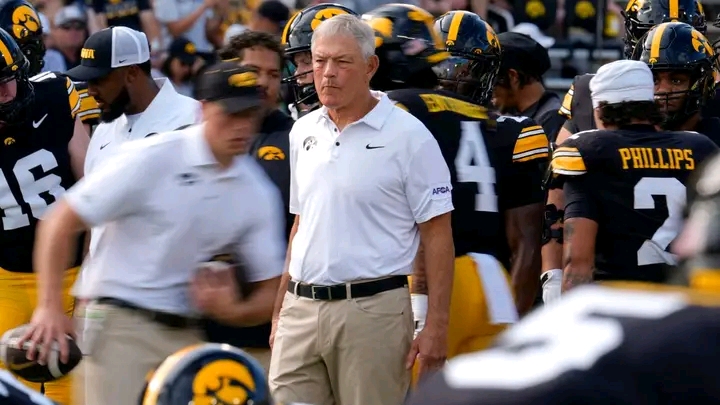
The fallout from a quiet recruiting misstep has now turned into a headline-grabbing penalty and it’s hitting the Iowa Hawkeyes where it hurts most.
The NCAA has officially vacated four wins from Iowa’s 2023 football season, tying the punishment directly to an impermissible recruiting contact involving former quarterback Cade McNamara. The decision, announced Tuesday, stems from a violation involving head coach Kirk Ferentz and quarterbacks coach Jon Budmayr during McNamara’s transfer process.
According to the NCAA, the violation occurred when Ferentz and Budmayr made contact with a prospective transfer athlete before the allowable window opened an infraction that ultimately led to disciplinary action. The governing body determined that the games in which McNamara appeared during the 2023 campaign four Iowa victories would be erased from the official record.
For a program built on consistency and discipline, the ruling lands as a significant blow, even if the games were played and won on the field.
Ferentz, who has led Iowa since 1999 and is one of the longest-tenured coaches in college football, didn’t hold back in his response. While acknowledging the mistake, he made it clear he believes the punishment doesn’t match the violation.
“I am disappointed by the NCAA’s decision today,” Ferentz said in his official statement. “Throughout the process, our program has been open and honest about my mistake contacting a potential player in the hours before it was permissible by NCAA rules.”
That admission is key. Unlike major recruiting scandals that involve inducements or repeated violations, this case centers on timing a matter of hours, not weeks or months. Still, the NCAA chose to enforce a tangible penalty that alters Iowa’s historical record.
Ferentz emphasized that he had already taken responsibility well before the NCAA’s final ruling. He voluntarily served a one-game suspension at the start of the 2023 season as part of corrective measures agreed upon during the investigation.
“I felt it was important to make amends for the issue,” he said. “That’s why I voluntarily served a one-game suspension to start the 2023 season.”
Despite that, the NCAA moved forward with vacating wins something Ferentz clearly sees as excessive.
“I believe today’s decision by the NCAA vacating four wins in our 2023 season is overly harsh and inconsistent with the violation,” he added.
The controversy traces back to McNamara’s high-profile transfer. After beginning his college career at Michigan, McNamara entered the transfer portal and quickly became one of the most sought-after quarterbacks available. Iowa, struggling offensively in 2022, saw him as a potential solution under center.
His arrival brought immediate expectations. Known for his leadership and experience including guiding Michigan to a Big Ten title and College Football Playoff appearance McNamara was expected to stabilize Iowa’s offense.
And in the games he did play during the 2023 season, Iowa delivered results in the win column. Those four victories now wiped from the official record were part of a campaign that showcased the team’s resilience despite offensive inconsistencies.
Vacated wins, however, don’t erase memories for players or fans. The games were played. The outcomes were real. But in NCAA record books, they’ll now be marked with an asterisk or removed entirely.
It’s a frustrating gray area that has long sparked debate across college athletics.
For Iowa players who competed in those games, the decision may feel particularly unfair. They executed on the field, followed game plans, and secured victories only to see those results stripped away due to a technical recruiting violation that had nothing to do with their performance.
That disconnect is part of what makes NCAA enforcement so controversial. Punishments often extend beyond the individuals responsible and impact entire teams, fanbases, and program legacies.
From a broader perspective, the ruling also raises questions about consistency. Across college football, similar minor infractions have sometimes resulted in lighter penalties warnings, fines, or short suspensions rather than vacated wins.
Ferentz’s comment about inconsistency reflects a sentiment shared by many coaches who’ve navigated NCAA compliance rules. The margin for error is razor-thin, especially in the transfer portal era, where timing and communication are critical.
The portal itself has transformed recruiting. What used to be a slower, more structured process is now fast-paced and highly competitive. Programs are constantly monitoring player movement, and the pressure to act quickly can lead to mistakes even for experienced staffs.
In this case, that urgency appears to have crossed a line.
Still, Ferentz made it clear that Iowa isn’t dwelling on the decision.
“As I tell our team and staff, it is how you respond and move forward that defines you,” he said. “Our focus is on the 2026 season and that is how we are moving forward.”
That forward-looking approach is typical of Ferentz’s leadership style. Over his decades in Iowa City, he’s built a program known for stability, player development, and a no-nonsense culture.
While this ruling adds an unexpected chapter to that legacy, it’s unlikely to define it.
Looking ahead, the Hawkeyes will aim to put the controversy behind them as they prepare for the 2026 season. The program remains competitive in the Big Ten, and its defensive identity continues to be one of the strongest in the conference.
Offensively, the lessons from the McNamara era and the circumstances surrounding his recruitment may influence how Iowa approaches the transfer portal moving forward. Compliance oversight will likely be tighter, and communication protocols more strictly enforced.
For fans, the news is undoubtedly frustrating. Four wins disappearing from the record isn’t just a statistical adjustment it’s a symbolic loss. Those games represented effort, execution, and moments of celebration that can’t truly be undone.
Yet, in the world of college athletics, perception and record books often carry as much weight as on-field results.
The NCAA’s decision ensures that Iowa’s 2023 season will be remembered differently than it was originally experienced. Instead of a straightforward tally of wins and losses, it now includes a footnote a reminder of how even minor missteps can lead to major consequences.
Whether that consequence fits the crime remains a matter of debate.
What’s clear is that Iowa is ready to move on. Ferentz’s message wasn’t about dwelling on the past but about controlling what comes next.
And in a sport where momentum, culture, and leadership matter as much as talent, that mindset could ultimately determine how quickly the Hawkeyes turn the page.
For now, though, the record books have changed and the conversation around NCAA enforcement just got a little louder.
