

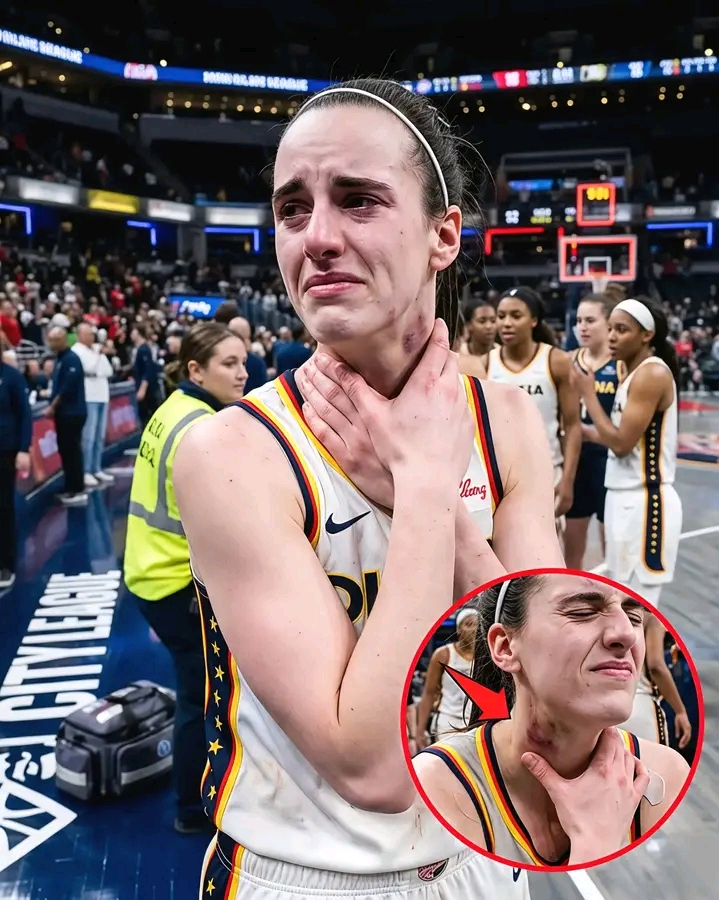
The image instantly sent shockwaves across the basketball world.
As cameras zoomed in during Wednesday night’s highly anticipated showdown between the Indiana Fever and Phoenix Mercury, Caitlin Clark could be seen clutching her neck in visible pain, grimacing as she tried to gather herself after a violent collision. Within moments, a dark bruise began forming near the point of impact, creating yet another troubling scene involving the WNBA’s biggest star.
And now, a question that has followed Clark throughout her young professional career is once again impossible to ignore: Is the league doing enough to protect its most valuable player?
The controversial moment unfolded during the second quarter of the Fever’s dramatic battle against Phoenix. While diving for a loose ball near the basket, Clark was knocked to the floor during a physical sequence involving Mercury star Alyssa Thomas. Replay angles appeared to show Thomas making contact with Clark’s throat area with a closed fist while both players battled for possession.
What stunned many viewers wasn’t just the contact itself it was what happened next.
No whistle.
No foul.
Play simply continued.
The lack of an immediate call left Indiana Fever head coach Stephanie White furious after the game, and she didn’t hide her frustration when addressing reporters.
“We have a generational talent and a WNBA superstar who had two cheap shots right there that weren’t called,” White said following the contest. “You’re coming in here aware of what happened in previous games and that still happens? Absolutely unacceptable.”
White’s comments quickly ignited widespread discussion across social media and sports television, where analysts revisited a season-long conversation surrounding the physical treatment Clark has received from opposing teams.
The Fever guard entered the league with unprecedented expectations after rewriting record books at Iowa and becoming the face of women’s basketball. Since arriving in the WNBA, Clark has transformed the league’s visibility, helping drive television ratings to historic levels, filling arenas across the country, and attracting millions of new fans.
But with that increased spotlight has come an equally intense level of physical attention on the court.
Throughout both her rookie season and sophomore campaign, Clark has frequently found herself at the center of hard fouls, heated confrontations, and highly debated officiating decisions. While many players and coaches insist physical play is simply part of professional basketball, critics argue that Clark has often been subjected to excessive contact that goes beyond normal competition.
Wednesday’s incident only intensified those concerns.
Before exiting the contest, Clark had once again demonstrated why she remains one of the league’s premier talents. In just under three quarters of action, she recorded 19 points and eight assists while helping keep Indiana within striking distance against a veteran Phoenix squad.
However, the physical toll eventually became too much.
Midway through the third quarter, Clark headed toward the locker room and did not return to the game. Her departure immediately raised alarm throughout the Fever organization, especially considering she had already dealt with lingering back soreness earlier this season and had previously appeared on Indiana’s injury report.
For Fever fans, watching Clark walk off the floor was an all-too-familiar and deeply unsettling sight.
The WNBA later reviewed the play and ultimately upgraded the contact involving Thomas to a Flagrant Foul 2. The league also issued Thomas a one-game suspension, acknowledging that the play constituted a non-basketball act.
Still, for many observers, the discipline arrived too late.
The central criticism remains unchanged: if dangerous plays are only penalized after extensive video review, what happens in the critical moments when officials fail to act in real time?
That concern extends far beyond one game.
Clark’s influence on the league is undeniable. Television networks continue to showcase Fever games in prime viewing windows. Merchandise sales remain among the highest in professional sports, and attendance numbers have surged wherever Indiana plays.
Simply put, Clark has become one of the most important figures in the history of the modern WNBA.
Because of that reality, some analysts believe the league must place greater emphasis on consistent officiating and player protection before a more serious injury occurs.
The optics are difficult to ignore.
Seeing the sport’s biggest attraction leave the floor injured while officials initially allowed play to continue creates a narrative the WNBA would undoubtedly prefer to avoid. Fair or not, moments like Wednesday’s feed criticism that the league has struggled to establish clear boundaries regarding acceptable physicality.
At the same time, defenders of the current system argue that basketball remains a contact sport and that star players in every era have faced aggressive defensive schemes designed to disrupt their rhythm.
The truth likely lies somewhere in between.
Physical competition is part of what makes professional sports compelling. Yet there is a clear difference between hard basketball plays and actions deemed dangerous or unnecessary.
As the WNBA continues experiencing unprecedented growth, finding that balance may become one of the league’s defining challenges.
For now, Indiana and its supporters await further updates regarding Clark’s condition, hoping the latest injury scare proves temporary rather than another setback in an increasingly physical season.
One thing is certain: the conversation surrounding Caitlin Clark’s protection isn’t going away anytime soon.
And with millions of eyes now watching the league every night, neither can the WNBA afford to ignore it.
