

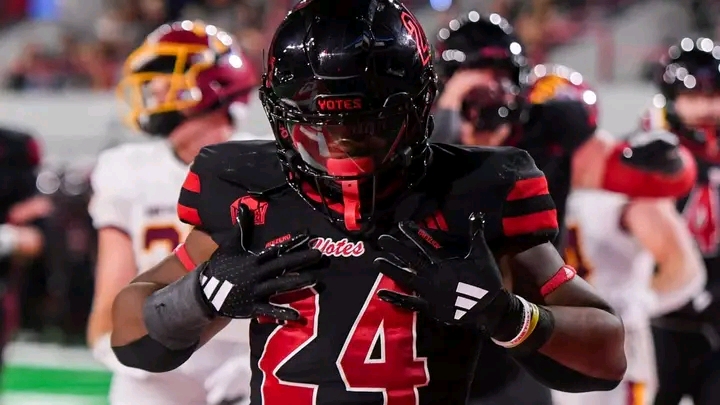
A bruising new presence has crashed into the Iowa backfield and the quotes coming out of spring practice are already turning heads in the Big Ten. At Iowa Hawkeyes football camp, one running back has become impossible to ignore, and coaches aren’t holding back on how they describe him.
That player is L.J. Phillips, a transfer portal addition from FCS South Dakota who arrives in Iowa City with serious production behind him. Phillips rushed for 1,920 yards and 19 touchdowns last season, earning FCS All-American honors before making the jump to the Big Ten and joining the Iowa Hawkeyes football ahead of the 2026 campaign.
Now, just a few practices into spring ball, Phillips is already generating viral-level praise from inside the program. New running backs coach Jay Norvell delivered one of the most eye-catching descriptions of the offseason, comparing his new back in unforgettable terms that quickly spread across the locker room and beyond.
“He’s like a bowling ball covered in butcher knives. Nobody wants to tackle him,” Norvell said, capturing the blend of size, strength, and physical punishment Phillips brings every time he touches the football.
For Iowa, a program long built on physical football and a dominant run identity, that kind of language isn’t just hype it’s a statement of intent. And in a room already filled with competition and talent, Phillips is forcing everyone to raise their level immediately.
Phillips didn’t arrive in Iowa City as an unknown, but the speed at which he’s adapted to Big Ten physicality has still surprised some inside the program. Coming from South Dakota, he already had a reputation as a punishing runner, but teammates say the transition has only sharpened his edge.
One of those teammates, sophomore running back Nathan McNeil, didn’t hesitate when describing what Phillips brings to the group. McNeil emphasized that the nickname inside the running back room fits perfectly with what coaches are seeing on the field.
“He’s a great running back. We call him pit bull in the room, because he doesn’t go down. Even if he gets hit hard, he’s still up and moving,” McNeil said.
That type of internal validation matters in a position group as crowded as Iowa’s. It’s not just coaches noticing Phillips it’s the players lining up next to him, competing for snaps, and watching him consistently finish runs through contact that would normally end plays.
And that competition is very real. The Hawkeyes’ backfield now features Phillips alongside McNeil, Kamari Moulton, and Xavier Williams each bringing different strengths, styles, and roles to what is shaping up to be one of the deepest units on the roster.
The arrival of Phillips also fits into a broader shift in how Iowa Hawkeyes football has approached roster building in recent years. The coaching staff has dipped into the transfer portal more frequently, not as a replacement for development, but as a way to supplement proven production with immediate-impact talent.
Phillips is a perfect example of that strategy working in real time. His FCS production 1,920 rushing yards and 19 touchdowns in a single season speaks for itself, but Iowa isn’t just betting on numbers. They’re betting on fit.
The Hawkeyes have built their offensive identity around a physical run game, particularly under offensive coordinator Tim Lester, whose system has leaned heavily on establishing control at the line of scrimmage. In that kind of scheme, running backs aren’t just ball carriers they’re tone setters.
That’s where Phillips is already separating himself. Coaches and teammates alike point to his willingness to absorb contact and keep pushing forward as a defining trait. It’s not flashy, but it’s exactly what Iowa’s offense demands when games get tight and yards become harder to find.
What makes the situation even more intriguing is the level of depth Iowa now has at running back. Instead of relying on one clear lead option, the Hawkeyes are entering 2026 with multiple players capable of handling significant workloads.
Phillips brings the downhill power and contact balance. McNeil adds experience within the system and versatility. Kamari Moulton has shown flashes of burst and acceleration, while Xavier Williams provides additional depth and competition that keeps every practice intense.
That kind of rotation potential is exactly what Iowa wants to build toward, especially in a conference where physical games often come down to which team can maintain efficiency late in the fourth quarter.
And in that environment, Phillips’ style stands out even more. He isn’t just competing for carries he’s setting a tone every time he steps on the field, forcing defenders in practice to rethink angles and tackle technique.
Spring practice is often where reputations are quietly built, and in Phillips’ case, that process has already accelerated. The combination of production, physical identity, and immediate impact has made him one of the most talked-about additions on the roster.
While it’s still early, the tone inside the program suggests that Phillips is not just adjusting to Big Ten football he’s leaning into it. And that matters for a team that has historically thrived when its run game is both physical and unpredictable.
For now, Iowa fans are left with a simple but exciting question: how quickly will that spring hype translate into game-day production when the lights come on in 2026?
If early practice quotes are any indication, opposing defenses may want to start preparing for exactly what Jay Norvell described a running back who doesn’t just carry the ball, but delivers punishment with every touch.
And for the Iowa Hawkeyes football backfield, that might be the most dangerous development of all.
