

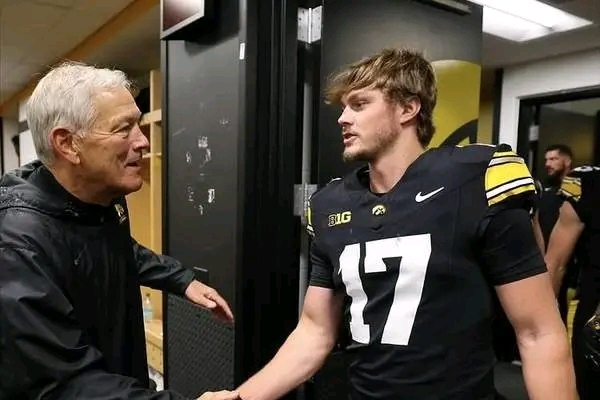
🚨 Career Cut Short: Teegan Davis Forced Into Medical Retirement After Tough Reality Check with Kirk Ferentz
Teegan Davis fought it for as long as he could.
Through the grind of practices, the wear and tear that comes with competing at a high level, and the internal battle athletes rarely talk about publicly, the former Princeton High School standout kept pushing forward. But eventually, the limits of the human body don’t negotiate and Davis reached his.
After returning from Christmas break, Davis sat down with , the longtime leader of the program. It was a conversation no player ever wants to have but one that ultimately changed the course of his life.
By the time it ended, the decision had been made.
Teegan Davis would medically retire from football.
A Promising Path That Took an Unexpected Turn
To understand the weight of this moment, you have to go back to where it all started.
At Princeton High School, Davis wasn’t just another name on a roster. He was an all-state talent a player who stood out on Friday nights with a combination of strength, discipline, and football IQ that made him a cornerstone of his team.
Coaches trusted him. Teammates leaned on him. Opponents planned around him.
That kind of reputation doesn’t come easily. It’s built over years of early mornings, late nights, and a willingness to push past limits most people never test.
Naturally, that success opened doors. And when the opportunity came to continue his career at Iowa a program known for toughness and player development it felt like the next logical step.
The Reality of College Football Hits Hard
But college football is different.
The speed is faster. The collisions are harder. The expectations are relentless.
For players like Davis, the transition isn’t just physical it’s mental. Every practice becomes a proving ground. Every rep matters. And every injury, no matter how small it seems at first, carries consequences.
Davis tried to manage it. He kept showing up, kept working, kept believing he could push through whatever his body threw at him.
That’s what athletes are wired to do.
But there’s a fine line between toughness and risk and at some point, that line becomes impossible to ignore.
The Conversation That Changed Everything
When Davis returned from Christmas break, the situation had reached a turning point.
He met with Kirk Ferentz, a coach known not just for his consistency on the field, but for his honesty with players off it. Ferentz has built a reputation over decades for putting long-term health ahead of short-term gain a philosophy that isn’t always easy to accept in the moment.
This wasn’t about depth charts or playing time. It wasn’t about strategy.
It was about life beyond football.
And during that conversation, reality set in.
Davis had pushed as far as he could go. His body wasn’t going to allow him to continue not safely, not sustainably.
So, together, they made the call.
Medical retirement.
A Decision Bigger Than Football
For most people, the word “retirement” comes at the end of a long career.
For college athletes, it can come before things even fully begin.
That’s what makes situations like Davis’s so difficult. You’re not just walking away from a sport you’re stepping away from a dream that’s been part of your identity for years.
Think about it. From high school practices to game-day routines, from lifting sessions to film study football isn’t just something players do. It becomes part of who they are.
And then, suddenly, it’s gone.
Not by choice. Not by plan.
But by necessity.

The Hidden Side of the Game
Stories like Davis’s don’t always make headlines. They don’t come with highlight reels or stat lines.
But they matter.
Because behind every roster, there are players dealing with injuries, setbacks, and decisions that never show up on a scoreboard.
Medical retirements are a reminder of the physical cost of the sport. Every snap carries risk. Every hit leaves a mark some visible, others not.
Programs like Iowa understand that reality. Under Ferentz, there’s been a consistent emphasis on doing what’s right for the player, even when it’s the hardest option.
In Davis’s case, that meant stepping away.
What Comes Next for Teegan Davis?
While his playing career has come to an early end, Davis’s journey is far from over.
Medical retirement doesn’t erase the discipline, leadership, and work ethic he developed through football. If anything, those traits become even more valuable as he transitions into the next phase of his life.
Former athletes often find new paths coaching, mentoring, business, academics bringing the same drive that once fueled their performance on the field.
And for Davis, those opportunities are still ahead.
The uniform may come off, but the mindset stays.
Inside Iowa’s Culture: More Than Just Wins and Losses
Moments like this also shine a light on the culture within the Iowa program.
Under Kirk Ferentz, the focus has never been solely on Saturdays. It’s about building players into well-rounded individuals prepared for life after football.
That approach isn’t always flashy. It doesn’t dominate headlines.
But when situations like Davis’s arise, it proves its value.
Because at the end of the day, the priority isn’t just keeping players on the field it’s making sure they can walk away from the game with their health and future intact.
Final Thoughts: Strength in Letting Go
There’s a common belief in sports that strength means pushing through anything.
But sometimes, real strength looks different.
Sometimes, it means knowing when to stop.
Teegan Davis didn’t quit. He didn’t give up.
He reached the point where continuing wasn’t the right choice and he had the courage to accept it.
That decision, as difficult as it is, speaks just as loudly as anything he accomplished on the field.
And while his football career may have ended sooner than expected, the impact of his journey and the lessons that come with it are just beginning.
