

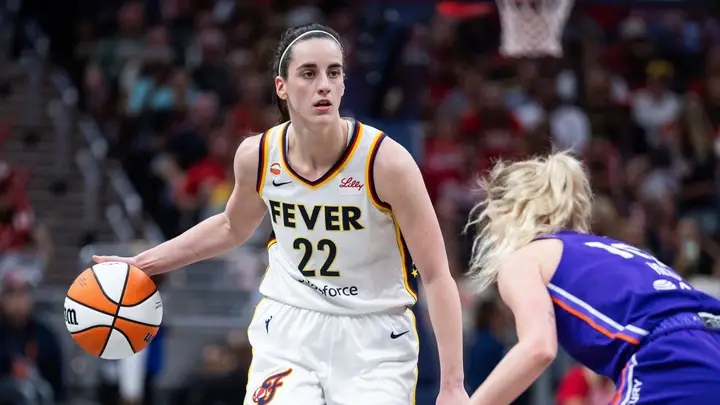
What began as a heated on-court incident between two WNBA stars has now spiraled into something far more disturbing and Indiana Fever head coach Stephanie White is making it clear that enough is enough.
White publicly addressed the shocking wave of online abuse directed at Alyssa Thomas after the Phoenix Mercury star served a one-game suspension for her controversial collision with Caitlin Clark. But instead of the conversation staying centered on basketball, it has taken an ugly turn involving death threats, racial slurs, and disturbing harassment.
The controversy began during the Phoenix Mercury’s dramatic 111-109 victory over the Indiana Fever last week. With 6:52 remaining in the second quarter, Clark drove into traffic before falling to the floor during a scramble for the ball. In the chaotic sequence, Thomas’ fist made contact with Clark’s throat while both players battled for possession. Surprisingly, officials did not call a foul in real time.
After reviewing the play, the WNBA upgraded the incident to a Flagrant Foul 2 and suspended Thomas for one game, ruling the contact a “non-basketball act.” The punishment immediately divided fans. Some believed the suspension was justified, while others argued the play was accidental and overblown.
But what happened next stunned even longtime observers of the league.
According to Thomas, the fallout moved far beyond criticism. The six-time All-Star revealed she has received death threats and racist abuse online, with some messages targeting not only her but also people close to her. She said the emotional toll has been difficult to ignore.
“It’s unfortunate that it’s come to this over basketball,” Thomas told reporters. “A lot of us myself included didn’t even know the play took place until after the game. Now we’re being painted as thugs. There’s death threats out on us. It’s really unacceptable.”
Thomas didn’t stop there.
She also criticized WNBA commissioner Cathy Engelbert, arguing that the league has not done enough to protect players from targeted harassment off the court. Her frustration centered less on the suspension itself and more on what she described as silence from league leadership during a dangerous moment.
Thomas said players are dealing with more than just angry comments. She referenced leaked addresses, manipulated images, and threats that crossed personal boundaries.
“We’re so concerned about safety on the court,” Thomas said, “but time and time again, we’re having people threaten our lives.”
That’s where White’s latest comments became especially powerful.
Despite previously criticizing the no-call during the game, White strongly condemned the abuse directed at Thomas, drawing a clear line between basketball criticism and outright hate. Her message was blunt and emotional.
“It’s absolutely unacceptable,” White said.
She expanded further, calling attention to a growing toxic culture surrounding women’s basketball discourse online.
“As a league as a whole, there’s been so much more toxicity, racism, homophobia straight-out hate nonsense. And it is absolutely unacceptable.”
White’s response carried added weight because of her history with Thomas. Before coaching the Fever, White coached Thomas with the Connecticut Sun, meaning this wasn’t just a coach commenting on a rival player—it was someone who knows Thomas personally and professionally.
That relationship gave White unusual credibility when discussing the situation.
She pushed back against the idea that abusive users represent genuine WNBA supporters, suggesting many are exploiting the league’s growing popularity to spread division and hostility.
In White’s view, these individuals are less interested in basketball and more focused on weaponizing social media outrage.
She made that distinction crystal clear.
“These people are using our league, using our players, to further divisive agendas,” White said. “If you are one of these people online doing this, do not call yourself a WNBA fan.”
The entire saga highlights a difficult reality for the WNBA.
The league is enjoying unprecedented visibility, thanks in large part to stars like Clark, Thomas, and others who have helped elevate women’s basketball into mainstream sports conversation. Television ratings are soaring. Arena attendance is climbing. Social media engagement has exploded.
But with greater visibility has come increased scrutiny—and in some cases, alarming hostility.
This is not the first time physical play involving Clark has triggered intense public reaction. Since entering the WNBA, Clark has frequently found herself at the center of viral debates over officiating, physical defense, and whether opponents target her more aggressively than other players.
White has previously voiced concern over officiating inconsistency, especially regarding how Clark is defended.
After the original incident, she didn’t hide her frustration.
“The fact that it was a no-call… you’ve got to call it,” White said after the game. “Absolutely unacceptable.”
Still, her latest remarks show a crucial distinction.
White can criticize a play. She can challenge referees. She can demand player protection.
But she refuses to tolerate harassment.
That nuance may be the most important takeaway from this entire controversy.
Sports rivalries create passion. Heated debates are inevitable. Hard fouls happen. Suspensions happen. Disagreements over officiating happen every week.
Death threats should never become part of the conversation.
As the WNBA continues to grow, league officials now face increasing pressure to address not only player safety during games but also the digital abuse players face after the final buzzer.
For now, one thing is clear.
The incident involving Thomas and Clark may have started with a basketball play but the larger story has become something much bigger.
And Stephanie White’s message to the basketball world couldn’t be clearer:
Compete fiercely. Debate passionately. Support your team.
But leave hate out of the game.
