

The NCAA Drops the Hammer on Iowa But Is Anyone Really Surprised?
The NCAA has finally ruled on one of college football’s most talked-about transfer cases and the fallout is already stirring debate across the sport. Iowa has been hit with penalties tied to Cade McNamara’s transfer, and while the program has technically already served part of the punishment, the latest decision is what’s grabbing headlines.
At the center of it all is a tampering violation. The NCAA determined that Iowa improperly contacted quarterback Cade McNamara before he officially entered the transfer portal, a move that violates long-standing recruiting rules. As a result, the Hawkeyes must now vacate four wins from the 2023 season games that came during a stretch when McNamara was leading the offense.
Those wins weren’t insignificant. Iowa went 4–1 in games where McNamara started and finished under center, providing stability to an offense that struggled mightily at other points in the season. The vacated victories now leave a visible mark on the program’s official record, even though the on-field results and memories remain unchanged for fans.
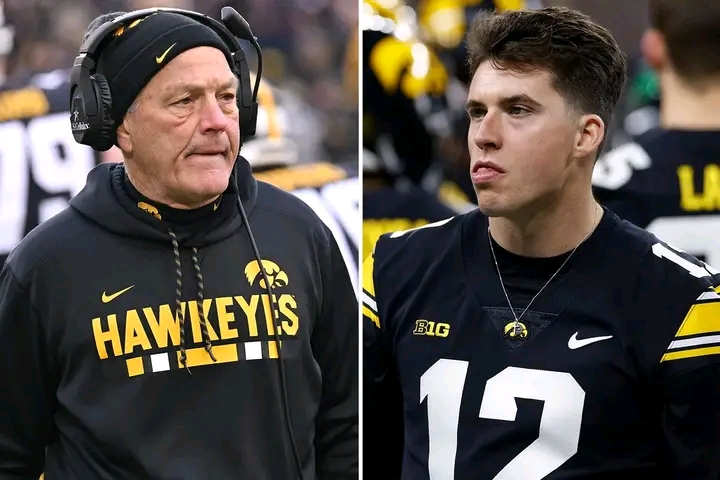
Head coach Kirk Ferentz and quarterbacks coach Jon Budmayr were both previously suspended as part of the NCAA’s enforcement process. Those suspensions have already been served, meaning the program won’t face additional immediate sideline penalties. Still, the ruling closes the book on a case that has quietly lingered for months and reopens a much louder conversation about consistency in NCAA enforcement.
McNamara’s arrival at Iowa was seen as a turning point at the time. After transferring from Michigan, where he had led the Wolverines to a Big Ten title and a College Football Playoff appearance, expectations were high. Iowa needed a steady presence at quarterback, and McNamara brought experience, leadership, and a winning résumé.
In the five games he played during that 2023 stretch, Iowa showed flashes of offensive competence that had been missing. The team averaged modest but improved numbers through the air, and McNamara’s command of the offense helped balance a run-heavy scheme. While the Hawkeyes were far from explosive, they were efficient enough to win games something that became increasingly difficult as injuries and inconsistency crept in later.
The NCAA’s decision to vacate those wins doesn’t erase what happened on the field, but it does alter how the season is remembered in official records. Instead of a 4–1 mark in those games, the results now exist in a kind of statistical limbo acknowledged by fans, but wiped from the books.
And that’s where the frustration begins to boil over.
Around college football, tampering has long been an open secret. Coaches, agents, and players operate in a gray area where early contact is often rumored, if not outright expected. The transfer portal era has only accelerated this reality, turning player movement into a year-round frenzy where programs are constantly searching for an edge.
So when the NCAA singles out a program like Iowa, it raises an uncomfortable question: why this case, and why now?
There’s no denying that rules were broken at least according to the NCAA’s findings. But critics argue that enforcement has been inconsistent at best, selective at worst. High-profile programs across the country have benefited from transfers under similarly murky circumstances, yet few have faced penalties this visible.
For Iowa fans, the punishment feels especially harsh given its delayed impact. The suspensions for Ferentz and Budmayr have already come and gone, and the games in question were played months ago. Vacating wins after the fact doesn’t change outcomes it just rewrites history in a way that feels disconnected from reality.
From a competitive standpoint, the decision won’t affect future standings or bowl eligibility. Iowa isn’t losing scholarships, facing postseason bans, or dealing with recruiting restrictions tied to this case. But reputationally, the program takes a hit, and the ruling adds another layer of scrutiny to a coaching staff that has already faced criticism in recent seasons.
Ferentz, one of the longest-tenured head coaches in college football, has built his career on stability and consistency. His teams are known for disciplined play, strong defense, and a methodical approach. This kind of NCAA violation doesn’t align with that image, which makes the situation all the more notable.
Budmayr, meanwhile, has been tasked with helping reshape Iowa’s quarterback play a position that has struggled to produce at a high level in recent years. McNamara’s transfer was supposed to signal progress. Instead, it’s now part of a compliance case that will follow the program for years.
The broader issue, though, goes beyond Iowa.
College football is in the middle of a massive transformation. The transfer portal, NIL deals, and shifting conference landscapes have created an environment where traditional rules are constantly being tested. Coaches are navigating uncharted territory, and enforcement bodies like the NCAA are struggling to keep up.
In that context, cases like this feel less like isolated incidents and more like symptoms of a larger problem. The rules haven’t fully adapted to the realities of modern college athletics, and the result is a system where violations are both common and unevenly punished.
For players like McNamara, the situation is even more complex. Transfers are often framed as opportunities for growth a chance to find a better fit, more playing time, or a fresh start. But behind the scenes, the process can be messy, with multiple parties involved and lines that aren’t always clearly defined.
McNamara himself hasn’t been accused of wrongdoing in this case. The focus remains on the program’s actions, not the player’s decisions. Still, his name is now tied to a ruling that will be discussed whenever that 2023 season comes up.
As for Iowa, the path forward is straightforward but not necessarily easy. The program must move on, both on the field and off it, while dealing with the lingering perception of the violation. Wins can be vacated, but trust and reputation take longer to rebuild.
Fans, meanwhile, are left to process a decision that feels out of step with the reality they see across the sport. Tampering isn’t new. It isn’t rare. And it certainly isn’t limited to one program.
That’s why this ruling resonates beyond Iowa City.
It taps into a growing sense that college football is operating under two different sets of rules one written, one unwritten. And until those align, cases like this will continue to spark debate, frustration, and more than a little skepticism.
In the end, the NCAA has made its call. The wins are gone from the record books, the suspensions have been served, and the case is officially closed.
But the conversation? That’s just getting started.
