

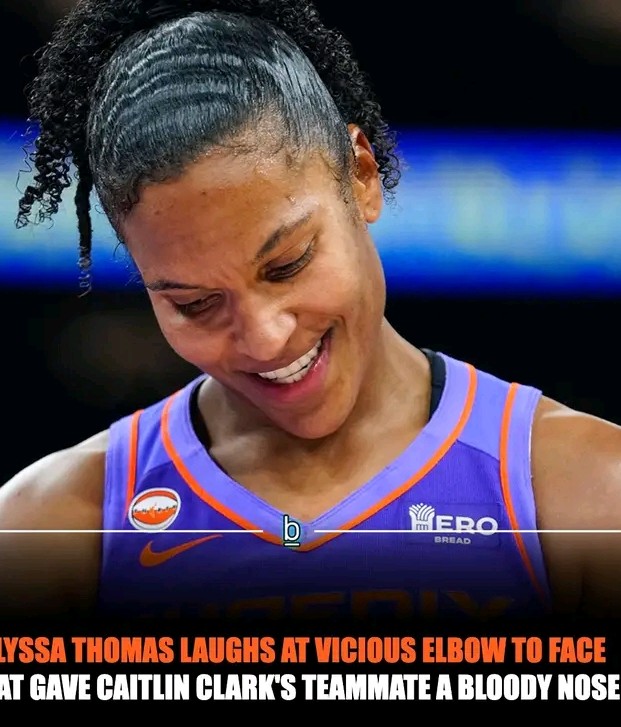
Another physical moment involving Alyssa Thomas has ignited debate across the WNBA, this time after Indiana Fever guard Lexie Hull was left bloodied following an accidental elbow during a heated matchup. The incident quickly went viral, with fans drawing comparisons to Thomas’ earlier controversial play involving Caitlin Clark and questioning whether the league should take a closer look at the physicality surrounding its games.
The collision occurred during a hard-fought contest between the Indiana Fever and Phoenix Mercury. As Thomas battled for position, her elbow caught Hull squarely in the face, sending the Fever guard to the floor in visible pain. Television replays showed blood streaming from Hull’s nose as medical staff rushed onto the court to evaluate her before escorting her to receive treatment.
Although the play appeared to happen during normal basketball action, the frightening scene immediately reignited conversations surrounding Thomas’ aggressive style of play. The veteran forward had already been at the center of league-wide discussions earlier this season after making contact with Caitlin Clark during another highly publicized game, a sequence that resulted in intense debate among players, analysts, and fans.
For Indiana, seeing Hull leave the floor with a bloodied face was another anxious moment in a season filled with physical challenges. Hull has become one of the Fever’s most dependable role players, known for her relentless defense, hustle plays, and timely shooting. Losing her, even temporarily, would have been a significant concern for head coach Stephanie White and the Fever coaching staff.
Medical personnel quickly attended to Hull after the collision, working to stop the bleeding before determining whether she could safely return. Blood injuries in basketball often require players to leave the court until the bleeding has completely stopped, regardless of how serious the injury ultimately proves to be.
The incident immediately spread across social media, where slow-motion clips circulated within minutes. Many fans referenced Thomas’ earlier collision with Caitlin Clark, arguing that the Mercury star has repeatedly found herself involved in controversial physical plays. Others defended Thomas, pointing out that basketball is a fast-paced, physical sport where accidental contact is unavoidable.
The replay showed Thomas extending her arms while fighting for position before her elbow made contact with Hull’s face. Officials reviewed the sequence as part of the normal game process, but there was no widespread indication that the contact was intentional. Instead, the debate centered on whether the play was simply an unfortunate basketball accident or another example of the league allowing excessive physicality.
Hull’s toughness quickly became one of the night’s biggest storylines. Despite the frightening amount of blood visible after the collision, she remained composed while trainers assisted her. Her willingness to battle through adversity has become a trademark throughout her WNBA career, earning respect from teammates and opponents alike.
The Fever have relied heavily on Hull’s versatility this season. Whether defending the opponent’s top perimeter scorer, diving for loose balls, or knocking down key three-pointers, she has consistently filled whatever role the team needs. Her energy has also complemented Indiana’s high-powered offense led by Caitlin Clark and Aliyah Boston.
For Thomas, the latest incident adds another chapter to what has become an unusually scrutinized season. Widely regarded as one of the WNBA’s toughest and most versatile forwards, Thomas has built her reputation on relentless defense, physical rebounding, and all-around playmaking. That aggressive approach has also placed many of her on-court collisions under the microscope.
Physical basketball has long been part of the WNBA’s identity, especially in games featuring playoff contenders. Players routinely battle through screens, rebounds, and contested drives that result in hard contact. However, with the league enjoying unprecedented national attention, every controversial play involving star players is now dissected from multiple angles across television and social media.
Indiana has frequently found itself in the middle of those conversations this season. Several games involving the Fever have featured hard fouls, technical fouls, and emotional exchanges, reflecting both the team’s growing profile and the intense competition surrounding every matchup.
Fortunately for the Fever, the early concern surrounding Hull centered primarily on the bleeding rather than a more serious facial injury. Medical evaluations continued after the game, while the organization monitored her condition before determining her availability for upcoming contests.
Whether the elbow is ultimately remembered as an unfortunate accident or another flashpoint in the ongoing discussion about physical play, it once again highlighted the razor-thin line between aggressive defense and dangerous contact in professional basketball.
As the WNBA season moves deeper into its most important stretch, one thing remains certain: every high-profile collision involving stars like Alyssa Thomas, Caitlin Clark, or Lexie Hull will continue to draw enormous attention. With playoff races intensifying and every possession carrying greater significance, the spotlight on player safety, officiating, and physical play is unlikely to fade anytime soon.
