

The tone out of Iowa City shifted fast and not in a way anyone inside the program was hoping for.
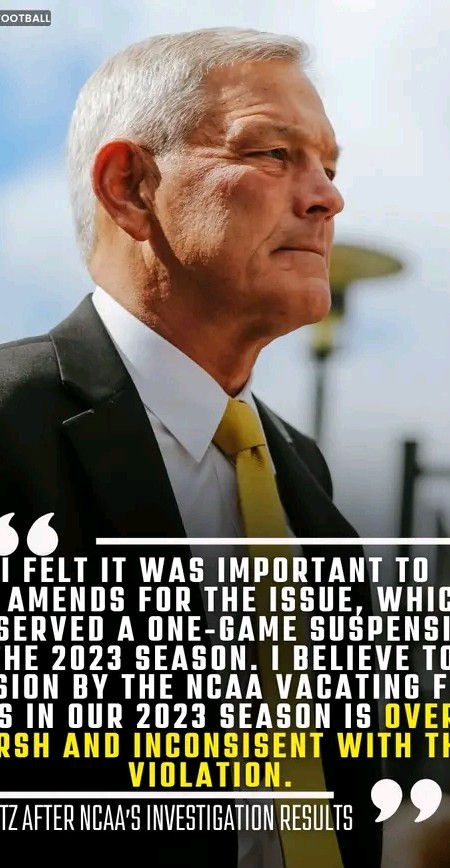
Kirk Ferentz didn’t hold back after the NCAA’s latest ruling, delivering a pointed response that made one thing crystal clear: he believes the punishment handed down to his program goes too far.
The NCAA announced sanctions that include vacating four wins from the 2023 season, a decision that immediately sparked debate across college football circles. For a program built on consistency and discipline, the ruling cuts deeper than just the record books it challenges the integrity of an entire season.
Ferentz, who already served a one-game suspension at the start of that 2023 campaign, emphasized that he had taken responsibility early. In his words, “I felt it was important to make amends for the issue,” a statement that reflects both accountability and frustration with what followed.
That’s where the tension truly begins.
Because while the Iowa head coach acknowledged the violation and accepted punishment at the time, he drew a firm line at the NCAA’s latest decision. “I believe today’s decision… is overly harsh and inconsistent with the violation,” Ferentz said, pushing back against what he sees as a disproportionate response.
For Iowa, those four vacated wins aren’t just numbers disappearing from a stat sheet. They represent real Saturdays, real performances, and real outcomes that players, coaches, and fans experienced in real time. Now, those moments exist in a strange gray area played, celebrated, but officially erased.
And that’s what makes this ruling sting.
Programs can accept penalties when they feel the process is fair. But when leadership publicly questions the consistency of enforcement, it opens a much bigger conversation about how the NCAA handles violations and whether similar cases receive similar treatment.
Ferentz’s statement walks that line carefully.
On one hand, he doesn’t deny the issue. In fact, he reiterates that he took action immediately by serving a suspension, signaling that the program didn’t try to sidestep accountability. On the other hand, his criticism of the NCAA’s ruling suggests he believes the case escalated beyond what the situation warranted.
That balance accepting blame while challenging the punishment isn’t easy to strike. But it’s a position Ferentz has clearly chosen to stand on.
To understand why this matters, you have to consider Iowa’s identity under Ferentz. Since taking over in 1999, he’s built the Hawkeyes into one of the most stable programs in the Big Ten. They’re not flashy. They’re not constantly chasing headlines. Instead, they’ve leaned on discipline, development, and a reputation for doing things the right way.
That’s why this moment feels different.
When a program like Iowa faces NCAA sanctions, it doesn’t just affect wins and losses it shakes the perception of a system that’s been carefully maintained for decades. And when the head coach publicly questions the severity of those sanctions, it adds another layer of complexity.
The vacated wins from 2023 will now be recorded differently in official NCAA history. Opponents won’t gain victories from those games, but Iowa’s record will no longer reflect them as wins. It’s a statistical adjustment that, on paper, might seem minor but emotionally and historically, it carries weight.
Think about the players.
For seniors who contributed to those victories, those wins were part of their legacy. Film doesn’t change. Game memories don’t disappear. But in official records, those moments lose recognition. That’s a difficult reality for athletes who had no direct involvement in whatever violation triggered the ruling.
And that’s part of what fuels debates like this.
Is the punishment aimed at the right people? Does it fairly reflect the severity of the violation? And perhaps most importantly, is it consistent with how other programs have been treated in similar situations?
Ferentz’s use of the word “inconsistent” wasn’t accidental.
In NCAA enforcement history, consistency has long been a point of criticism. Different programs, different timelines, and different interpretations can lead to vastly different outcomes. Coaches across the country have quietly voiced concerns about that for years. Ferentz just chose to say it out loud.
Still, his statement wasn’t explosive or emotional in tone. It was measured, direct, and deliberate. That’s been his style throughout his tenure steady, controlled, and focused on the bigger picture.
But make no mistake, the message landed.
By acknowledging the initial issue while challenging the additional punishment, Ferentz effectively split the narrative into two parts: what happened, and how it’s being handled now. And in his view, those two things don’t align.
That disconnect is what’s now driving conversation around Iowa football.
Inside the locker room, the focus will likely remain on moving forward. Players still have games to prepare for, seasons to build, and goals to chase. But outside the building, the discussion isn’t going away anytime soon.
Because whenever the NCAA steps in with sanctions especially ones that alter official records it invites scrutiny.
Fans, analysts, and even rival programs start comparing cases. They look for patterns. They question fairness. And in today’s college football landscape, where NIL deals, transfer portal movement, and enforcement challenges already complicate the system, every major ruling becomes part of a larger narrative.
Iowa now finds itself at the center of that narrative.
For Ferentz, this isn’t just about defending his program it’s about protecting the players and staff who worked through that 2023 season. His statement, while brief, carries that underlying message: accountability matters, but so does fairness.
And right now, he’s not convinced the balance is right.
The coming weeks will determine how much this ruling lingers. Sometimes, NCAA decisions fade quickly as new games take over headlines. Other times, they stick becoming reference points in future debates about enforcement and fairness.
This one has the potential to do both.
Because it touches on something deeper than wins and losses. It challenges how college football defines accountability. It raises questions about proportional punishment. And it puts a spotlight on the gap between accepting responsibility and feeling over-penalized.
Ferentz didn’t use many words, but the ones he chose were precise.
“Overly harsh.”
“Inconsistent.”
Those aren’t throwaway phrases. They’re calculated, intentional, and designed to make a point without escalating into outright confrontation. It’s the kind of response you expect from a coach who’s spent decades navigating both the highs and the complexities of college football.
Now, the focus shifts to what comes next.
Iowa will continue preparing for the future, just as it always has. The players will keep competing. The staff will keep coaching. And on Saturdays, the games will still be played.
But the record books will tell a slightly different story.
Four wins from 2023 gone.
Not forgotten, not erased from memory, but officially removed from history.
And for a program that prides itself on doing things the right way, that distinction matters.
Whether the NCAA’s decision stands uncontested or sparks further response remains to be seen. What’s certain, though, is that Ferentz has already made his stance clear.
He accepted responsibility.
He served his suspension.
But in his view, the punishment didn’t stop there and that’s where the problem begins.
