

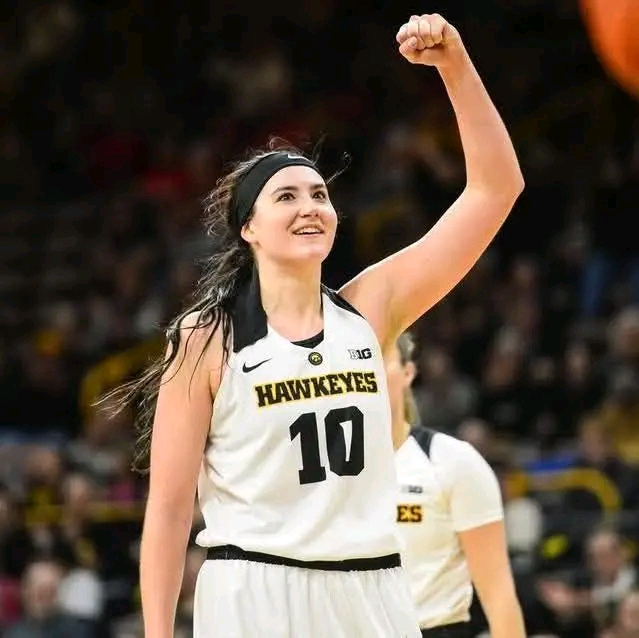
It’s one of the most unexpected “what if” twists in modern women’s college basketball: Caitlin Clark might never have ended up at Iowa if not for Megan Gustafson’s dominance in black and gold. Long before Clark became a national superstar, it was Gustafson’s historic run that helped reshape how the Hawkeyes were viewed on the recruiting trail.
Gustafson, who grew up in Port Wing, Wisconsin and starred at South Shore High School, arrived at Iowa and quickly established herself as one of the most dominant players in program history. Over her four seasons from 2015 to 2019, she didn’t just produce she defined an era for Iowa women’s basketball with consistency, efficiency, and record-breaking scoring.
Her impact reached its peak during a legendary senior season in 2018–19, when she led Iowa to the Elite Eight and earned National Player of the Year honors. That season, Gustafson became only the fourth player in NCAA history and the first post player ever to score 1,000 points in a single season, a feat that cemented her place in college basketball history.
But beyond the awards and numbers, Gustafson’s presence had an unexpected ripple effect. It helped change how elite recruits viewed Iowa as a destination.
At the time, Iowa head coach Lisa Bluder was actively recruiting a rising in-state talent from Minnesota who would eventually become one of the most recognizable names in sports: Caitlin Clark. But Clark’s recruitment path was not straightforward. She originally committed to Notre Dame, setting her future outside the Big Ten and away from Iowa City.
Then everything shifted.
Gustafson’s senior season became a turning point not just for Iowa’s program success, but for its perception. Watching a post player dominate at a national level, carry a team deep into the NCAA Tournament, and win the sport’s highest individual honor sent a clear message: elite talent could thrive in Iowa’s system.
That message reached Clark.
According to Bluder, the impact of Gustafson’s season became clear almost immediately after Iowa’s Elite Eight run. Clark reconsidered her future and made an unexpected call to the Iowa coaching staff.
The question she asked was simple, but it carried enormous weight: was there still room for her in Iowa’s program?
Bluder later recounted the moment on a podcast, describing her reaction with a mix of disbelief and excitement. “Ummmm, yeah!” she said with a laugh, recalling how quickly Iowa moved to bring Clark into the fold.
That phone call would alter the trajectory of Iowa basketball and the sport as a whole.
Clark eventually joined the Hawkeyes in 2020 and played through the 2023–24 season, transforming Iowa into a national powerhouse. She became the program’s first-ever No. 1 overall WNBA Draft pick and one of the most influential players in women’s basketball history, breaking scoring records and drawing unprecedented attention to the sport.
But according to those close to the program, that era doesn’t begin without what Gustafson built before her.
Gustafson’s success at Iowa wasn’t just statistical it was cultural. She helped establish the Hawkeyes as a legitimate destination for elite players who wanted both development and national exposure. Her ability to dominate in the paint, combined with Iowa’s offensive system under Bluder, created a blueprint that future stars could see themselves in.
And that visibility mattered.
For recruits like Clark, seeing a player like Gustafson succeed at the highest level of college basketball provided something beyond highlight reels. It offered proof. Proof that Iowa could produce National Players of the Year. Proof that deep NCAA Tournament runs were possible. And proof that the system could elevate talent to national recognition.
Gustafson’s 2019 season remains one of the most dominant individual campaigns in NCAA history. She consistently overwhelmed opposing defenses with efficiency, footwork, and positioning, turning contested looks into high-percentage finishes. Her ability to control games from the post made Iowa a nightmare matchup during that tournament run.
That Elite Eight appearance wasn’t just a team achievement it became a recruiting statement.
While Gustafson’s career concluded in 2019, her basketball journey didn’t stop there. She was selected 17th overall in the second round of the 2019 WNBA Draft and transitioned into the professional ranks. Since then, she has built a successful career both in the United States and in Europe, competing in the EuroLeague and continuing to develop her game at the professional level.
Her impact, however, continues to echo in Iowa City.
When Caitlin Clark took over the program from 2020 to 2024, she didn’t just elevate Iowa she expanded its global reach. Record-breaking scoring performances, deep NCAA Tournament runs, and national attention turned Iowa into one of the most watched programs in women’s basketball.
Clark’s eventual selection as the No. 1 overall pick in the WNBA Draft marked the culmination of that era. But even that moment traces back to earlier groundwork laid by Gustafson.
It’s a rare chain reaction in sports: one player’s breakthrough season influencing a future superstar’s recruitment decision, which then reshapes an entire program’s identity.
In this case, the timeline is clear. Gustafson’s dominance in 2018–19 helped elevate Iowa’s credibility. That credibility helped sway Caitlin Clark. And Clark’s arrival turned Iowa into a national spotlight program unlike anything it had experienced before.
Coaches often talk about culture being built in layers, and Iowa’s recent history is a textbook example.
Gustafson brought dominance and national recognition. Clark brought visibility and generational stardom. Together across different eras they helped transform Iowa from a respected Big Ten program into a national powerhouse.
And yet, the connection between the two is often overlooked.
There’s no rivalry between their legacies only continuity. Gustafson set the stage. Clark expanded it. And Iowa basketball benefited from both in ways that are still unfolding today.
Even now, as the program continues to recruit and evolve, Gustafson’s influence remains part of the story coaches reference behind the scenes. Her success is a reminder that individual excellence can shift perception far beyond a single season.
For Iowa fans, the narrative is almost poetic. A Wisconsin-born post player arrives quietly, dominates the nation, and in doing so helps open the door for one of the most iconic guards in basketball history to choose Iowa over Notre Dame.
It’s the kind of storyline that doesn’t fully reveal itself until years later.
And now, looking back, the impact is impossible to ignore.
Megan Gustafson didn’t just win awards at Iowa. She helped change the program’s future and, indirectly, helped bring Caitlin Clark to the place where she would become a legend.
