

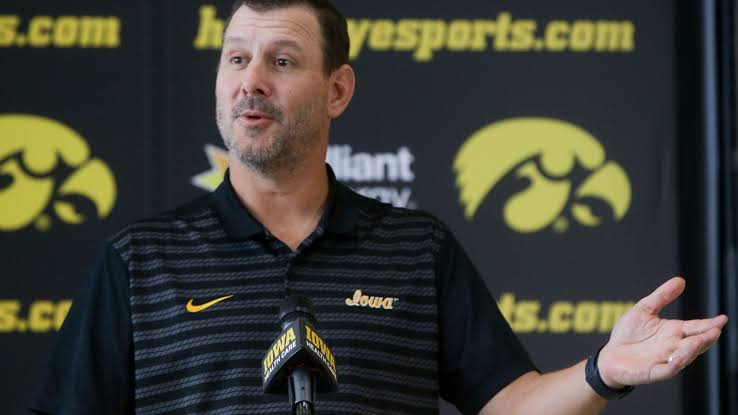
The identity of Iowa Hawkeyes football has been predictable for years power runs, suffocating defense, and a grind-it-out mentality. But heading into 2026, that script may finally be getting a rewrite. And if offensive coordinator Tim Lester is to be believed, the change won’t just be subtle it could redefine how Iowa wins games.
For decades under Kirk Ferentz, Iowa has leaned heavily on field position, defense, and a bruising rushing attack. That formula has produced consistent success, but also criticism for its lack of explosiveness. Lester, now entering his third year calling plays, made it clear: his mission is to inject big-play energy into an offense that’s long been labeled conservative.
“I think I said it in my opening press conference my job is about being explosive,” Lester explained. And based on his detailed breakdown of the team’s evolution, Iowa fans might finally see that philosophy come to life in 2026.
The transformation hasn’t happened overnight. In 2024, Iowa’s offense revolved almost entirely around running back Kaleb Johnson. In critical situations like third-and-long, the ball still went to Johnson not out of predictability, but because he gave Iowa its best chance at a game-changing play. It was old-school football, but it worked.
By 2025, things began to shift. A player identified only as “No. 11” emerged as a consistent explosive threat, forcing the coaching staff to diversify the playbook. The offense started incorporating more run-pass options, while quarterback Mark Gronowski added a new dimension with his mobility. His ability to extend plays and attack defenses on the ground opened up spacing, allowing Iowa to experiment with zone schemes and spread concepts.
Lester believes that late in the 2025 season, the offense finally found a rhythm a balance between the traditional run-heavy identity and a more modern, versatile attack. “The last couple of games, I felt we were a pretty good balance of running and throwing and being explosive,” he said. That balance now serves as the foundation for what’s coming next.
Still, 2026 won’t simply be a continuation it’ll be a reset.
“This will be a totally new team,” Lester emphasized. Despite maintaining consistent practice structures, he noted that Saturdays are about maximizing what players do best. That adaptability could be the key to unlocking a more dynamic offense, especially with an influx of emerging talent across multiple positions.
One of the biggest reasons for optimism is the growing number of playmakers. Lester pointed to several receiving options jersey numbers two, 81, 14, eight, and seven as legitimate targets capable of winning one-on-one matchups. That’s a significant shift from earlier years, when Iowa struggled to consistently threaten defenses through the air.
“You’ve got to get those guys the ball,” Lester said plainly. And that’s where creativity comes in.
Interestingly, Lester revealed that some plays in Iowa’s playbook have been sitting unused for two years. The reason? They require the right personnel multiple playmakers who can execute complex designs while the offensive line provides enough protection. Now, he believes Iowa finally has the “horses” to bring those concepts to life.
That evolution isn’t limited to the passing game. The running back room is also deep, with rising talent like Kamari Moulton turning heads in practice. Lester singled him out as a potential breakout candidate, even challenging him to hit the 100-yard mark in a game a milestone that would signal his arrival as a major contributor.
“I couldn’t believe how good he’s been,” Lester admitted, underscoring the internal competition that could elevate the entire offense.
Another intriguing development is how player growth is tracked within the program. According to Lester, Ferentz regularly asks coaches to rank players from leaders to top playmakers and revisits those lists over time. It’s a method that highlights development and keeps players accountable, while also revealing unexpected risers.

“Two years ago, a guy might not even be on the list, and now he’s number one,” Lester said. “It’s fun to see that growth.”
That growth mindset ties directly into Iowa’s offensive philosophy heading into 2026. Rather than forcing a rigid system, Lester is building an adaptable framework one that evolves based on personnel strengths. Whether it’s leaning into a strong running game, exploiting mismatches in the passing attack, or even experimenting with unconventional schemes, the goal remains the same: create explosive plays.
And make no mistake, explosiveness is the missing piece Iowa has been chasing.
Even Lester acknowledged that regardless of scheme whether it’s a spread offense or something as unconventional as the triple option success ultimately comes down to generating big plays. “Even if we ran the triple option, you have to find ways to be explosive,” he said.
The offensive line could also play a pivotal role in this transformation. Lester hinted at significant progress up front during spring practices, alongside notable improvements from players like Tony, Evan, and LJ. A stronger, more cohesive line would not only enhance the running game but also provide the protection needed for deeper passing concepts to develop.
What makes this upcoming season particularly fascinating is the element of unpredictability. Lester admitted that the offense may continue evolving even after the season begins, depending on which players emerge and how defenses respond. That flexibility could make Iowa far more difficult to game-plan against a stark contrast to the predictability critics have pointed out in the past.
“It’s kind of a program of stories,” Lester said, suggesting that each season — and even each game — writes its own narrative.
For Iowa fans, that narrative has often been defined by defense and discipline. But in 2026, there’s a growing sense that something different is brewing something faster, more aggressive, and far less predictable.
If Lester’s vision becomes reality, the Hawkeyes won’t abandon their identity. They’ll expand it.
And for the first time in years, opposing defenses might not know what’s coming next.
