

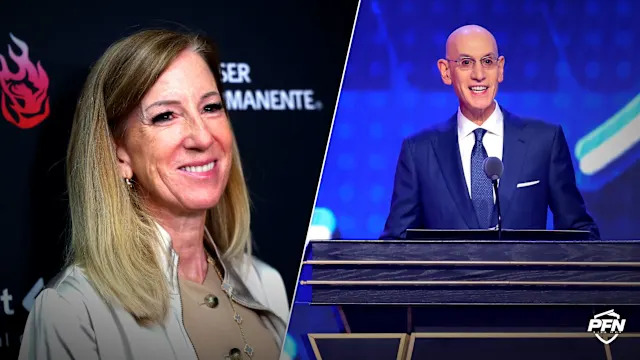
The WNBA has found itself at the center of another major controversy after a new report claimed NBA Commissioner Adam Silver played a decisive role in the league’s disciplinary process involving Phoenix Mercury star Alyssa Thomas. The revelation has raised fresh questions about the WNBA’s leadership and whether Commissioner Cathy Engelbert remains firmly in control during one of the league’s most important periods.
According to an exclusive report from Sports Business Journal (SBJ), multiple sources said Engelbert initially had no plans to suspend Thomas following the incident under review. However, the report alleges that Silver personally urged the WNBA commissioner to reconsider her decision and issue disciplinary action instead.

Following those reported discussions, the WNBA suspended Thomas for one game while also upgrading the play to a Flagrant 2 foul. In addition to the suspension, Thomas was fined $1,000, making the league’s response significantly more severe than what sources reportedly expected before Silver’s involvement.
The report has quickly become one of the biggest talking points around the WNBA because it suggests the NBA commissioner may have influenced a disciplinary decision inside a league that operates with its own commissioner. Neither the WNBA nor the NBA publicly confirmed the report’s claims at the time of publication, but the allegations have already generated widespread discussion across the basketball world.
Even more notable is what several league sources reportedly believe the incident says about Engelbert’s future. According to SBJ, some insiders view Silver’s reported intervention as another indication that Engelbert could be entering her final season as WNBA commissioner.

That belief comes despite Engelbert overseeing one of the league’s biggest recent accomplishments. In March, the WNBA finalized a landmark collective bargaining agreement (CBA), an achievement widely viewed as a significant milestone for the league’s continued growth and long-term stability.
Still, the latest report suggests that questions surrounding leadership have not disappeared. If the NBA commissioner felt compelled to encourage a different disciplinary outcome, it naturally raises questions about how major league decisions are being handled behind closed doors.
Thomas remains one of the WNBA’s most respected veterans and fiercest competitors. Throughout her career, she has built a reputation as one of the league’s toughest players, regularly impacting games with her physical style, elite playmaking, rebounding, and defensive intensity. Any disciplinary action involving a player of her stature is guaranteed to attract significant attention.
The one-game suspension, combined with the Flagrant 2 assessment and accompanying $1,000 fine, now becomes part of a much larger conversation than the original on-court incident itself. Instead of focusing solely on Thomas’ punishment, much of the discussion has shifted toward the decision-making process inside league headquarters.
For Engelbert, the timing is especially significant. The WNBA continues experiencing unprecedented momentum, fueled by record television ratings, increased attendance, expanding corporate partnerships, and growing national attention. With the league attracting more scrutiny than ever before, every major ruling carries added weight.
Leadership decisions are often judged as much by consistency as by the punishments themselves. If reports suggesting outside influence prove accurate, they could intensify debates about league governance and commissioner authority at a pivotal moment in the WNBA’s evolution.
Neither Silver nor Engelbert publicly addressed the reported conversations described by SBJ before publication. Without official confirmation, the report remains based on information provided by multiple sources familiar with the situation.
Nevertheless, the allegations have introduced another layer of intrigue surrounding the league’s leadership. Questions about whether Engelbert will remain commissioner beyond this season are likely to persist, particularly if more reports emerge regarding internal decision-making.
For now, the official outcome remains unchanged: Alyssa Thomas will serve a one-game suspension after receiving a Flagrant 2 penalty and a $1,000 fine. Yet the story extends well beyond one player’s discipline. It has become a broader examination of leadership, authority, and the future direction of a league that continues to grow at an unprecedented pace.
As the WNBA pushes forward through one of the most transformative periods in its history, attention may now shift from what happened on the court to what reportedly unfolded behind the scenes and whether those events signal even bigger changes still to come.
