

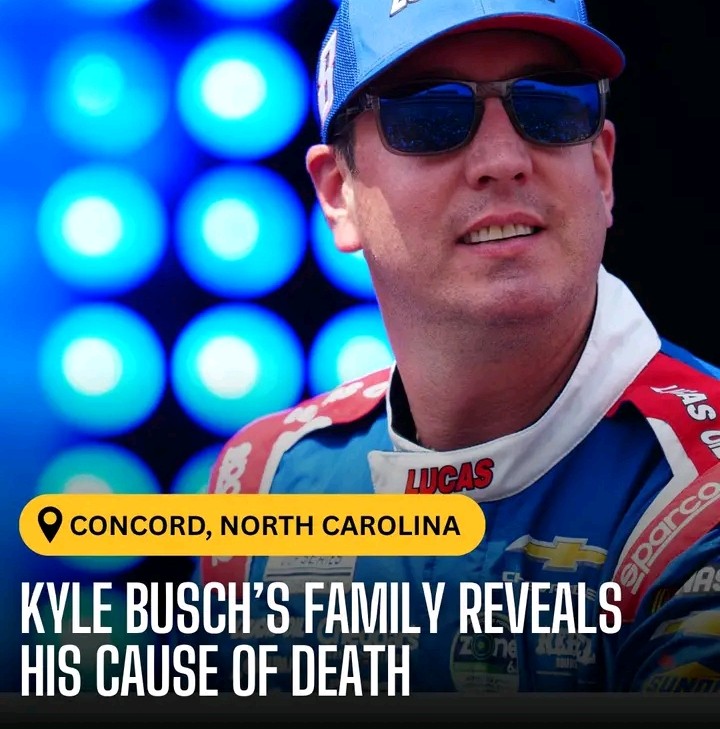
A shocking turn in the world of NASCAR has left fans stunned after the death of two-time champion Kyle Busch at just 41 years old, with his family now revealing the devastating medical chain of events that led to his sudden passing. What initially appeared to be a lingering illness quickly escalated into a life-threatening emergency that even those closest to him did not fully grasp until it was too late.
According to a statement released by his family and shared through Dakota Hunter, vice president of Kyle Busch Companies, the official medical evaluation was received on Saturday. Busch died on Thursday after becoming unresponsive during a Chevrolet racing simulator session in Concord, North Carolina. The timeline, now pieced together, shows a rapid decline that shocked both medical staff and the racing community.
Doctors determined that Busch’s death was caused by severe pneumonia that progressed into sepsis, a dangerous condition where the body’s immune response to infection spirals out of control. Instead of fighting the infection normally, the immune system begins damaging its own organs and tissues. The result, as explained in medical guidance from the Centers for Disease Control and Prevention, can include widespread inflammation, blood clotting issues, and leaking blood vessels, all of which can become fatal in a short period of time.
The earliest warning signs reportedly appeared weeks before his death. While competing at Watkins Glen on May 10, Busch was already feeling unwell and told his team over the radio that he needed a “shot” from a doctor after the race. At the time, it was thought to be nothing more than a sinus cold. Despite that, he continued competing at a high level, showing the same aggressive consistency he was known for throughout his career.
In a surprising twist that now feels haunting in hindsight, Busch managed to push through the illness and still delivered strong performances on track. He went on to win a Trucks Series race at Dover the following weekend and later finished 17th in the All-Star race on Sunday. Those results briefly suggested he was recovering, masking the severity of the infection developing beneath the surface.
Everything changed on Wednesday during a simulator testing session at a Chevrolet facility in Concord. According to multiple people familiar with the situation, Busch became unresponsive while inside the complex. Emergency services were called after a distress report described a man experiencing shortness of breath, overheating, dizziness, and coughing up blood. The caller said Busch was lying on a bathroom floor but was still awake when help was requested. Paramedics quickly transported him to a hospital in Charlotte.
The emergency call details paint a chilling picture of how quickly the situation deteriorated. Dispatch audio released by Cabarrus County Sheriff’s Office included the report: “I’ve got an individual that’s short of breath, very hot, thinks he’s going to pass out, and is producing a little bit of blood, coughing up some blood.” The urgency of the situation escalated within minutes, prompting immediate medical intervention, though efforts ultimately could not reverse the damage caused by the infection and sepsis.
NASCAR veteran Brad Keselowski later acknowledged that Busch had not been feeling well in recent weeks, though the full seriousness was not widely known among competitors. “Yes, but I won’t go into any specifics,” Keselowski said when asked about Busch’s condition. He added that many drivers continue racing through illness due to the intense competitive pressure in the sport, where missing a race can mean losing a seat to another driver eager for an opportunity.
“There’s no shortage of drivers that would love to take my seat or anybody else’s seat if we weren’t feeling well,” Keselowski explained. “All athletes feel that pressure. We’re all thinking to ourselves, ‘I don’t wanna be replaced.’ So you try to power through it the best you can.” His comments underline a long-standing reality in motorsports: physical discomfort is often ignored until it becomes unavoidable.

Busch’s career achievements now stand as a monumental legacy in NASCAR history. Over two decades of competition, he collected 234 victories across NASCAR’s top three series, the most ever recorded by a single driver. A two-time NASCAR Cup Series champion, Busch built a reputation for aggressive driving, relentless competitiveness, and a willingness to race through almost any condition.
In honor of his passing, all 39 drivers scheduled for Sunday’s race will carry a black No. 8 decal on their cars. The tribute reflects both his impact on the sport and the respect he earned from fellow competitors. The gesture will be visible across the entire field, turning the race into a collective moment of remembrance for one of NASCAR’s most dominant figures.
As the racing world processes the loss, attention has turned toward both his extraordinary career and the sudden medical emergency that ended it. What began as what seemed like a routine illness escalated into severe pneumonia and then sepsis, leaving even experienced medical professionals racing against time. Busch’s death now stands as a stark reminder of how quickly untreated infections can become fatal, even for elite athletes at the peak of physical conditioning.
