

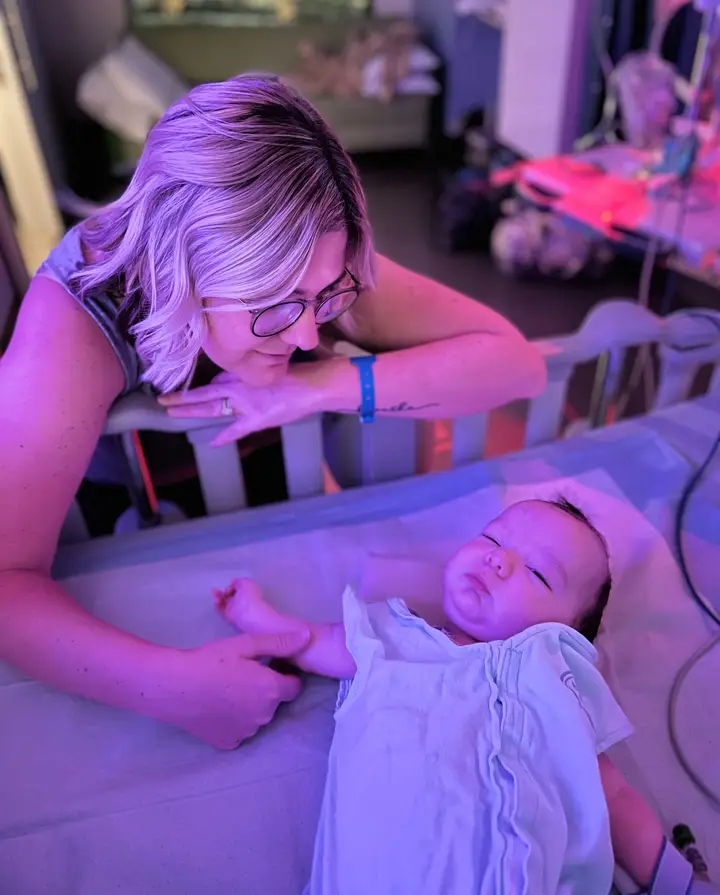
A mother’s instinct may have saved her son from a condition that could have permanently affected his brain development. When Megan Dorton noticed that her newborn son, Bodhi, had an unusual head shape shortly after birth, she refused to accept reassurances that everything would eventually correct itself. That determination ultimately led the family to the University of Iowa Health Care Stead Family Children’s Hospital, where specialists diagnosed a rare condition and launched a treatment plan that transformed Bodhi’s future.
For Megan and her husband, the journey began almost immediately after Bodhi was born. Instead of the rounded head shape they expected, their son’s skull appeared elongated, and Megan described it as looking “almost like a football,” with noticeable ridging along the top. As the days passed, another troubling sign emerged—Bodhi became increasingly irritable and struggled to lie comfortably on his back, convincing his parents that something more serious was happening.
Their concerns were initially dismissed as normal effects of childbirth. But Megan trusted her instincts. She repeatedly questioned whether Bodhi might have craniosynostosis, a rare condition in which one or more of a baby’s skull growth plates close too early. Eventually, after seeking additional guidance and speaking with a friend who worked as a nurse at University of Iowa Health Care, the family brought Bodhi to the emergency department in Iowa City.
Everything changed within hours.
According to Megan, Bodhi underwent medical imaging almost immediately. Within four hours, doctors confirmed the diagnosis, assembled a multidisciplinary care team, and began planning treatment. Although the diagnosis was frightening, the family finally had answers after weeks of uncertainty.
“It was a huge sigh of relief,” Megan recalled. “But the unknown was just so fearful.”
Doctors diagnosed Bodhi with craniosynostosis, a condition that occurs when one or more of the fibrous joints, or sutures, in a baby’s skull fuse before the brain has finished growing. Instead of expanding naturally, the skull becomes restricted, potentially increasing pressure inside the head and affecting both brain development and head shape if left untreated.

Rebecca Reynolds, the pediatric neurosurgeon leading Bodhi’s care, explained that growth plates are designed to remain open during infancy to allow the skull to expand alongside the rapidly developing brain.
In Bodhi’s case, one of those growth plates had already fused before birth or immediately afterward.
“We needed to reopen Bodhi’s growth plate,” Reynolds explained. Unlike positional head flattening which often improves naturally Bodhi’s condition would not resolve without surgery.
The timing of the diagnosis proved crucial.
Because Bodhi was diagnosed early, his parents were presented with two treatment options. The first involved a minimally invasive surgical procedure performed during early infancy, followed by approximately one year of specialized helmet therapy. The second option required a larger, more invasive surgery later in infancy but eliminated the need for postoperative helmet treatment.
Faced with one of the biggest decisions of their lives, Megan and her husband carefully questioned every aspect of each procedure, including the long-term impact on Bodhi’s brain development.
Ultimately, after discussions with Reynolds and the medical team, they chose the minimally invasive surgery because delaying treatment would have allowed additional pressure to build as Bodhi’s brain continued to grow.
Bodhi underwent surgery when he was just 11 weeks old.
Even though the operation was successful, the experience tested the family emotionally. Bodhi required a blood transfusion during surgery and later recovered in the intensive care unit while surrounded by monitors and medical equipment.
Yet Megan says one thing never changed throughout the process the compassion shown by everyone caring for her son.
“The nurses and the doctors were wonderful,” she said, adding that the team treated Bodhi “almost like our baby is their baby.”
Surgery, however, represented only the beginning of Bodhi’s recovery.
Following the minimally invasive procedure, helmet therapy became essential. Doctors reopened the fused growth plate during surgery, but they relied on Bodhi’s own brain growth to gradually reshape his skull over the following months.
Reynolds described the process simply: the brain becomes the driving force behind the correction, while the custom-made helmet gently directs the skull into its proper shape as the child grows.
Bodhi became the first patient in Iowa to receive a custom 3D-printed cranial helmet through UI Health Care’s partnership with Limb Lab. He wore the lightweight helmet for up to 23 hours each day and eventually progressed through approximately six different helmets over the course of a year as he continued growing. Megan praised the design, saying it was breathable, lightweight, and allowed him to function like any other baby.
Today, the results speak for themselves.
Now 2½ years old, Bodhi is described by his mother as “spunky,” “vibrant,” and an energetic child who loves spending time outdoors. Although he still attends periodic follow-up appointments so specialists can monitor his skull development, he continues reaching developmental milestones and enjoys the active childhood his parents hoped he would have.
Reynolds says that is exactly why early diagnosis matters.
When treated promptly, children with craniosynostosis often grow into healthy, active youngsters who can attend school, participate in sports, and enjoy everyday life without limitations.
“This is something that we can treat early with surgery,” Reynolds said. “Then kids go on to develop very healthy, active lifestyles.”
Bodhi’s story also highlights another important distinction for families. Many infants are referred to the University of Iowa Health Care Pediatric Craniofacial Clinic because of concerns about unusual head shapes, but most cases turn out to be positional flattening rather than craniosynostosis. That’s why specialists encourage parents to seek evaluation whenever something doesn’t seem right rather than assuming it will improve on its own.
The University of Iowa Health Care Stead Family Children’s Hospital operates Iowa’s only comprehensive Pediatric Craniofacial Clinic, bringing together pediatric neurosurgeons, craniofacial and plastic surgeons, ENT specialists, genetic experts, and pediatric ophthalmologists under one coordinated team. That collaborative approach helped Bodhi receive imaging, diagnosis, surgery, helmet therapy, and long-term follow-up without needing to travel to multiple hospitals.
Looking back, Megan remains convinced that trusting her instincts changed her son’s life. What began as a mother’s concern over an unusual head shape became a story of persistence, expert medical care, and a remarkable recovery. Today, Bodhi is running, playing, and thriving a powerful reminder that parents know their children best, and that early intervention can make all the difference.
