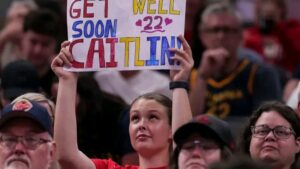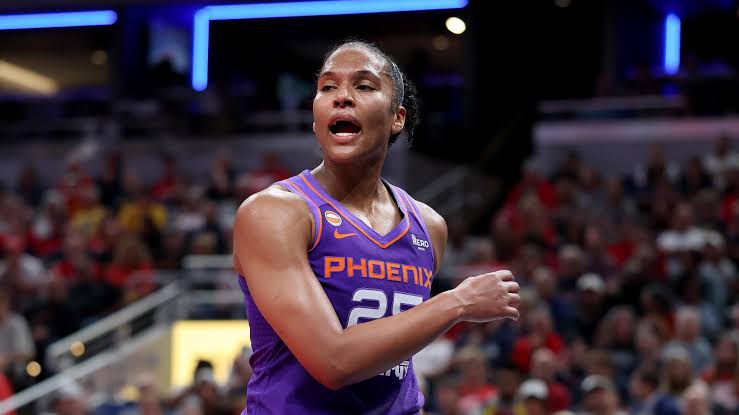
The tension surrounding Alyssa Thomas and Caitlin Clark has taken another dramatic turn but this time, it wasn’t about a hard foul or a suspension. It was about something far darker. Stephanie White opened her press conference with a powerful statement that instantly grabbed attention across the WNBA, calling out the toxic online attacks aimed at Thomas and issuing a warning to those pushing divisive narratives.
White didn’t wait for reporters’ questions. Before discussing basketball, injuries, or game plans, the Indiana Fever head coach made one thing crystal clear: the harassment directed at Thomas has gone too far. Her message came after Thomas revealed she and her family had been hit with death threats, racial slurs, and disturbing abuse following her controversial on-court collision with Clark.
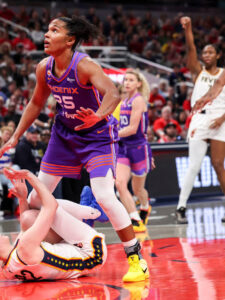
The controversy traces back to June 24, when the Phoenix Mercury defeated Indiana 111-109. Midway through the second quarter, Thomas made contact with Clark’s throat during a scramble for a loose ball. Officials initially called nothing, but after league review, the WNBA upgraded the play to a Flagrant 2 and suspended Thomas for one game. The decision triggered explosive reactions across social media, with debate quickly escalating beyond basketball.
What started as a heated basketball debate soon spiraled into something uglier. Thomas said the backlash crossed a dangerous line, revealing that not only she but also her loved ones including children had become targets of online abuse. She argued that the situation had unfairly painted her and her teammates as villains, adding fuel to an already volatile discussion surrounding physical play in the WNBA.
That’s what pushed White to speak out.
“Before we start with questions, I just want to address what’s going on with Alyssa,” White said during Wednesday’s media availability. “First and foremost, it’s absolutely unacceptable.”
Then came the quote now dominating headlines.
White condemned what she described as growing toxicity around the league, specifically pointing to racism, homophobia, and hate-driven commentary masquerading as fandom.
“There’s been so much more toxicity, racism, homophobia straight-out hate nonsense,” White said. “It is absolutely unacceptable.”
But White didn’t stop there.
In perhaps the most striking part of her statement, she challenged the legitimacy of those driving the outrage. According to White, many of the loudest voices online aren’t genuine basketball supporters at all.
“Most of this, in my heart of hearts, I believe is not coming from WNBA fans, Indiana Fever fans,” she said. “I believe this is people who are using our league, using our players, to further divisive agendas.”
That comment hit at the heart of a growing concern inside the league. As the WNBA’s popularity continues to explode largely fueled by stars such as Clark so too has the intensity of online discourse. Increased attention has brought bigger audiences, but it has also opened the door to outsiders using the sport as a battleground for cultural and political fights rather than appreciating the game itself.
White, who has coached Thomas in the past and knows her personally, seemed especially frustrated by how quickly the basketball conversation was hijacked.
She acknowledged that criticism is part of sports. Players miss shots. Coaches make bad calls. Fans argue. That’s normal.
But harassment? Threats? Racist attacks?
That, White said, has nothing to do with being passionate about basketball.
Her sharpest words came next.
“It’s not hard to not be a jerk,” White said. “If you are one of these people who are online doing this, do not call yourself a WNBA fan.”
That line resonated across the sports world.
The statement carried extra weight because White isn’t just any coach. She played in the WNBA from 1999 to 2004 and understands the league’s long fight for visibility, respect, and growth. She has witnessed firsthand how far women’s basketball has come and how much remains at stake as the league enters a new era of mainstream attention.
Her comments also exposed a difficult truth.
The Clark effect has transformed the WNBA in undeniable ways. Television ratings are soaring. Arenas are fuller. Media coverage has expanded dramatically. But with that surge has come intense polarization. Every hard foul involving Clark becomes headline news. Every officiating decision gets dissected frame-by-frame. Every rivalry becomes amplified.
And sometimes, narratives take on lives of their own.
That’s exactly what White appeared determined to stop.
Rather than allowing fans or bad-faith actors to reduce players into heroes and villains, she redirected the focus toward accountability and humanity. Basketball can be physical. Emotions can run high. Suspensions can be debated.
Threatening players and their families should never be part of the conversation.
The WNBA itself later issued a statement condemning the abuse and reaffirming its commitment to player safety, but many around the league felt White’s words landed harder because they felt personal, urgent, and unscripted.
For many, White’s press conference marked a turning point.
This wasn’t merely a coach defending a player. It was a veteran voice drawing a line.
As the WNBA continues growing into one of the most talked-about leagues in sports, White’s message may end up being remembered long after the controversy fades: passion for the game should elevate players, not endanger them.
And if your version of fandom includes hate, threats, or racism, Stephanie White made the league’s position painfully clear.
You don’t belong in the WNBA community.