

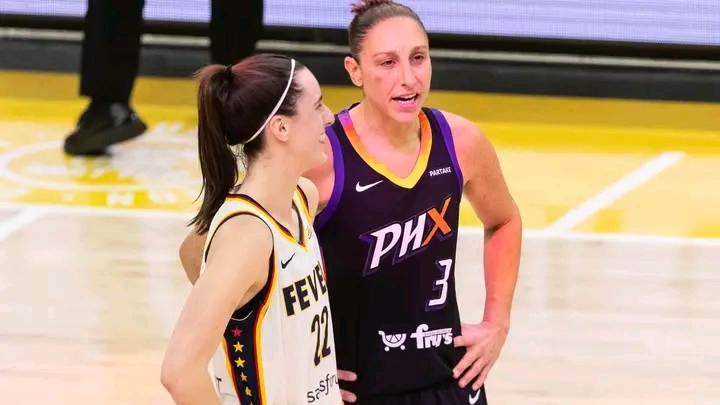
The WNBA wanted to celebrate three decades of history. Instead, it may have created a controversy that could’ve easily been avoided.
As the league unveiled its official 30th anniversary promotional poster this week, fans quickly shifted their attention away from the celebration itself and toward one glaring issue: the absence of two of the sport’s biggest names Diana Taurasi and Caitlin Clark. What should have been a unifying tribute to the league’s past, present, and future immediately turned into a heated debate across social media.
For many fans, the omissions were impossible to ignore. Taurasi, widely regarded as the greatest player in WNBA history, owns virtually every major scoring record the league has to offer. Clark, meanwhile, has become the face of a new era, helping deliver unprecedented television ratings, attendance records, merchandise sales, and mainstream visibility.
The controversy erupted almost immediately after the anniversary artwork was released. Screenshots of the poster spread rapidly online, with fans pointing out that while numerous current and former stars appeared, neither Taurasi nor Clark could be found anywhere in the design.
The timing made the reaction even stronger. The WNBA is currently experiencing arguably the most significant growth period in its history. Television audiences have surged over the past two seasons, arenas are selling out at record rates, and the league has expanded its national footprint unlike ever before. In the eyes of many supporters, leaving out two players who symbolize both the league’s foundation and its explosive future felt like a major misstep.
Taurasi’s absence stunned longtime followers of the league.
The Phoenix Mercury legend has spent more than two decades building a résumé that may never be matched. A three-time WNBA champion, two-time Finals MVP, league MVP, and the all-time leading scorer in WNBA history, Taurasi has been one of the defining faces of women’s basketball since entering the league in 2004.
Beyond statistics, Taurasi’s impact stretches across generations. She helped elevate the league during its early growth years and remained a marquee attraction deep into her career. Few athletes in professional sports have maintained relevance and elite-level production for as long as she has.

That’s why many fans viewed her omission not simply as surprising, but almost unthinkable.
Then there’s Clark.
Since entering the WNBA in 2024, the Indiana Fever star has transformed the league’s visibility in ways few could have predicted. During her final collegiate season at Iowa, Clark shattered NCAA scoring records and became one of the most recognizable athletes in America. Her transition to the professional game only accelerated interest.
Games featuring Clark routinely rank among the most-watched in league history. Road arenas regularly report sellout crowds when the Fever visit. Merchandise sales have skyrocketed, and television networks have aggressively expanded WNBA coverage to capitalize on the increased demand.
Whether fans love her, criticize her, or simply tune in out of curiosity, Clark has become impossible to ignore.
That reality is precisely why many observers believe excluding her from a commemorative poster celebrating the league’s milestone anniversary was a mistake.
Critics argue that anniversary campaigns are designed to tell a story. In the WNBA’s case, that story spans three decades of trailblazing athletes, transformative moments, and continued evolution. Taurasi represents the league’s sustained excellence and historical greatness. Clark represents its next chapter and unprecedented momentum.
Leaving both out, many say, creates an incomplete picture.
Social media platforms were flooded with reactions shortly after the poster debuted. Some fans questioned the selection process entirely, while others accused the league of once again missing an opportunity to embrace the very stars driving conversation around women’s basketball.
The WNBA has occasionally faced criticism in recent years for messaging decisions involving its biggest personalities. Discussions surrounding player promotion, marketing strategy, and star visibility have become increasingly common as the league’s audience expands.
This latest controversy appears to have reignited those debates.
Supporters of the league, however, point out that anniversary artwork can never include every deserving player. Thirty years of history have produced countless legends, champions, MVPs, and cultural icons. Any attempt to condense that history into a single image will inevitably leave some fans disappointed.
That’s a fair argument.
Still, critics counter that Taurasi and Clark aren’t simply “some” players. One is arguably the greatest athlete the league has ever produced. The other is currently the sport’s most marketable and talked-about figure.
From a branding perspective, excluding both simultaneously seems difficult for many fans to understand.
The situation underscores a larger challenge facing the WNBA as it enters its 30th season: balancing respect for its history while fully embracing its rapidly changing future.
The league has never been more popular. Attendance continues to climb, media coverage has expanded dramatically, and sponsorship interest remains strong. Expansion franchises are on the horizon, and women’s basketball has never enjoyed greater mainstream attention.
Yet moments like this demonstrate just how passionate and protective the fan base has become.
Every marketing decision is now scrutinized. Every promotional campaign is dissected. And every omission carries consequences.
Perhaps that’s ultimately a sign of progress.
For years, critics argued that the WNBA lacked mainstream visibility. Today, the league commands enough attention that a single promotional image can dominate sports conversations for days.
Still, as the WNBA celebrates 30 years of groundbreaking achievements, many fans believe the anniversary campaign missed an opportunity to unite generations of supporters.
Because when basketball fans think about the league’s history, Diana Taurasi is one of the first names that comes to mind.
And when they think about where the league is headed, Caitlin Clark is almost impossible to leave out of the picture.
For a celebration intended to honor the WNBA’s past, present, and future, that omission may become the storyline fans remember most.
