

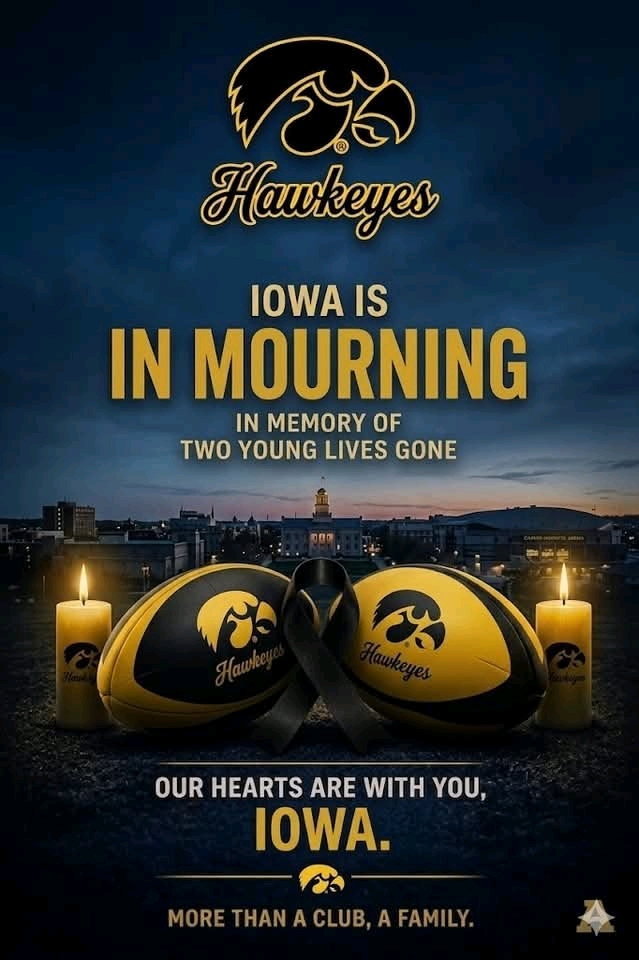
The Iowa Hawkeyes football program has been left shaken to its core after the tragic deaths of two young athletes whose futures were once viewed as incredibly bright. Clayton Adams and Dylan Bentley, both closely connected to the future vision of Iowa football, lost their lives in a devastating shooting that has sent grief far beyond Iowa City.
What was supposed to be a journey toward packed Saturdays at Kinnick Stadium instead became one of the darkest moments the program has faced in recent memory. Coaches, teammates, fans, and members of the college football community are now mourning two young men who were widely respected not only for their athletic potential, but for the character they carried every day.
Inside the Iowa football facilities, the atmosphere reportedly changed almost instantly after the heartbreaking news surfaced. Conversations became quieter. Team activities slowed. The normal energy that surrounds a competitive college football program disappeared under the weight of disbelief.
For a program known for toughness, discipline, and resilience under head coach Kirk Ferentz, this tragedy created a kind of pain no game plan can prepare anyone for. Football suddenly became secondary.
Ferentz, who has spent decades leading the Hawkeyes through some of the program’s biggest moments, struggled to fully express the heartbreak surrounding the loss.
“This is a heartbreaking loss,” Ferentz said in a statement.
“Clayton and Dylan were not only talented players, but exceptional young men with tremendous character and incredibly bright futures ahead of them. The entire Iowa Hawkeyes family sends its deepest thoughts and prayers to their loved ones.”
Those words reflected more than a coach speaking publicly. Behind them was the reality of a football program trying to process unimaginable grief while supporting teammates, friends, and family members dealing with overwhelming loss.
Clayton Adams had earned a reputation as one of the most intelligent and disciplined young players connected to the program. Coaches and evaluators reportedly admired his calm presence, leadership qualities, and advanced understanding of the game.
People around him believed he possessed the kind of football IQ that separates good athletes from future impact players. His ability to stay composed under pressure and quickly process situations on the field made him someone many believed could eventually thrive at the college level.
Dylan Bentley brought a completely different style, but one that was equally exciting.
Bentley was known for explosive athleticism, speed, and fearless playmaking ability. His aggressive approach and natural instincts allowed him to stand out as a player capable of changing momentum instantly.
Whether through a powerful run, a defensive stop, or a game-changing moment, Bentley carried the type of energy coaches love building around. His physical tools and fearless mentality reportedly made him one of the players the coaching staff watched closely as part of Iowa’s future plans.
Though their personalities and playing styles differed, Adams and Bentley represented something similar within the program: hope.
They symbolized the next generation of Hawkeye football.
That is one reason the tragedy has hit so hard throughout the Iowa community and across college football as a whole.
News of their deaths quickly spread beyond the walls of the Iowa program. Messages of support and condolences began pouring in from players, coaches, fans, and universities across the country.
In college football, rivalries often disappear when real-life tragedy strikes. Moments like this remind everyone that behind every jersey number is a young person with dreams, goals, family, and a future still being built.
The loss of Adams and Bentley became larger than football almost immediately.
For current Iowa players, the emotional impact has reportedly been overwhelming. Team leaders and veteran players have tried to support younger teammates as everyone attempts to process what happened.
The university and football program have also reportedly introduced internal support systems focused on counseling, emotional care, and providing players and staff with resources during this difficult period.
At times like these, the normal conversations surrounding football rankings, depth charts, recruiting battles, and season expectations suddenly feel meaningless.
There are no wins or losses that compare to the pain of losing two young lives.
There is no scoreboard capable of easing grief.
And there is no strategy that can fully prepare a locker room for heartbreak like this.
For Iowa fans, the tragedy has created a deep emotional response because Hawkeye football has always been built around more than performance on Saturdays. The culture surrounding the program has long emphasized family, accountability, discipline, and relationships.
That is why the loss of two young men viewed as part of the program’s future feels deeply personal throughout the Iowa community.
Many supporters have continued sharing tributes online, remembering Adams and Bentley as young athletes filled with promise and ambition. Others have reflected on how quickly life can change, even for individuals whose futures once seemed destined for major college football success.
The emotional weight surrounding the tragedy has also become a painful reminder of how fragile athletic journeys truly are.
For many athletes, reaching a program like Iowa represents years of sacrifice, training, family support, and personal determination. Dreams are built through endless workouts, long practices, injuries, setbacks, and moments of perseverance.
That is part of what makes this loss so difficult to process.
Clayton Adams and Dylan Bentley were still at the beginning of their journeys.
There were future games yet to be played, milestones yet to be reached, and memories still waiting to be created inside Kinnick Stadium.
Instead, teammates and coaches are now left holding onto memories that arrived far too soon.
Within the program, the focus has reportedly shifted entirely toward supporting one another and honoring the lives of the two young men.
Practices, routines, and football preparations naturally feel different under the circumstances. The emotional atmosphere surrounding the team remains heavy as players continue trying to navigate grief together.
Even in a sport celebrated for physical toughness, moments like this expose the emotional side of football that fans rarely see publicly.
Behind every helmet is a person.
Behind every recruiting story is a family.
And behind every athlete chasing greatness is a life filled with hopes far bigger than sports alone.
The deaths of Clayton Adams and Dylan Bentley have now become part of the emotional history of Iowa Hawkeyes football.
Not because of statistics or on-field accomplishments, but because of the impact they left on the people around them.
Those who knew them remember two young men respected for both talent and character. Teammates saw individuals driven to succeed. Coaches saw players with long-term potential. Friends and loved ones saw lives filled with purpose.
As the Iowa football community continues grieving, one thing remains painfully clear.
This is no longer just about football.
It is about two lives gone far too soon.
It is about a locker room trying to heal.
It is about families enduring unimaginable pain.
And it is about a community coming together during one of the most heartbreaking moments the program has experienced.
Tonight, Iowa Hawkeyes football stands united not by competition or championship goals, but by grief, remembrance, and support for the families of Clayton Adams and Dylan Bentley.
Their journeys were interrupted far too early, but within the Hawkeye community, their memory will continue to endure long after the silence fades.
