


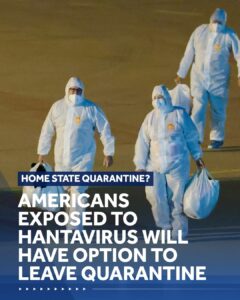
A frightening health scare involving American cruise ship passengers stranded after a suspected hantavirus outbreak has taken another dramatic turn. Federal health officials confirmed Monday that some of the Americans currently being monitored inside Nebraska’s National Quarantine Unit may soon be allowed to return home but only if they meet a long list of strict medical and safety requirements first.
The update came after 16 American passengers evacuated from the hantavirus-affected cruise ship arrived in Omaha early Monday morning under federal supervision. According to officials from the Centers for Disease Control and Prevention (CDC), the Department of Health and Human Services (HHS), and Nebraska public health agencies, the passengers are now undergoing medical assessments while doctors determine whether they can safely complete their 42-day monitoring period outside the federal quarantine facility.
The outbreak has already turned deadly. Reports linked to the cruise ship incident confirmed that three people died during the suspected hantavirus outbreak while the vessel traveled through the Atlantic Ocean. Health authorities are now racing to prevent any further spread while carefully monitoring everyone who may have been exposed.
One of the evacuated American passengers has already tested positive for hantavirus but is reportedly not showing symptoms at this time. Another passenger was said to have mild symptoms, increasing concern among medical experts overseeing the case.
During Monday’s press conference in Omaha, officials stressed that they are attempting to provide what they described as the “least restrictive” form of care possible while still protecting public safety.

“Passengers will undergo an initial health assessment and receive guidance on next steps from the CDC, experts and other partners,” said John Knox, principal deputy assistant secretary for HHS Preparedness and Response.
According to CDC official Dr. Brendan Jackson, 15 passengers are currently being housed inside the National Quarantine Unit, a federal facility designed specifically for monitoring individuals who may have been exposed to dangerous infectious diseases but are not yet showing symptoms.
Jackson explained that every passenger’s situation will be evaluated individually before any decision is made about allowing them to travel back to their home states.
“There’s going to be an individualized decision plan for them,” Jackson said during the briefing. “Determine if it makes more sense for them to complete their 42-day monitoring period at home.”
That possibility, however, comes with several strict conditions.
Federal officials said passengers hoping to leave quarantine must prove they have a safe environment available once they return home. Among the biggest requirements is the ability to completely isolate from other people inside their residence.
“Making sure that they can be able to isolate in a separate part of a structure from anybody else,” Jackson explained.
Passengers must also show that they have direct access to their local health departments, testing facilities, and emergency medical care if symptoms suddenly appear. Officials emphasized that immediate medical intervention could become critical if the disease progresses.
At this stage, authorities have not explained exactly how compliance with those conditions will be enforced once passengers return home. However, state and federal officials insisted that nobody will be released unless every public health concern has been addressed.
“We are here also to make sure that there’s a structure in place,” said Dr. Ashley Newmyer, director of Public Health for Nebraska DHHS. “To make sure that no one poses a public health threat.”
The quarantine situation has sparked growing public concern because hantavirus is considered a serious and potentially deadly disease. The virus is most commonly spread through contact with infected rodents, their urine, saliva, or droppings. While human-to-human transmission is extremely rare in most hantavirus strains, the illness can rapidly become life-threatening if symptoms develop.
Doctors say early symptoms often resemble the flu, including fever, fatigue, muscle aches, headaches, and dizziness. In more severe cases, patients can develop serious respiratory complications that may require hospitalization and intensive medical treatment.
Dr. Michael Wadman, medical director of the National Quarantine Unit, strongly encouraged passengers to remain at the Nebraska facility instead of returning home if given the option.
“If I was exposed to this and I had the option to stay in a quarantine unit proximate to that care, I would definitely take that,” Wadman said. “Because you’re putting yourself in the position, if you were to turn positive, that you’d be in a position to take advantage of all those things.”
He added that staying close to specialized medical treatment could significantly improve survival chances if symptoms appear suddenly during the monitoring period.
“That’s going to give you the best chance of survival,” Wadman warned.
Another major unanswered question involves transportation.
Officials confirmed that if passengers are approved to return home, they will not simply be released on their own. Instead, they will reportedly be escorted under what authorities described as “appropriate circumstances” from the quarantine facility all the way back to their homes.
However, health agencies did not reveal whether passengers would travel by commercial flights, private transportation, or specialized medical transport arrangements.
The outbreak has generated nationwide attention not only because of the deaths already reported but also because of the unusually long 42-day monitoring window now being enforced for exposed passengers.
Health experts say that extended incubation periods are necessary because hantavirus symptoms can sometimes take weeks to appear after exposure.
For now, the evacuated Americans remain under careful observation in Nebraska while health officials continue daily evaluations. Families across the country are anxiously waiting for updates as authorities determine who may be cleared to leave federal quarantine and who may need to remain under strict monitoring much longer.
The situation also raises broader concerns about health safety aboard international cruise ships, where infectious disease outbreaks can quickly escalate because of close living quarters and large passenger populations.
As federal agencies continue investigating the source and scope of the outbreak, the focus remains on preventing additional infections while balancing the rights and safety of those already exposed.
For the passengers currently isolated inside the National Quarantine Unit, the next several days could determine whether they’ll finally be allowed to return home or remain under federal watch as one of the most closely monitored public health scares of 2026 continues unfolding.
