

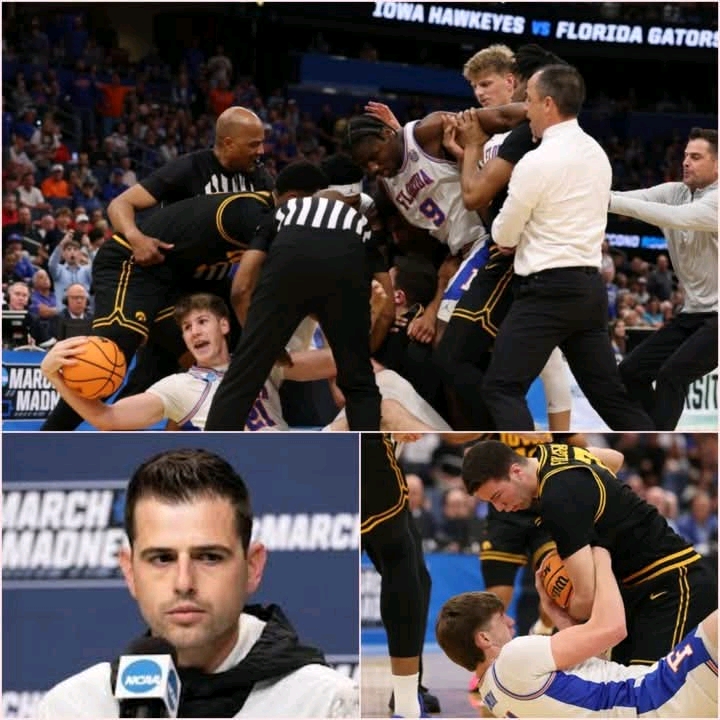
Controversy Explodes After Iowa’s 73–72 Thriller Over Florida — But It Wasn’t the Final Shot That Stole the Spotlight
Published: March 23, 2026
The scoreboard told one story: Iowa 73, Florida 72. A one-point classic. The kind of game that should’ve been remembered for clutch plays, late-game execution, and March Madness drama.
Instead, within minutes of the final buzzer, the narrative flipped entirely.
What followed didn’t unfold on the hardwood it erupted behind a microphone.
And now, one of the most thrilling games of the NCAA Tournament has become the center of a growing storm about officiating, physical play, and the very integrity of college basketball.
A Game Decided by Inches
For 40 minutes, Iowa and Florida traded blows in a tightly contested second-round battle. Neither side led comfortably. Every possession felt like it carried the weight of the season.
By the final stretch, the margin was razor-thin.
Iowa executed when it mattered most converting key possessions, staying composed under pressure, and finding just enough offense to edge ahead. Florida had chances late but couldn’t quite deliver the final punch.
When the buzzer sounded, the difference was just one point: 73–72.
It should’ve been a celebration of resilience and execution.
Instead, it became a launchpad for controversy.
Todd Golden’s Explosive Accusation
Moments after the loss, Florida head coach Todd Golden stepped into the press conference room and didn’t hold back.
His frustration was obvious from the start. But what came next went far beyond disappointment over a narrow defeat.
“Let’s stop lying to ourselves,” Golden said, his voice tight with emotion.
“Iowa didn’t win tonight because of heart, discipline, or clean basketball they won by controlling everything and playing a game that wasn’t fair.”
That statement alone turned heads.
But Golden kept going.
He accused Iowa of leaning heavily into excessive physicality and, more importantly, suggested that officials allowed it to happen.
“They dominated with excessive contact. There were blatant fouls that just weren’t called,” he continued.
“You saw players pushing, grabbing, making rough, borderline dirty plays and nothing was called when it mattered most.”
Golden’s criticism wasn’t just about a few missed whistles. He framed it as a systemic issue.
“That’s not an advantage. That’s exploitation,” he said.
“That’s not what basketball is supposed to be.”
“This Isn’t Competition It’s Manipulation”
As the press conference continued, Golden’s remarks escalated beyond the game itself.
He questioned the broader direction of college basketball suggesting that what happened on the court reflected deeper problems within the sport.
“This isn’t about growth or earning success anymore,” he said.
“It’s about who can buy the biggest advantage and get away with the most physical, almost dirty style of play.”
Then came the line that truly ignited debate:
“Let’s call it what it is this isn’t competition, it’s manipulation. It’s a system of cheating disguised as a game.”
He paused briefly before delivering his final shot:
“That’s not the spirit of this sport. That’s not integrity. That’s a dirty game and everyone watching knows it.”
Within minutes, clips of the press conference spread across social media.
The reaction was immediate and deeply divided.
A Nation Divided: Was Golden Right?
Golden’s comments struck a nerve.
Supporters of Florida pointed to specific moments in the game missed calls, heavy contact in the paint, and late-game physical sequences that went unwhistled. To them, Golden wasn’t making excuses he was saying what others were afraid to say.
On the other side, Iowa supporters and neutral analysts pushed back hard.
They argued that the game was physical but not unusual for March basketball. Tournament games, especially in tight contests, often allow more contact as officials try to avoid over-influencing the outcome.
Many critics saw Golden’s remarks differently.
Not as truth-telling but as deflection.
After all, Florida still had opportunities to win. The Gators scored 72 points. They had possessions late. They just didn’t convert.
In a one-point game, every missed shot, turnover, and defensive lapse matters.
Blaming officiating alone? That didn’t sit well with everyone.
Ben McCollum’s Calm Counter
While Golden’s comments lit the fire, Iowa head coach Ben McCollum took a completely different approach.
When he stepped to the podium, the tone shifted instantly.
Measured. Controlled. Professional.
“We respect Florida and the way they competed tonight,” McCollum said.
“It was a hard-fought game on both sides.”
No accusations. No defensiveness.
Just composure.
“Our players executed, stayed composed, and found a way to win. That’s what this tournament is about.”
Without directly addressing Golden’s claims, McCollum still made his stance clear.
“Basketball at this level is intense. It’s physical,” he said.
“But it’s also about discipline and resilience. I believe our guys showed that tonight.”
The contrast couldn’t have been sharper.
Where Golden was fiery, McCollum was steady.
Where one escalated, the other diffused.
And that contrast didn’t go unnoticed.
The Bigger Question: Where Is the Line?
Beyond the emotions of one game, the controversy has sparked a broader conversation one that’s been building quietly for years.
How physical is too physical?
College basketball has always walked a fine line between toughness and control. In high-stakes tournament games, that line often shifts.
Officials tend to “let them play.” Players respond by pushing boundaries. Coaches adapt or complain.
But when does physical play cross into something else?
Golden believes Iowa crossed that line and got away with it.
Others believe Iowa simply played winning basketball in a high-pressure environment.
The truth likely sits somewhere in between.
What the Numbers Don’t Show
The box score says Iowa won by one point.
But it doesn’t capture the intensity of each possession, the contact inside the paint, or the judgment calls or non-calls that shaped the flow of the game.
It doesn’t show the moments Florida could’ve seized and didn’t.
And it definitely doesn’t reflect the emotional aftermath that followed.
What This Means Moving Forward
For Florida, the loss is devastating.
A one-point defeat is always painful. But one surrounded by controversy? That lingers even longer.
For Iowa, the win should be a moment of celebration.
Instead, it comes with scrutiny.
Their physical style previously seen as toughness is now under a microscope. Every game moving forward will be watched differently.
Every whistleor lack of one will be questioned.
A Game That Became Something Bigger
In the end, this wasn’t just a 73–72 game.
It became a flashpoint.
A debate about fairness. About officiating. About what college basketball is and what it’s becoming.
Was Iowa simply tougher?
Or did they benefit from a game that tilted in their favor?
Was Golden speaking truth?
Or reacting to the pain of a loss that slipped away?
Those questions don’t have easy answers.
But one thing is certain:
What should’ve been remembered as a classic March Madness thriller has turned into something far more complicated and far more controversial.
And the conversation is just getting started.
