‘Vet Move’ or Desperation? Brendan Hausen’s Controversial Shot vs Ohio State Explained
CHICAGO — In the frantic closing seconds of Iowa’s Big Ten Tournament battle with Ohio State, one play instantly sparked debate. Brendan Hausen’s shot vs Ohio State looked reckless at first glance a hurried, off-balance three-pointer from near the sideline that barely threatened the rim.
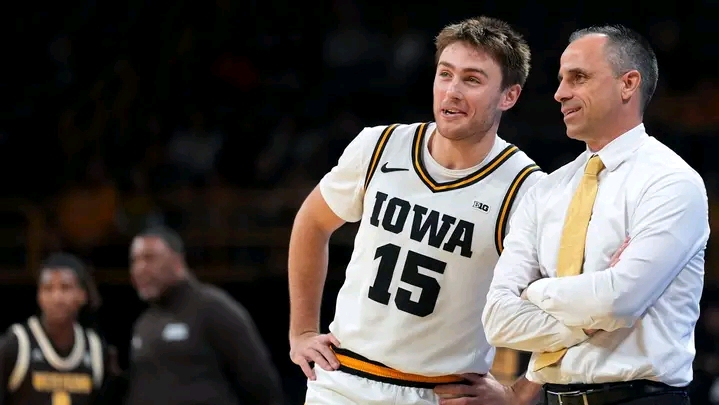
But according to Iowa head coach Ben McCollum, the moment wasn’t reckless at all. In fact, he called it a “vet move.”
The play, which unfolded with less than eight seconds remaining in Iowa’s 72–69 loss to Ohio State, carried more strategy than it seemed. What looked like a desperate heave was actually part of a calculated plan one that nearly worked if a whistle had blown.
Iowa’s Comeback Set the Stage
Iowa entered the final minutes fighting uphill. At one point in the second half, the Hawkeyes trailed by 16 points. Yet they refused to fold.
Instead, they clawed their way back possession by possession, cutting the deficit until the game hung on a single play. With the score 72–69 in favor of Ohio State, Iowa had one final opportunity to tie the game.
The tension inside Chicago’s arena was unmistakable. Every possession mattered. Every movement off the ball carried purpose.
And everyone in the building knew what Iowa wanted a three-pointer.
Ohio State knew it, too.
Why Iowa Expected Ohio State to Foul
Late-game basketball strategy often becomes a chess match, and Iowa anticipated Ohio State’s move.
With a three-point lead, many teams choose to foul intentionally before a three-point shot can be attempted. The logic is simple: send the opponent to the free-throw line for two shots instead of allowing a potential game-tying three.
McCollum revealed after the game that Iowa designed its final action with that expectation in mind.
“We knew we were going to have a tough time getting Bennett (Stirtz) open,” McCollum explained. “And then if we did get him open, they were just going to foul him right away.”
Instead of running a predictable play for their primary shooter, Iowa spread the floor and created multiple options.
McCollum continued:
“So you run him off that side. Ran Brendan (Hausen) off the other side and then Tate (Sage) in the middle. We were just getting ready for them to foul us, anyway, for the most part.”
The play wasn’t just about getting a shot.
It was about baiting a foul.
Brendan Hausen’s Shot vs Ohio State
The ‘Crafty’ Decision Explained
When Hausen caught the ball near the sideline, the situation unfolded exactly as Iowa anticipated.
An Ohio State defender reached in and made contact. Recognizing the moment, Hausen immediately rose for a three-pointer.
The shot sailed far off target the kind of miss that usually triggers criticism from analysts and fans.
But McCollum saw something different.
“It looked worse than it actually was,” the Iowa coach said. “You’ll see the kid reach and kind of shove him. And so, he shot it knowing that he was going to get fouled. So it was actually a pretty crafty move.”
In other words, Hausen wasn’t necessarily trying to make the shot.
He was trying to draw a three-shot foul, which would have given Iowa a chance to tie the game from the free-throw line.
If the whistle had come, the narrative surrounding the play would likely be very different.
Hausen Believes He Was Fouled
After the game, Hausen didn’t hide his frustration.
Speaking to reporters, the Iowa guard insisted the contact should have resulted in free throws.
“He fouled me,” Hausen said. “They said they were going to foul coming out of the huddle. I heard them say it. Grabbed me. Unfortunate. The ref probably had a bad angle on it.”
From Hausen’s perspective, the plan worked at least from a strategic standpoint.
The defender reached.
The contact happened.
But the referees never blew the whistle.
Without the call, the play looked like a rushed and inaccurate shot.
Iowa Still Had One Last Chance
Even after Hausen’s miss, the drama wasn’t finished.
Ohio State stepped to the free-throw line with a chance to put the game out of reach but missed one of its attempts.
That opened the door for Iowa again.
The Hawkeyes secured possession, and Ohio State quickly fouled Alvaro Folgueiras, sending him to the line for a 1-and-1 opportunity.
The moment carried enormous pressure.
Folgueiras missed the front end, preventing Iowa from extending the possession with another free throw.
However, the Hawkeyes grabbed the rebound, giving themselves one final shot to force overtime.
The ball eventually found Isaia Howard, who launched a three-pointer in the closing seconds.
It didn’t fall.
Just like that, Iowa’s Big Ten Tournament run ended.
Ohio State Escapes With a 72–69 Win
When the final horn sounded, Ohio State walked away with a 72–69 victory, eliminating Iowa from the 2026 Big Ten Tournament.
The Buckeyes survived a furious second-half rally and avoided what could have been a heartbreaking collapse.
For Iowa, the defeat was especially painful considering how close they came to completing the comeback.
Down 16 earlier in the half, the Hawkeyes had turned the game into a final-possession battle.
But basketball often comes down to tiny margins a missed free throw, a no-call, or a three-pointer that rattles out.
The Thin Line Between Smart and Risky
Plays like Brendan Hausen’s shot vs Ohio State highlight one of basketball’s enduring truths: context changes everything.
A wild-looking shot can actually be a calculated gamble.
Without the whistle, Hausen’s attempt appeared hurried and ill-advised. With a foul call, it could have sent him to the line with three chances to tie the game.
That’s why McCollum defended the decision so strongly.

The coach saw the strategy unfolding exactly as planned except for the officiating.
Late-game scenarios often reward players who understand these subtle moments. Recognizing defensive contact and converting it into free throws is a skill experienced players develop over time.
That’s what McCollum meant by calling it a “vet move.”
Hausen read the situation, anticipated the foul, and reacted instantly.
Unfortunately for Iowa, the referees saw it differently.
What This Means for Iowa Moving Forward
Although the loss ended Iowa’s run in the conference tournament, the Hawkeyes showed resilience that could carry into the postseason conversation.
The comeback from a 16-point deficit demonstrated the team’s ability to compete under pressure.
Players like Hausen, Howard, and Folgueiras were involved in nearly every key moment of the closing minutes.
Even in defeat, Iowa’s performance suggested a team capable of battling elite opponents deep into games.
And sometimes, those narrow losses become the most valuable learning experiences.
The Play Fans Will Debate
In the days following the game, the final sequence will likely remain a topic of discussion among fans and analysts.
Was the contact enough for a foul?
Should the referees have blown the whistle?
Did Hausen rush the shot?
Opinions will vary.
But within Iowa’s locker room, the explanation is clear.
The play wasn’t chaos.
It was strategy.
And according to Ben McCollum, Brendan Hausen made the right basketball decision in the moment even if the outcome didn’t reward it.