THE SOUND OF BROTHERHOOD: HOW IOWA TURNED A SWEET 16 WIN INTO A MARCH MADNESS MOMENT NO ONE SAW COMING
Published: March 27, 2026
HOUSTON The final buzzer said Iowa had won.
The scoreboard read 77–71.
But what happened next inside that arena? That’s what people are still talking about.
Because in a tournament built on pressure, noise, and chaos, the Iowa Hawkeyes did something unexpected after knocking off Nebraska in the Sweet 16 they slowed everything down… and created a moment that felt bigger than basketball.
This wasn’t just a win.
It became a statement about identity, trust, and something every championship team quietly leans on but rarely shows this clearly:
Brotherhood
FROM BATTLE TO BREAKTHROUGH
Before the moment, there was the fight.
Nebraska didn’t make anything easy. The Cornhuskers came out aggressive, forcing Iowa into uncomfortable spots early. They attacked in transition, applied physical pressure on defense, and kept the Hawkeyes from settling into rhythm.
For long stretches, Nebraska looked like the team dictating the night.
But Iowa never unraveled.
Instead, they responded the way disciplined teams do in March not with panic, but with control. Head coach Ben McCollum’s system began to show itself possession by possession. Defensive rotations tightened. Ball movement improved. Shot selection became more deliberate.
By the second half, the tone had shifted.
And then came the players who would define the night.
BENNETT STIRTZ: CONTROL UNDER FIRE
Bennett Stirtz didn’t need to dominate the stat sheet to dominate the game.
He controlled it.
Late in the second half, with Nebraska pushing and the margin razor-thin, Stirtz took over as the decision-maker. He slowed the tempo when it needed calming. He attacked when gaps appeared. And most importantly, he made sure Iowa didn’t waste possessions.
That’s what separated Iowa in the final minutes.
Not highlight plays but smart ones.
Stirtz’s ability to read the floor under pressure turned chaos into clarity. And when the game demanded leadership, he didn’t hesitate.
He delivered it.
ALVARO FOLGUEIRAS: THE DIFFERENCE-MAKER
While Stirtz dictated the pace, Alvaro Folgueiras delivered the moments.
The forward’s impact came at exactly the right times. He stretched Nebraska’s defense, forcing mismatches. He found space when Iowa needed it most. And when the pressure climbed, he knocked down shots that kept momentum on Iowa’s side.
Every close game has a tipping point.
Folguerias lived in those moments.
Not flashy. Not forced. Just efficient, timely basketball the kind that wins games in March.
THE FINAL PUSH: WHERE THE GAME WAS WON
With under five minutes left, the game hung in the balance.
Nebraska was still within reach. One run could’ve flipped everything.
Instead, Iowa shut the door.
A defensive stop sparked it. Then a composed offensive possession. Then another key shot that found nothing but net.
What followed wasn’t a blowout run it was control.
Iowa executed. Nebraska chased.
And just like that, the window closed.
When the buzzer sounded, Iowa had secured a 77–71 victory, earning a place in the Elite Eight.
But the story didn’t end there.
THE MOMENT THAT CHANGED EVERYTHING
As the noise inside the arena reached its peak players celebrating, coaches embracing, fans on their feet something unexpected began to unfold.
Iowa players gathered.
Not in chaos.
In rhythm.
What started as a chant turned into something deeper a shared expression, a collective release, a sound that echoed far beyond the game itself.
It wasn’t rehearsed.
It wasn’t staged.
It was real.
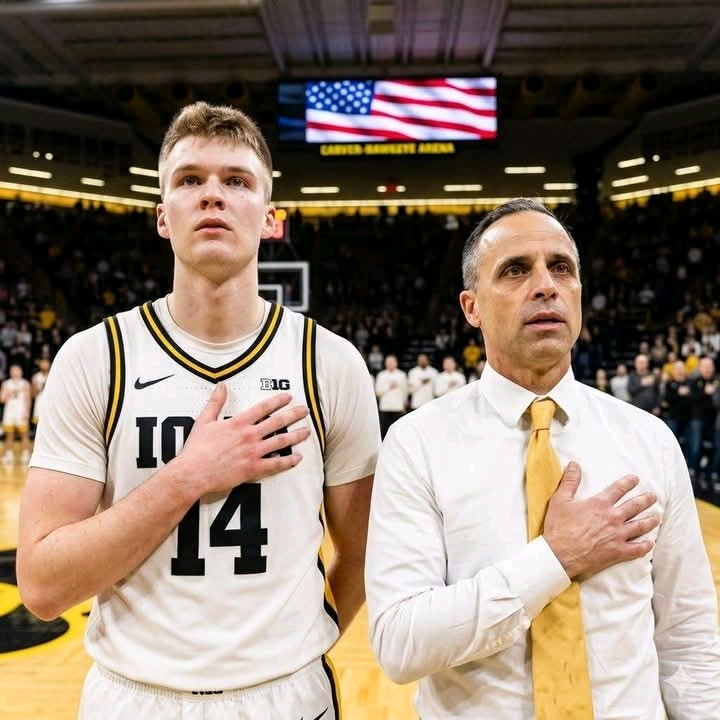
At the center of it stood Bennett Stirtz, alongside Alvaro Folgueiras, both trying to capture what had just happened.
Stirtz paused before speaking. Then, calmly, he said:
“It’s bigger than us.”
That line didn’t just describe the win.
It defined the moment.
WHY THIS WASN’T JUST CELEBRATION
Teams celebrate wins all the time in March Madness.
But this felt different.
This wasn’t about hype. It wasn’t about showmanship. It was about connection.
You could see it in how the players moved together, how they stayed locked in even after the pressure lifted. There was no rush to leave the court, no scattered energy.
Everything about it felt intentional even if it wasn’t planned.
For Stirtz, that moment reflected responsibility.
Not just to win games, but to lead to represent something larger than individual performance. To carry the expectations of a program and deliver when it matters most.
For Folgueiras, it came down to trust.
Trust in teammates. Trust in preparation. Trust in a system that held strong under pressure.
He put it simply:
“We stay together. We believe. And we fight.”
That wasn’t a postgame cliché.
It was a summary of everything Iowa showed for 40 minutes
NEBRASKA’S ROLE IN A CLASSIC
While Iowa moves on, Nebraska’s impact on this game can’t be ignored.
The Cornhuskers forced Iowa into one of its toughest tests of the tournament. Their defensive pressure disrupted rhythm. Their transition play created problems. And their ability to stay within striking distance kept the tension alive until the final minutes.
They didn’t fade.
They pushed.
And for most of the night, they made Iowa earn every single point.
This wasn’t a case of one team collapsing.
It was a case of one team executing just a little better when it mattered most.
A CULTURAL MOMENT IN MARCH MADNESS
What makes March Madness unforgettable isn’t just the upsets or the buzzer-beaters.
It’s moments like this.
Moments where the game spills into something more meaningful where identity, emotion, and competition collide in a way that feels authentic.
Iowa didn’t just win a Sweet 16 game.
They created a snapshot of who they are.
A team built on discipline. A team grounded in trust. A team that understands that success in March isn’t just about talent it’s about connection.
And in that postgame scene, that connection was impossible to miss.
THE ELITE EIGHT AWAITS
Now comes the next challenge.
The Elite Eight.
The stakes get higher. The competition gets tougher. And the margin for error? Almost nonexistent.
But if Iowa’s performance and their response after it proved anything, it’s this:
They’re ready.
Ready for pressure.
Ready for adjustments.
Ready for whatever comes next.
Because teams that rely only on talent can be stopped.
Teams that play for each other?
They’re harder to break.
FINAL TAKEAWAY
The box score will remember this as a 77–71 win over Nebraska.
History will record it as an Elite Eight qualification.
But anyone who watched knows it was more than that.
It was a night where leadership showed up under pressure.
Where execution decided the outcome.
And where, in the aftermath, a group of players turned a victory into something that felt lasting.
Something real.
Something bigger than the game itself.
And as March Madness continues, one thing is clear:
Iowa isn’t just playing to win.
They’re playing for each other.
And right now, that might be the most dangerous advantage of all.