Hawkeye Legend Robert Gallery Breaks Silence on the Hidden Cost of Football — The Therapy That Changed His Life
For years, Robert Gallery depression battle was something the former Iowa Hawkeyes legend kept mostly private. The All-American offensive lineman who once dominated college football fields was quietly fighting a brutal opponent off the field brain trauma, depression, and the emotional aftermath of years of violent collisions in the NFL.
Now, the former No. 2 overall pick in the 2004 NFL Draft is finally telling the full story. And he hopes his experience will help athletes everywhere understand they’re not alone.
Gallery’s journey from football stardom to mental health crisis and ultimately to healing has become one of the most powerful stories in modern sports.
From Hawkeye Hero to NFL Star
Long before the struggles that would define his post-football life, Robert Gallery was one of the most dominant offensive linemen in college football history.
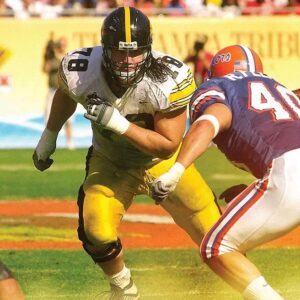
At the University of Iowa, Gallery became a cornerstone of the Hawkeyes’ offensive line. In 2003, he captured the Outland Trophy, awarded to the nation’s best interior lineman. His performance that season helped elevate Iowa’s reputation as one of the toughest teams in the Big Ten.
The following year, Gallery’s dominance made him one of the most coveted prospects in the NFL.
In the 2004 NFL Draft, the Oakland Raiders selected him with the No. 2 overall pick. It was a rare moment offensive linemen are seldom drafted that high and it confirmed what scouts already believed: Gallery was a generational talent.
Over the next eight seasons in the NFL, he played primarily with the Raiders before finishing his career with the Seattle Seahawks. But the physical punishment that came with playing offensive line would eventually leave a deeper mark than anyone realized.
The Physical Price of Playing Football
During his career, Gallery endured a long list of injuries.
He underwent multiple surgeries, including:
- A fibula fracture
- An emergency appendectomy
- Back surgery to fuse vertebrae and relieve pressure on his spinal canal
But those injuries weren’t the real danger.
The biggest threat came from something far less visible repeated head trauma.
Gallery later estimated he suffered hundreds, if not thousands, of concussive impacts during his football career.
“A concussion isn’t just getting knocked out,” Gallery explained in interviews. “It’s a blow to the head that causes symptoms in your brain.”
For years, like many football players, he didn’t recognize the damage that was accumulating.
By the time his career ended in 2012, the real consequences were only beginning.
The Robert Gallery Depression Battle After Football
The most difficult chapter of the Robert Gallery depression battle began after retirement.
At first, it looked like the ideal life.
Gallery had earned roughly $46 million in NFL contracts, lived comfortably with his wife Becca and their three children, and remained connected to the Iowa football community.
But inside, things were unraveling.
His symptoms were frightening:
- Severe depression
- Sudden rage episodes
- Memory problems
- Brain fog
- Anxiety
- Trouble speaking clearly
At times, even small everyday moments triggered intense anger.
Gallery later admitted he felt like he was losing control of his mind.
“I thought I was going crazy,” he said.
A brain scan finally revealed the truth.
Doctors found significant areas of brain damage likely caused by years of head trauma. Some specialists even warned he likely suffered from chronic traumatic encephalopathy (CTE), a degenerative brain condition linked to repeated concussions.
The diagnosis brought both fear and relief.
“For the first time,” he recalled, “I knew I wasn’t crazy.”
Rock Bottom and the Fight for Answers
Despite medical treatment, Gallery’s mental health continued to spiral.
Doctors recommended numerous therapies:
- Blood work and hormone treatments
- IV therapies
- Brain specialists
- Hyperbaric oxygen therapy
He even purchased a hyperbaric chamber to try to improve brain function.
Nothing worked.
Alcohol became a coping mechanism.
Gallery admitted he often drank heavily just to get through social situations. Behind the scenes, depression and anxiety were consuming him.
At one point, he feared he might not survive the downward spiral.
“If I did nothing,” he said, doctors warned he could become “a statistic.”
For a man who once thrived under the bright lights of college football stadiums, the isolation after retirement made the struggle even worse.
Many elite athletes experience a loss of identity once their playing careers end.
Gallery was no exception.
The Podcast That Changed Everything
The turning point came unexpectedly.
One day, while driving, Gallery listened to a military podcast featuring former Navy SEAL Marcus Capone.
Capone spoke about experiencing similar symptoms rage, depression, anxiety after combat.
But he also talked about something unusual that helped him recover: a psychedelic plant medicine called ibogaine.
The treatment was available in Mexico through a clinic that worked with military veterans suffering from trauma.
Gallery heard the story and immediately recognized himself in it.
He contacted the organization not expecting a reply.
But the next day, he got a call.
The Therapy That Helped Him Heal
In 2021, Gallery traveled to Mexico to undergo ibogaine therapy.
The experience wasn’t easy.
The treatment can last 24 to 48 hours and is physically and mentally intense. But when it ended, Gallery noticed something extraordinary.
The symptoms that had plagued him for years were suddenly gone.
“No anxiety. No rage. No suicidal thoughts,” he said afterward.
For the first time in years, he felt present with his family.
Moments that once triggered anger like his children spilling food at dinner no longer caused an emotional explosion.
Instead, he found himself laughing and playing with them.
The transformation was immediate.
Even his wife noticed the change.
Why Gallery Is Speaking Out Now
Gallery knows his story is unusual and controversial.
Ibogaine remains illegal in the United States and is still being studied as a potential treatment for conditions such as PTSD, traumatic brain injury, depression, and addiction.
But early research suggests it may help the brain create new neural pathways.
Gallery believes that’s exactly what happened to him.
Rather than keeping the experience private, he’s chosen to speak publicly in hopes of helping other athletes.
His message is simple: suffering in silence doesn’t have to be the norm.
Building a New Mission: Helping Athletes Heal
Today, Gallery is channeling his experience into advocacy.
He serves as co-founder and president of Athletes for Care, a nonprofit organization dedicated to improving health care and mental wellness for former athletes.
The organization focuses on four key areas:
- Community support for athletes
- Advocacy for improved health policies
- Research into new treatments
- Education about long-term sports injuries
While the group works with retired professional athletes, its message extends far beyond the NFL.

Student athletes, veterans, and everyday people facing mental health challenges are part of the conversation.
“We want to help people get resources before they get to where I was,” Gallery said.
A Hawkeye Legacy That Goes Beyond Football
Today, Gallery’s legacy at Iowa remains legendary.
In addition to winning the Outland Trophy, he has been inducted into:
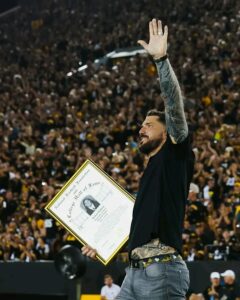
- The College Football Hall of Fame
- The University of Iowa Athletics Hall of Fame
His name is also honored on the Kinnick Stadium Wall of Honor, ensuring Hawkeye fans will never forget the dominance he displayed on the field.
But Gallery believes the most meaningful chapter of his life is happening now.
For years, he hid his struggles.
Now, he’s using his voice to make sure other athletes don’t feel they have to do the same.
“If sharing my story helps even one person realize they’re not alone,” he said, “it’s worth it.”