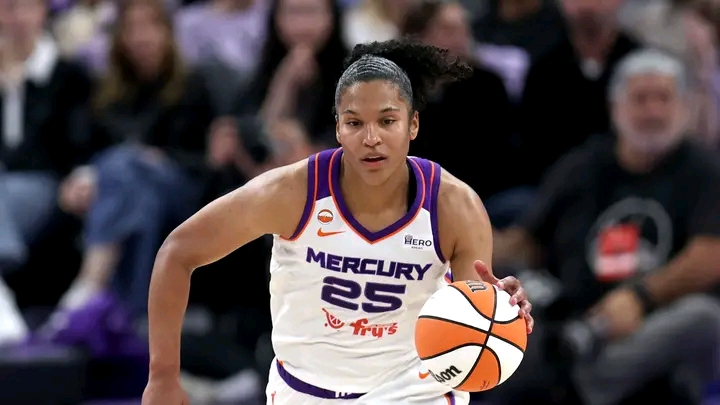
What started as a heated moment in a high-profile WNBA matchup has now exploded into something far more disturbing. Alyssa Thomas, one of the league’s most respected veterans and a six-time All-Star, says she has received death threats and racial abuse following the controversial incident involving Caitlin Clark during last week’s game between the Phoenix Mercury and the Indiana Fever.
Thomas spoke publicly on Tuesday at the Mercury’s practice facility in Phoenix, and her comments painted a troubling picture of the fallout. What she described went far beyond basketball criticism. According to Thomas, online harassment escalated rapidly after the league suspended her for one game over contact involving Clark’s throat during the June matchup.
“It’s unfortunate that it’s come to this over basketball,” Thomas said. “A lot of us — myself included — didn’t even know the play took place until after the game. Now we’re being painted as thugs. There’s death threats out on us. It’s really unacceptable.”
The controversy stems from a play that occurred with 6:52 remaining in the second quarter of the Mercury-Fever showdown. During the sequence, Thomas made contact with her fist near Clark’s throat area while battling for position. At the time, game officials did not call a foul, and play continued without interruption.
That changed after the game.
Following league review, the WNBA reclassified the contact as a Flagrant Foul 2, labeling it a non-basketball act. That decision resulted in a one-game suspension for Thomas, a punishment that immediately ignited debate across sports media and social platforms.
Thomas insists the contact was accidental.
She made it clear that the suspension itself isn’t what upset her most. Instead, she says the league’s handling of the situation and its silence regarding player safety off the court has become the bigger issue.
“It’s not even about the suspension,” Thomas explained. “If that’s what they felt was necessary in that moment, then so be it. But there are plenty of other plays you could say the same about.”
Then she revealed something even more alarming.
“The biggest thing is our safety,” Thomas said. “We’re so concerned about safety on the court, but time and time again people are threatening our lives. They’re leaking addresses. Posting crazy pictures that have nothing to do with basketball.”
That statement sent shockwaves through the WNBA community.

Harassment of athletes online is unfortunately nothing new, but Thomas says what she and others are experiencing has crossed a dangerous line. She drew a clear distinction between sports trolling and outright hate.
“There’s a difference between trolling and hatred,” she said. “People are sending racial slurs and all types of stuff. The hatred that we’re experiencing over a play that honestly was a complete accident—it’s just unfortunate.”
Her comments also turned attention toward WNBA leadership, specifically commissioner Cathy Engelbert.
Thomas criticized Engelbert for what she sees as a failure to publicly support players facing threats and harassment.
“We still have yet to hear anything from Cathy,” Thomas said. “It’s no surprise. You can see what’s being said on social media. It’s unfortunate, but as usual, she remains silent.”
That criticism adds another layer to an already explosive situation. For many players, the issue is no longer just about officiating or suspensions—it’s about whether the league is doing enough to protect athletes from real-world consequences tied to online abuse.
Another surprising detail emerged during Thomas’ press conference: she said she didn’t even know she had been suspended until just 10 minutes before the announcement hit social media.
That revelation raised fresh questions about league communication and disciplinary transparency.
The suspension was served Saturday when Phoenix traveled to face the Toronto Tempo. But even after serving her punishment, the conversation around the incident hasn’t cooled down.
Meanwhile, Indiana has continued emphasizing player safety.
The Fever released a statement Thursday renewing calls for stronger protection for players, especially in games involving heightened physical intensity. Tensions between these two teams had already been building before the Thomas-Clark incident.
Just two games earlier, the rivalry had become increasingly physical. Officials called six technical fouls in that contest and issued one ejection. Clark herself received her fifth technical foul of the season during that game.
Indiana attempted to have that technical rescinded, but the WNBA upheld the ruling.
Fever head coach Stephanie White did not hold back when discussing the officiating surrounding the Thomas play.
“It was egregious,” White said after the game. “The fact that it was a no-call … You’ve got to call it.”
She continued with visible frustration.
“You’re coming in here aware of what happened two nights ago and that still happens? Absolutely unacceptable.”
Those comments underscored the growing tension surrounding matchups between Phoenix and Indiana. What began as competitive basketball now carries emotional, physical, and increasingly personal consequences.
Clark’s presence has brought enormous attention to the WNBA, with television ratings, attendance, and media coverage reaching new heights. But with that visibility has also come intensified scrutiny, heated fandom, and increasingly toxic online behavior.
That reality is forcing the league into difficult conversations.
How should the WNBA protect star players from dangerous physical play? At the same time, how should it protect all players veterans and rookies alike from targeted harassment, racism, and threats once the final buzzer sounds?
Those questions remain unanswered.
For Thomas, the issue is painfully simple: basketball rivalries should never escalate into threats against players’ lives.
And with emotions still running high, all eyes are now on July 9.
That’s when the Mercury and Fever meet again in Phoenix for what is now one of the most anticipated games on the WNBA calendar. Given everything that has happened the suspension, the backlash, the public criticism of league leadership, and the growing rivalry the rematch carries massive stakes.
It won’t just be about wins and losses.
It will be about accountability, safety, and whether the league can regain control of a narrative that has spiraled far beyond the court.
One thing is certain: when Phoenix and Indiana face off again, the basketball world will be watching closely.