

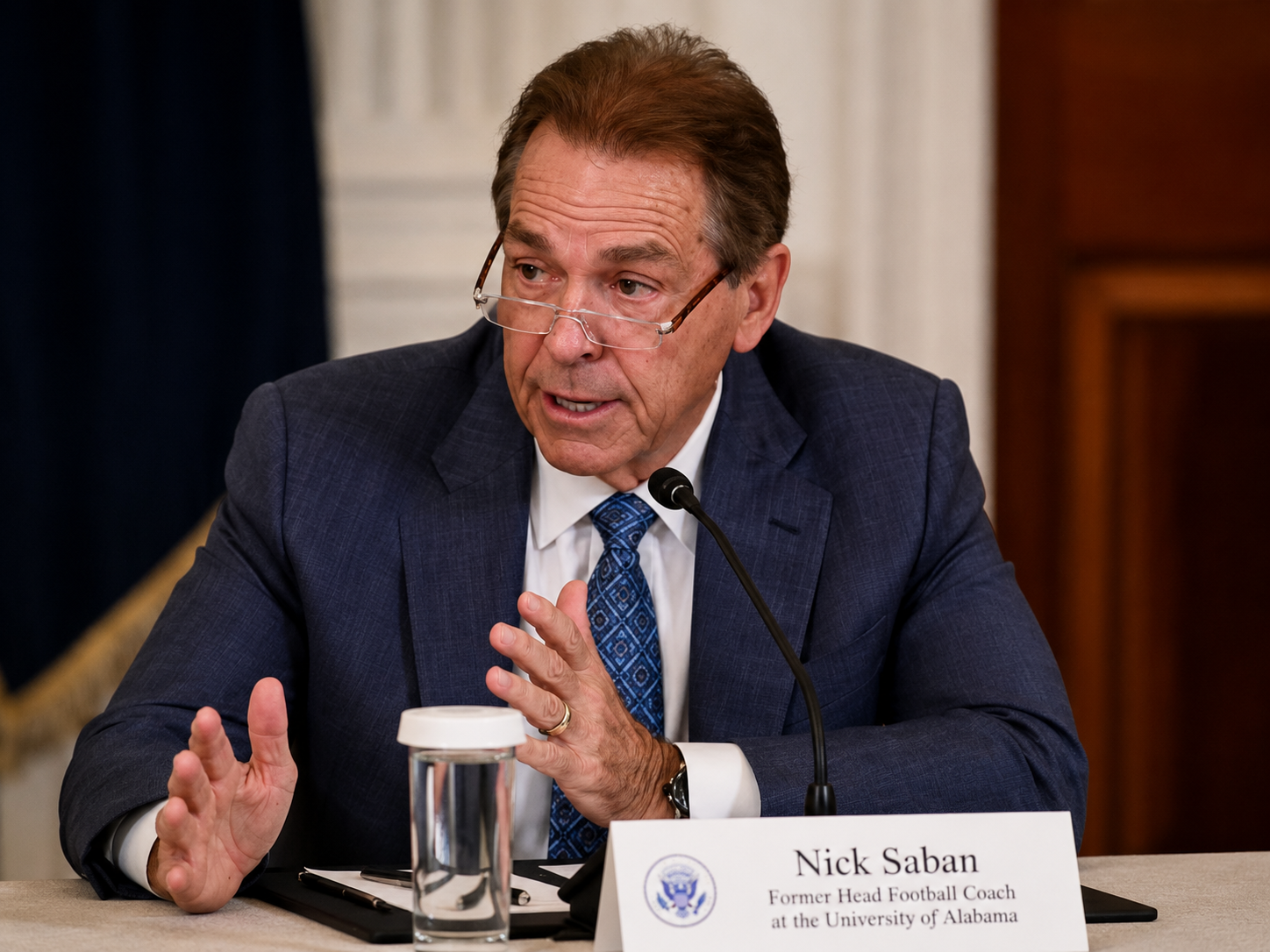
Nick Saban has spent decades building championship teams and shaping the future of college football. Now, the seven-time national championship-winning coach is taking on a different challenge trying to save college athletics from what he believes is a rapidly growing crisis.
In a rare appearance on Capitol Hill Wednesday morning, the former Alabama head coach delivered a powerful message to members of the United States Senate, urging Congress to step in and establish national rules for college sports before the current system spirals further out of control.
Speaking during a hearing held by the Senate Commerce, Science and Transportation Committee, Saban didn’t mince words. Standing before lawmakers in a packed hearing room, he argued that the Name, Image and Likeness (NIL) era and the transfer portal have created a landscape that is becoming increasingly difficult to regulate.
“Congress does not need to micromanage college athletics,” Saban told senators. “Congress does need to fix the mess in the courts and create a national framework so the people inside college sports can enforce fair rules.”
His comments immediately drew attention across the college sports world, as Saban outlined what he sees as one of the biggest threats to the future of collegiate athletics.
The Hall of Fame coach warned that without federal legislation, every attempt to create rules will continue to be challenged in court. According to Saban, that uncertainty is pushing college athletics closer to becoming a professional sports model rather than an educational-based system designed to develop student-athletes.
“Without that legal certainty, every rule becomes another lawsuit, every standard becomes another risk, and the system keeps drifting toward a professional model,” Saban added.
The hearing focused heavily on the proposed Protect College Sports Act, legislation that has emerged after months of negotiations between Senator Ted Cruz of Texas and Senator Maria Cantwell of Washington.
The bill is designed to provide the NCAA with an antitrust exemption that would allow the organization to enforce several rules that have faced legal challenges in recent years.
Among the most notable provisions included in the proposed legislation are restrictions on athlete transfers, eligibility limits and protections against in-season coaching poaching.
If passed, the bill would allow the NCAA to enforce a rule limiting athletes to one penalty-free transfer during their college careers. It would also establish a maximum of five years of eligibility for student-athletes.
Another key provision would prevent former professional athletes from competing in college sports. Additionally, schools would be prohibited from hiring coaches away from another institution while that coach’s sport is still in season.
Senator Cruz referred to the coaching restriction as the “Lane Kiffin rule,” a reference to LSU’s hiring of Kiffin away from Ole Miss during the football season in November.
While Saban was the headline figure at the hearing, he wasn’t alone in sounding the alarm.
Several influential leaders from across college athletics joined him in support of the legislation, including Notre Dame athletic director Pete Bevacqua, Pac-12 Commissioner Teresa Gould, former West Virginia University president Gordon Gee and Utah defensive end Lance Holtzclaw.
Holtzclaw provided lawmakers with a player’s perspective, discussing the realities of the transfer portal, agent involvement and the constant movement that now defines many college athletic programs.
The administrators and conference leaders focused on a different concern the long-term survival of college sports beyond football and basketball.
One of the strongest warnings came from Gould, who pointed to data suggesting that many schools could be forced to eliminate non-revenue sports if a stable framework isn’t established soon.
“We’ve seen the data,” Gould said. “The threats are real.”
That statement underscored one of the central themes of the hearing. While NIL opportunities have provided athletes with unprecedented earning potential, many athletic departments are struggling to adapt financially.
The concern among college leaders is that rising costs, legal uncertainty and constant roster movement could force schools to make difficult decisions about which sports they can continue to sponsor.
Olympic sports, which often rely on revenue generated by football and basketball programs, are viewed as particularly vulnerable.
Saban acknowledged that the proposed legislation is not perfect and likely will require revisions moving forward. However, he emphasized that doing nothing is no longer an acceptable option.
“I think it should be nonpartisan,” Saban said. “It’s that important in terms of college athletics, in terms of the future for young people.”
The former Alabama coach argued that the bill serves a much larger purpose than simply helping athletic departments maintain order.
According to Saban, the legislation would help protect student-athletes by creating clear and enforceable standards that apply nationwide rather than allowing a patchwork of state laws and court decisions to dictate the future of college sports.
“It protects athletes, it protects opportunity, it protects competitive balance,” Saban explained.
He also stressed that the bill could help preserve sports programs that don’t generate significant revenue but still provide valuable opportunities for thousands of student-athletes across the country.
Perhaps most importantly, Saban believes a federal framework would restore stability to a system that many coaches, administrators and athletes feel has become increasingly unpredictable.
“It gives college athletes a chance to move forward with rules that are clear, national and enforceable,” Saban said.
As college athletics continues to evolve at a historic pace, Wednesday’s hearing may prove to be a significant turning point. The growing influence of NIL deals, transfer portal activity and legal battles has transformed the landscape faster than many anticipated.
Whether Congress ultimately passes the Protect College Sports Act remains uncertain. What is clear, however, is that some of the most influential voices in college athletics believe the future of the industry hangs in the balance.
And when Nick Saban, one of the most successful coaches in college football history, travels to Washington to urge lawmakers to act, the sports world tends to pay attention.
