

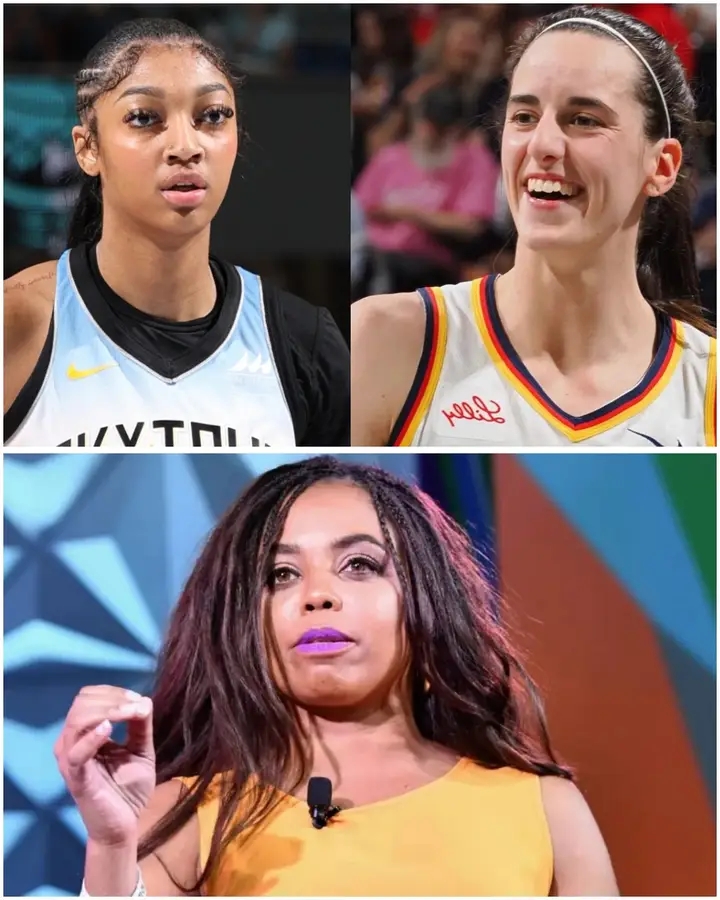
SHOCKWAVES ACROSS THE WNBA: Jemele Hill Calls Angel Reese the “Michael Jordan” of Women’s Basketball And Sparks Explosive Caitlin Clark Debate
The rivalry between and has already transformed women’s basketball into one of the hottest stories in sports. But now, veteran sports journalist has thrown gasoline on the fire with a statement that instantly ignited social media and divided basketball fans everywhere.
During a recent podcast appearance, Hill boldly referred to Reese as the “Michael Jordan of the WNBA” and went even further by suggesting the Chicago Sky star is already better than Clark.
Within minutes, the basketball world exploded.
Fans flooded social media platforms with reactions ranging from passionate support to outright disbelief. Some praised Hill for highlighting Reese’s impact on the game and her unapologetic confidence. Others accused her of pushing a narrative that had little to do with basketball and everything to do with race and public perception.
And just like that, one of sports’ most intense modern rivalries reached another level.
A Rivalry That Changed Women’s Basketball Forever
The roots of this debate stretch back to the unforgettable 2023 NCAA women’s national championship game between LSU and Iowa a matchup that became one of the most watched moments in women’s basketball history.
Clark entered the game as America’s basketball sweetheart. The Iowa superstar was torching defenses with logo threes, flashy assists, and an offensive skillset many analysts compared to NBA-level creativity. She averaged 27.8 points and 8.6 assists that season while leading Iowa to the title game almost single-handedly.
On the other side stood Reese dominant, physical, emotional, and fearless.
The LSU star averaged 23 points and 15.4 rebounds during her historic championship season. She controlled the paint, bullied opponents on the glass, and carried herself with the swagger of a player who knew exactly how good she was.
When LSU defeated Iowa 102-85 to win the national championship, Reese celebrated with the now-famous “you can’t see me” gesture directed toward Clark late in the game.
That moment became bigger than basketball.
Critics immediately labeled Reese “classless” and “unsportsmanlike,” while Clark’s emotional reactions during previous games had largely been celebrated as competitive fire and passion. The contrast in public reaction sparked a national conversation about race, gender, and double standards in sports coverage.
Three years later, people are still arguing about it.
Jemele Hill’s Comments Reignite the Firestorm
Hill’s recent comments reopened every old wound surrounding the Reese-Clark debate.
Calling Reese the “Michael Jordan of the WNBA” wasn’t just praise it was a statement guaranteed to provoke reaction because of what Michael Jordan represents in sports history. Jordan isn’t merely considered great; he’s viewed by many as the greatest basketball player ever.
So when Hill attached that label to Reese, fans immediately began comparing résumés, stats, influence, and overall talent.
And that’s where things became explosive.
Clark supporters pointed to her record-breaking rookie season, her elite shooting range, and the unprecedented television ratings she brought to the WNBA. Reese supporters fired back by highlighting her rebounding dominance, defensive intensity, and emotional edge that has helped redefine the league’s culture.
The debate quickly moved beyond basketball.
Some fans accused Hill of racial bias. Others argued the backlash itself proved her point about how differently Reese and Clark are perceived.
It became less about who scores more points and more about what each athlete represents in today’s sports landscape.

Caitlin Clark’s Meteoric Rise Changed the League
There’s no denying Clark’s impact on women’s basketball has been historic.
Since entering the WNBA, Clark has helped drive television ratings to levels the league had never previously experienced. Arenas have sold out wherever she plays. Road teams have moved games into larger venues simply because Clark was coming to town.
Her rookie numbers backed up the hype too.
Clark averaged over 19 points and 8 assists during her debut WNBA campaign while routinely hitting shots from distances rarely seen in the women’s game. Her deep shooting range and elite passing ability turned ordinary possessions into viral highlights.
More importantly, she attracted millions of casual fans who previously paid little attention to women’s basketball.
That level of visibility naturally made her the face of the league in many people’s eyes.
But Reese’s supporters believe the conversation around Clark often overshadows other stars who have also elevated the sport.
Angel Reese Built Her Reputation Differently
Unlike Clark’s perimeter brilliance, Reese built her identity through toughness.
Every rebound feels personal. Every defensive stop carries emotion. Every celebration comes with energy that electrifies teammates and frustrates opponents.
She doesn’t try to be polished or universally liked and that’s exactly why many fans love her.
Reese quickly became one of the WNBA’s most marketable personalities because she embraced being unapologetically herself. Whether celebrating after a big play or speaking confidently in interviews, she refused to shrink her personality to make others comfortable.
And statistically, her impact has been undeniable.
Reese became one of the league’s top rebounders almost immediately, recording double-doubles at a historic pace while anchoring the interior defense for Chicago. Her physical style brought a level of intensity that old-school basketball fans appreciated.
To supporters, Reese represents authenticity, resilience, and emotional competitiveness.
To critics, she can sometimes appear confrontational or overly theatrical.
That divide is exactly why every conversation involving Reese becomes massive news.
The Double Standard Debate Isn’t Going Away
One reason Hill’s comments generated such enormous reaction is because the Reese-Clark rivalry has never existed in a vacuum.
For many observers, it reflects broader cultural conversations happening across American sports and society.
When Clark trash-talks opponents or celebrates after hitting deep threes, commentators often describe her as fiery, confident, and competitive.
When Reese does similar things, critics frequently use words like emotional, arrogant, or provocative.
That difference in language has repeatedly been called out by current and former players throughout the basketball world.
Even Clark herself addressed the topic in previous interviews, saying Reese should never receive hate for competing passionately.
Meanwhile, Reese has openly discussed how criticism sometimes feels personal rather than basketball-related.
That tension continues to fuel every headline involving either player.
Social Media Turns Every Matchup Into a War
The modern sports world thrives on rivalry, and Reese versus Clark has become social media gold.
Every matchup trends online.
Every hard foul becomes a debate show topic.
Every stare-down gets replayed from 15 different angles.
Fans dissect body language, officiating, postgame interviews, and even pregame outfits with the intensity usually reserved for NBA Finals matchups.
Networks understand the value too.
Games featuring Reese and Clark consistently generate some of the WNBA’s biggest television audiences. Their rivalry has become appointment viewing not just for diehard basketball fans, but for casual viewers who want to witness the drama surrounding two of the sport’s brightest stars.
In many ways, the WNBA has entered a new era because of them.
Maybe the League Doesn’t Need “One Face”
What makes this entire debate fascinating is that it may actually miss the bigger picture.
The WNBA doesn’t necessarily need one singular superstar.
Clark brings generational shooting and playmaking.
Reese brings toughness, charisma, rebounding dominance, and emotional intensity.
Together, they attract different audiences while pushing the league to unprecedented popularity.
That diversity is part of what makes today’s women’s basketball so compelling.
Some fans connect with Clark’s precision and offensive brilliance. Others identify with Reese’s passion and swagger. Neither approach is wrong.
And perhaps that’s the real story hidden beneath all the outrage.
A New Golden Era Is Here
Whether fans agree with Jemele Hill or completely reject her comments, one thing is undeniable: people are paying attention to women’s basketball like never before.
The WNBA is experiencing soaring ratings, sold-out arenas, increased sponsorships, and nonstop national conversation. Reese and Clark have become central figures in that transformation.
Their rivalry has transcended sports headlines and entered mainstream culture.
And while debates over who is “better” will continue all season long, the league itself may be the biggest winner of all.
Because every argument, every viral moment, every heated television segment keeps the spotlight firmly on women’s basketball.
That spotlight isn’t fading anytime soon.
