NO DEPTH CHART, NO PROBLEM? Inside Iowa Football’s Quiet Shake-Up That Has Everyone Guessing
For a program built on structure, predictability, and old-school discipline, something unusual is happening in Iowa City and it’s turning heads across college football.
For the first time in years, the Iowa Hawkeyes have gone completely silent on one of their most routine traditions: the release of a depth chart.
No January update.
No spring practice version.
And—perhaps most surprising of all none expected heading into the summer.
That’s not just a minor procedural tweak. Under head coach Kirk Ferentz, consistency has been the backbone of Iowa football. Depth charts have long served as a window into the program’s identity who’s rising, who’s falling, and who’s ready to take the next step. Now, that window is firmly shut.
The Last Glimpse: December 2025
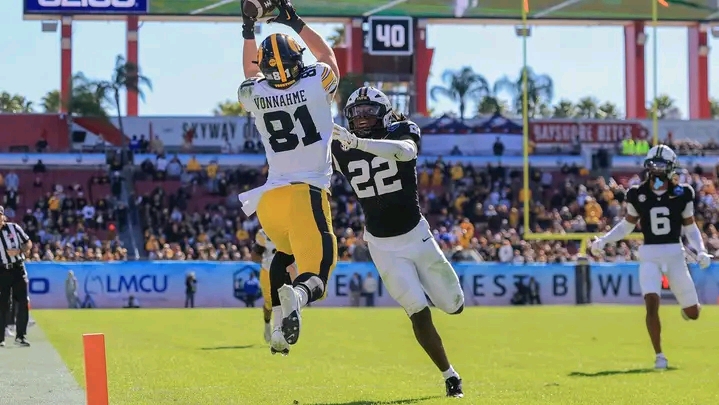
To understand just how unusual this is, you have to rewind to Dec. 23, 2025 the last time Iowa released an official depth chart. That version came just before the ReliaQuest Bowl matchup against Vanderbilt.
But here’s the catch: that depth chart is already outdated in a major way.
Thirteen players listed on it are now preparing for NFL opportunities. Add in two players who transferred out of the program, and suddenly, a significant portion of that lineup is gone.
That’s not just turnover that’s a roster reset.
A New Era Without a Roadmap
What makes this situation even more intriguing is that fans, analysts, and even media insiders are now left to piece things together without official guidance.
Usually, spring football provides clarity. Position battles become visible. Rising stars emerge. Coaches hint directly or indirectly at how the roster is shaping up.
But this year? Silence.
And that silence is fueling speculation.
Is this a strategic move by Ferentz to keep competition open longer?
Is it a response to the modern transfer portal era?
Or is it simply a shift in how the program wants to communicate internally and externally?
Whatever the reason, one thing is clear: Iowa’s depth chart has become one of the biggest mysteries of the offseason.
The Impact of NFL Departures
Losing 13 players to the NFL isn’t just a Stat it’s a seismic shift.
That kind of turnover forces immediate changes across multiple position groups. Veterans who once anchored the team are gone, leaving behind opportunities and pressure for the next wave of players.
Positions that were once locked in are now wide open.
For younger players, this is the moment they’ve been waiting for. For coaches, it’s a balancing act between experience and potential. And for fans? It’s both exciting and nerve-wracking.
Because without a depth chart, there’s no official way to measure who’s truly leading the race.
Transfers Add Another Layer of Uncertainty
On top of the NFL departures, two players from that December depth chart have exited via the transfer portal.
In today’s college football landscape, that’s not unusual but it does complicate roster evaluation.
The transfer portal has turned roster building into a year-round process. Players can leave, arrive, or shift roles at any time. And without a depth chart, tracking those changes becomes even harder.
It’s like trying to solve a puzzle without seeing the full picture.

Reading Between the Lines
Even without an official depth chart, there are still clues if you know where to look.
Practice reports, coach interviews, and player availability all offer subtle hints. Who’s taking first-team reps? Who’s getting praised by the coaching staff? Who’s consistently showing up in key situations?
These details matter more than ever now.
In fact, some insiders argue that this approach might actually provide a more authentic view of the team. Without a formal chart locking players into roles, competition stays fluid. Players have to earn their spot every single day.
And that can elevate performance across the board.
Why Ferentz Might Be Doing This
Kirk Ferentz isn’t known for making impulsive decisions. If he’s deviating from tradition, there’s likely a reason behind it.
One possibility? Accountability.
Without a published depth chart, no one can get comfortable. There are no guaranteed starters, no fixed hierarchies. Every position remains up for grabs.
Another possibility is strategy. In an era where opponents analyze every detail, keeping the depth chart private could provide a competitive edge. Less information means fewer clues for rival teams.
It could also reflect the evolving nature of college football. With constant roster movement, a static depth chart might simply no longer reflect reality.
What This Means for the 2026 Season
Heading into the 2026 season, Iowa finds itself in a fascinating position.
There’s talent on the roster no question about that. But there’s also uncertainty. And sometimes, that combination can be dangerous… in a good way.
Teams with something to prove often play with an edge. Players fighting for roles tend to push harder. And when competition is fierce, the overall quality of the team can rise.
Still, questions remain.
Who will step up as leaders?
Which positions will stabilize first?
And how long can the program maintain this level of secrecy?
Fans Left Guessing but Still Watching
For Iowa fans, this offseason feels different.
There’s less concrete information, fewer official updates but somehow, more intrigue.
Every practice report becomes must-read material. Every coach’s comment gets dissected. Every hint, no matter how small, carries weight.
It’s a different kind of engagement one driven by curiosity rather than certainty.
And in a way, that might be exactly what keeps the excitement alive.
The Bigger Picture
Zoom out, and this situation reflects a broader shift in college football.
Programs are adapting. Traditions are evolving. And the way teams manage information is changing.
Iowa, a program known for its steady, methodical approach, is now at the center of that evolution.
No depth chart. No clear roadmap. Just competition, uncertainty, and opportunity.
And maybe that’s the point.
Final Thoughts
The absence of a depth chart might seem like a small detail, but in a program like Iowa’s, it speaks volumes.
It signals change.
It invites speculation.
And it raises the stakes for everyone involved.
As the 2026 season approaches, one thing is certain: the Hawkeyes won’t be defined by a piece of paper listing starters and backups.
Instead, they’ll be defined by what happens on the field where roles are earned, not assigned.
And until that first kickoff?
Everyone’s still guessing.