

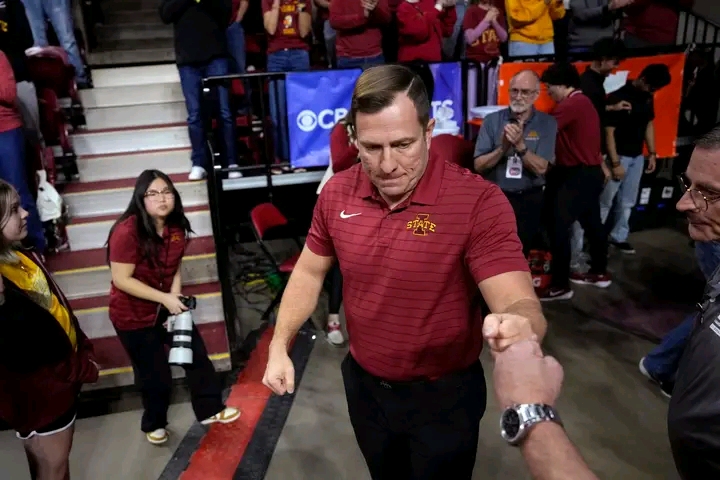
There’s a number tied to T. J. Otzelberger that’s suddenly turning heads across college basketball and it’s not just the $60 million headline figure. Beneath the surface of his long-term deal lies a detail that could shape the future of Iowa State Cyclones for years: a buyout clause that feels both modest and massive, depending on how you look at it.
According to the latest update, Otzelberger’s buyout currently sits at $4 million. That’s the amount another program would need to pay to lure him away from Ames. In today’s coaching market where elite names routinely command eight-figure commitments that figure stands out as relatively accessible, especially for power-conference programs looking to make a splash hire.
But flip the scenario, and the financial picture changes dramatically. If Iowa State were to make the hard-to-imagine decision to fire Otzelberger, the university would be on the hook for the remaining balance of his $60 million contract. That’s not just a routine payout it’s a long-term financial commitment that could stretch across years, depending on when such a move would hypothetically occur.
This dual-structure deal creates a fascinating dynamic. On one hand, Otzelberger is somewhat “gettable” for other schools willing to pay $4 million. On the other, Iowa State has essentially tied itself to its head coach with a golden handcuff scenario one that makes a mid-contract split extremely costly.
That contrast is what’s grabbing attention. It’s rare to see such a wide gap between a coach’s external buyout and the internal financial penalty for dismissal. In practical terms, it signals just how strongly Iowa State believes in Otzelberger’s leadership and long-term vision for the program.
Since taking over, Otzelberger has steadily elevated the Cyclones’ profile. His teams have been defined by defensive intensity, disciplined play, and a clear identity traits that don’t always show up in box scores but consistently translate into wins. While exact season-by-season numbers vary, the upward trajectory under his leadership has been undeniable, with postseason appearances and marquee wins reinforcing his reputation.
That success likely played a major role in the structure of this contract. Programs don’t commit $60 million without conviction. And they certainly don’t agree to potentially pay out the remainder of that deal unless they’re confident the coach can sustain success over the long haul.
Still, the $4 million buyout introduces an element of intrigue. In a coaching carousel that never truly stops spinning, opportunities can emerge quickly. If a high-profile program comes calling, that relatively manageable buyout could make Otzelberger one of the more attractive and attainable targets on the market.
Of course, money isn’t the only factor in these decisions. Fit, culture, recruiting pipelines, and long-term stability all play critical roles. Otzelberger has deep ties to Iowa State, and those relationships often matter as much as any contract clause. Walking away isn’t just about writing a check it’s about leaving behind a program he’s helped build.
From Iowa State’s perspective, the structure sends a clear message: they’re all-in. By agreeing to such a significant financial obligation in the event of a firing, the university is signaling patience and belief. It’s a commitment not just to a coach, but to continuity something many programs struggle to maintain in today’s win-now environment.
At the same time, it’s a calculated risk. College athletics can be unpredictable. Injuries, recruiting swings, conference realignment, and shifting expectations can all impact a program’s trajectory. Locking into a long-term deal always carries some degree of uncertainty.
Yet for now, there’s little indication that Iowa State regrets the decision. If anything, this contract structure reflects confidence rooted in results. Otzelberger hasn’t just kept the program competitive he’s made it relevant on a national stage.
And that’s where the real story lies. This isn’t just about numbers on a contract. It’s about how those numbers reflect belief, strategy, and ambition. The $4 million buyout might catch the eye, but the underlying message is bigger: Iowa State is betting heavily on stability in an era defined by constant change.
For fans, it’s a reassuring sign. Programs that commit to their leaders often reap the benefits of consistency stronger recruiting classes, clearer identity, and sustained success. But it also raises the stakes. With such a significant financial commitment, expectations naturally follow.
Every season, every game, every decision carries added weight when that kind of money is involved. That’s the reality of modern college basketball, where contracts are as much about optics and messaging as they are about compensation.
So while the idea of Iowa State firing Otzelberger remains firmly in the realm of “hard to imagine,” the clause is still there, quietly shaping the program’s future. It’s a reminder that in college sports, the biggest stories often aren’t just about what happens on the court they’re about the decisions made behind closed doors.
And in this case, those decisions have created one of the more intriguing contract situations in the game today.
