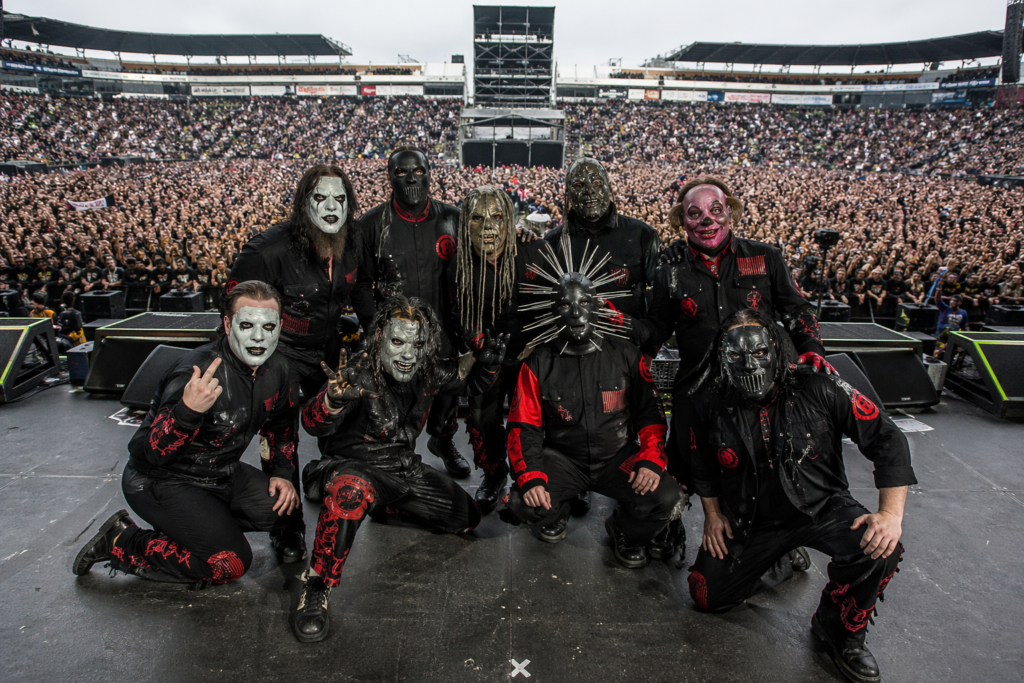
Chaos Reigns: Slipknot’s Explosive World Tour Sends Shockwaves Across Five Continents
The masked titans of metal, Slipknot, have once again proven why they remain one of the most formidable forces in modern music. Their latest world tour, a sprawling, high-octane spectacle that has ripped through five continents, is not just a series of concerts—it’s a cultural event redefining the boundaries of live performance.
From the moment the opening sirens blare and the band storms the stage in their signature industrial masks, audiences are plunged into a visceral experience that blends music, theater, and raw chaos. The tour, which kicked off earlier this year, has already sold out arenas across North America, Europe, Asia, South America, and Australia, drawing millions of fans into Slipknot’s dark, immersive universe.
What sets this tour apart is not just its scale, but its intensity. Known for their aggressive sound and confrontational stage presence, Slipknot has elevated their live show into something almost cinematic. Massive LED walls, pyrotechnic eruptions, and synchronized lighting transform each venue into a dystopian arena, where every beat feels like a seismic удар and every lyric resonates like a battle cry.
Frontman Corey Taylor has been at the center of it all, delivering performances that are both ferocious and emotionally charged. His ability to switch from guttural screams to haunting melodies continues to captivate audiences, many of whom describe the experience as both cathartic and overwhelming. Taylor has also used moments between songs to address fans directly, speaking about mental health, resilience, and the unifying power of music.
Behind him, the band operates like a well-oiled machine of chaos. Percussionists Shawn Crahan and Michael Pfaff create a thunderous backbone, often using unconventional instruments that add to the band’s signature industrial sound. Guitarists Jim Root and Mick Thomson unleash relentless riffs, while Sid Wilson’s turntable work injects an eerie, unpredictable edge into the performance.
The setlist itself is a carefully curated blend of classic hits and newer material. Fan favorites like “Duality,” “Psychosocial,” and “Wait and Bleed” ignite immediate crowd reactions, with thousands of voices shouting every word in unison. Meanwhile, tracks from their latest album showcase the band’s evolution, incorporating more experimental elements without losing their core identity.
One of the most striking aspects of the tour is its global reach. In cities like Tokyo, São Paulo, Berlin, and Sydney, the response has been nothing short of explosive. Fans from vastly different cultures come together under the banner of Slipknot’s music, forming a temporary but powerful community bound by shared intensity. In many locations, tickets sold out within minutes, prompting additional dates to meet overwhelming demand.
Industry analysts have noted that the tour’s success reflects a broader resurgence of live music following years of disruption. However, Slipknot’s dominance suggests something deeper—a hunger for authenticity and raw energy that few artists can deliver at this level. Their refusal to conform to mainstream trends has only strengthened their appeal, particularly among younger audiences discovering the band for the first time.
Security and logistics for the tour have also been a massive undertaking. Transporting elaborate stage setups across continents requires precision planning, with dozens of crew members working behind the scenes to ensure each show runs seamlessly. Despite the complexity, reports indicate that the tour has maintained a remarkably high level of consistency, with each performance delivering the same explosive impact.
Critics have been largely unanimous in their praise. Many have described the tour as one of the most ambitious in recent memory, highlighting its ability to merge spectacle with substance. Unlike some large-scale productions that rely heavily on visuals, Slipknot’s shows remain grounded in musical power and emotional connection.
As the tour continues to roll across the globe, its influence is already being felt throughout the music industry. Emerging bands cite Slipknot as a benchmark for live performance, while established acts are rethinking how to engage audiences on a deeper level. The tour has also sparked renewed interest in heavy metal as a genre, drawing attention from listeners who might not typically gravitate toward it.
For fans, however, the experience is far more personal. It’s about losing oneself in the music, releasing pent-up эмоции, and feeling part of something larger than life. In a world that often feels fragmented, Slipknot offers a rare sense of unity—albeit wrapped in distortion, fire, and controlled chaos.
With several months still remaining, the tour shows no signs of slowing down. If anything, the momentum continues to build, with each performance adding another chapter to what is shaping up to be one of the most iconic tours in modern music history.
In true Slipknot fashion, the message is clear: chaos isn’t just inevitable—it’s unstoppable.