

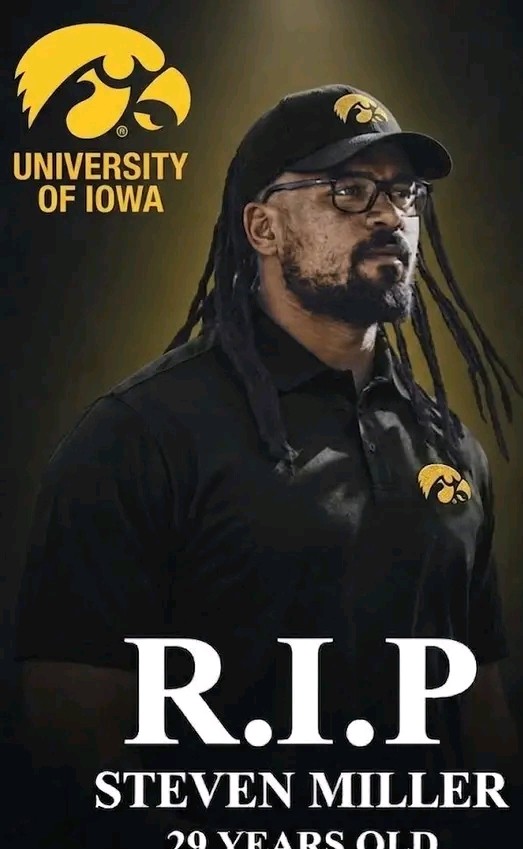
The community has been left stunned by a sudden and deeply personal loss one that has shaken players, coaches, and fans far beyond the field.
, a 29-year-old assistant strength and conditioning coach and former offensive tackle, has died unexpectedly following a medical emergency that initially appeared to be under control. His passing came just days after he briefly returned to the sidelines, offering what many believed was a hopeful sign of recovery.
The program confirmed the devastating news shortly after, canceling practice and giving players and staff time to process the loss. In a short but emotional statement, the team said: “The Iowa Hawkeyes football family mourns the passing of Steven Miller. We extend our thoughts to those who knew and loved him.” Those words, while simple, reflected the heavy silence surrounding a program now grappling with grief.
Miller’s death comes after he suffered a medical emergency following a practice session the previous week. At first, there was cautious optimism. He had been seen back with the team earlier in the week present, engaged, and supporting players as usual. That brief return made the news of his passing even harder to comprehend.
For those inside the program, this wasn’t just the loss of a staff member. It was the loss of someone woven into the daily rhythm of the team someone who showed up early, stayed late, and poured energy into every athlete he worked with.
Miller’s journey in football began long before his coaching career. As a former offensive lineman, he understood the grind of the sport at its most demanding level. Offensive line play requires discipline, endurance, and a willingness to do the unseen work qualities that defined his playing days and later shaped his coaching philosophy.
Teammates from his playing career often described him as steady and dependable. He wasn’t the loudest voice in the room, but when he spoke, people listened. His leadership came through action consistent effort, resilience, and a commitment to the team above all else.
After hanging up his cleats, Miller found his calling in strength and conditioning a role that rarely gets headlines but sits at the core of every successful football program. At Iowa, he became a key figure behind the scenes, helping athletes build not just physical strength, but mental toughness.
Players didn’t just see him as a coach. They saw him as a mentor someone who pushed them hard but always made sure they knew why. His sessions weren’t just about lifting heavier or running faster; they were about discipline, accountability, and belief.
One player described his approach simply: “Coach Miller didn’t let you quit on yourself. Even when you thought you were done, he knew you had more.” That mindset became part of the culture he helped build.
His impact was visible every Saturday, even if his name wasn’t announced over the stadium speakers. Stronger linemen holding the pocket longer. Faster defenders closing gaps. Players finishing games with the same intensity they started. Those details often trace back to the weight room and to coaches like Miller.
But beyond performance, it was his personality that left the deepest impression.
Colleagues recall a coach who brought energy into every space he entered. Early morning workouts? He was already there, setting the tone. Late-night film sessions? Still engaged, still encouraging. His consistency made him someone players could rely on not just in training, but in life.
That’s why his loss cuts so deeply.
College football programs are tight-knit environments. Players spend more time with coaches and teammates than they do with their own families. Bonds form quickly, and they run deep. Losing someone within that circle creates a ripple effect one that touches everyone from freshmen just starting out to veteran coaches who have seen decades of the game.
For Iowa’s players, many of whom are still in their late teens or early twenties, this tragedy is a harsh reminder of life’s unpredictability. It’s the kind of moment that forces perspective one that extends far beyond wins and losses.
Coaches now face the difficult task of guiding their players through grief while managing their own. Practices will resume eventually. Games will be played. But for now, the focus is on supporting one another.
Moments like this test a team’s identity. And if there’s one thing the Hawkeyes have long emphasized, it’s the idea of family.
That identity is now being lived out in real time in conversations behind closed doors, in shared memories, and in the quiet moments where teammates check in on one another.
Tributes are already beginning to take shape. There will likely be moments of silence before games, decals on helmets, and public acknowledgments in the weeks ahead. But the most meaningful tribute may not be something visible.
It may be how the team carries forward what Miller stood for.
His coaching wasn’t just about building stronger athletes it was about building stronger people. He emphasized resilience in the face of adversity, unity in the face of challenges, and determination no matter the circumstances.
Those lessons don’t disappear with his passing. They stay with every player he coached.
In that sense, his legacy is already secured.
Every time an Iowa player pushes through the final rep in a workout… every time they refuse to give up in the fourth quarter… every time they support a teammate going through a tough moment a part of Miller’s influence lives on.
And that’s what makes this loss both painful and powerful.
Painful because a young life, full of promise and purpose, has been cut short at just 29. Powerful because of the impact he managed to make in that time an impact that continues even now.
Strength and conditioning coaches rarely get the spotlight. They don’t call plays. They don’t stand in front of cameras after games. But within a program, they are foundational figures shaping the physical and mental core of the team.
Miller embodied that role completely.
He wasn’t chasing recognition. He was focused on the work on helping others become better versions of themselves.
And in doing so, he became far more than a coach.
He became a trusted voice. A motivator. A steady presence.
A friend.
As the community continues to mourn, there’s a shared understanding that while Miller is gone, what he built remains.
Not in statistics. Not in records.
But in people.
And every time the Hawkeyes take the field moving forward, they won’t just be playing for wins.
They’ll be carrying forward the legacy of someone who helped shape who they are both as athletes and as individuals.
