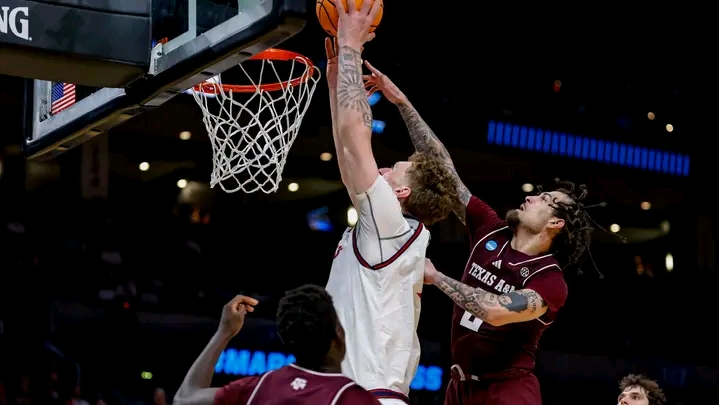
🚨 Iowa Lands a Giant: Andrew McKeever’s Arrival Signals a Frontcourt Transformation
There’s no subtle way to put it Iowa just got bigger. Much bigger.
At 7-foot-3 and 285 pounds, Andrew McKeever doesn’t just walk into a gym; he changes the geometry of it. And after a season where size or the lack of it proved costly, Iowa’s decision to bring in the towering big man could end up being one of the most important moves of the offseason.
But this isn’t just about height. It’s about timing, development, and a player who quietly turned himself into one of the most productive rebounders in college basketball.
From Limited Role to Breakout Production
McKeever’s journey hasn’t been one of instant stardom. In fact, his early college career barely hinted at what was coming.
As a redshirt freshman, his role was minimal just about six minutes per game across 20 appearances. He was raw, adjusting, and largely a background piece. The kind of player fans barely notice unless they’re looking closely.
Fast forward one season, and everything changed.
As a redshirt sophomore, McKeever didn’t just earn more playing time he demanded it. He appeared in 33 games, starting 10 of them, and his impact began to show up across the stat sheet.
His numbers tell part of the story:
– 8.2 points per game
– 9.2 rebounds per game
– 1.8 assists per game
– ~23 minutes per game
But numbers alone don’t capture the leap.
There was the dominant performance against San Francisco 10 points, 18 rebounds, six assists, two steals, and one block a stat line that reads more like a video game than a box score. That game wasn’t just a highlight; it was a statement. McKeever had arrived.
A Rebounding Machine
If there’s one thing McKeever does at an elite level, it’s rebound.
And not just casually relentlessly.
He recorded 12 games with at least 10 rebounds, showing consistency that coaches dream about. Even more impressive? His rebounding rate when adjusted for playing time.
– 15.7 rebounds per 40 minutes
That’s not just good that’s dominant.
On the offensive end, he averaged 3.8 offensive rebounds per game, turning missed shots into second chances. And for a team that struggled at times to generate efficient offense, that kind of presence is invaluable.
Second-chance points don’t just boost the scoreboard they wear opponents down. They shift momentum. They win games.
Fixing Iowa’s Biggest Weakness
Last season, Iowa’s biggest issue wasn’t effort or execution it was size.
The Hawkeyes often found themselves battling bigger frontcourts, giving up rebounds, struggling to protect the rim, and lacking a true interior anchor. It became clear as the season unfolded that something had to change.
Enter McKeever.
His presence alone alters matchups. At 7-foot-3, he immediately becomes one of the tallest players on the court every night. Add in his rebounding instincts and improving skill set, and suddenly Iowa has something it didn’t have before:
A true interior force.
This move also aligns perfectly with head coach Ben McCollum’s vision heading into his second season. After evaluating last year’s shortcomings, the priority was obvious add size, add toughness, and control the paint.
McKeever checks all those boxes.
Growth Beyond the Paint
While rebounding is his calling card, McKeever’s development hasn’t been limited to the glass.
One of the most noticeable improvements came at the free-throw line.
As a redshirt freshman, he struggled badly, shooting just 30.8% a number that made late-game situations tricky and limited his offensive reliability.
But in his sophomore season, he showed real growth, boosting that number to 62.8%.
That kind of jump doesn’t happen by accident. It reflects work, repetition, and a player committed to improving weaknesses. And while 62.8% isn’t elite, it’s respectable enough to keep him on the floor when it matters most.
Tested Against Top Competition
Stats can sometimes be misleading if they come against weak opposition but McKeever proved he could produce against quality teams.
– vs Santa Clara (WCC Tournament): 11 points, 11 rebounds
– vs Vanderbilt: 6 points, 7 rebounds, 3 assists
– vs Virginia Tech: 14 points, 8 rebounds
Even in tougher matchups, like against Gonzaga, where scoring was harder to come by, McKeever still found ways to contribute averaging eight rebounds per game in those contests.
That’s the mark of a player who understands his role.
Even when the shots aren’t falling, he impacts the game. Rebounding. Defending. Creating extra possessions.
More Than Just Size
It’s easy to look at McKeever and focus on the obvious his height, his frame, his physical presence.
But what makes him intriguing isn’t just his size it’s how he uses it.
He’s not just tall; he’s active. He tracks the ball well, positions himself effectively, and shows a natural instinct for where rebounds will fall. His six-assist game against San Francisco also hints at underrated passing ability, especially for a player his size.
That combination size, effort, and growing skill gives him a ceiling that’s still rising.
What This Means for Iowa
Adding McKeever isn’t just about plugging a hole it’s about reshaping identity.
With him anchoring the frontcourt, Iowa can:
– Control the boards more effectively
– Protect the rim with greater consistency
– Generate second-chance scoring opportunities
– Match up physically with bigger teams
It also allows more flexibility across the roster. Perimeter players can focus on scoring and spacing, knowing there’s a reliable presence inside to clean up misses and defend the paint.
And perhaps most importantly, it gives Iowa something every successful team needs:
Balance.
The Bigger Picture
In today’s game, where speed and shooting often dominate headlines, it’s easy to overlook the value of a traditional big man.
But when March comes around, and games slow down, and every possession matters, having someone who can control the paint becomes critical.
McKeever has already shown flashes of being that kind of player.
He’s not the finished product far from it. But his trajectory is clear. From limited minutes to impactful starter. From raw prospect to reliable contributor. From liability at the free-throw line to steady improvement.
And now, he steps into a bigger role, on a bigger stage.
Final Thought
This isn’t just a transfer story. It’s a transformation story both for the player and the program.
Andrew McKeever didn’t arrive as a star. He became one through development, effort, and opportunity. And now, he brings that growth to a team that desperately needed exactly what he offers.
Size. Strength. Production.
If his upward trend continues, don’t be surprised if this move ends up being one of the defining decisions of Iowa’s season.
Because sometimes, the biggest difference really does come down to one thing:
Who controls the glass.