

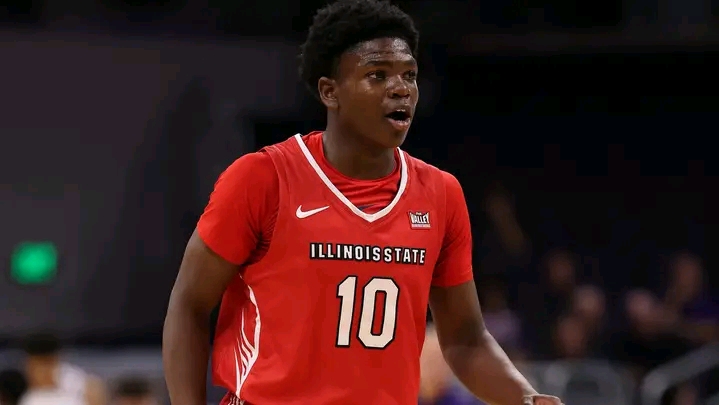
BREAKING: Iowa Secures Another Backcourt Weapon as Ty’Reek Coleman Commits Underrated Freshman Phenom Set for Big Ten Leap
IOWA CITY, IA Just when it looked like the Iowa Hawkeyes men’s basketball had already made a loud statement in the transfer portal, they doubled down this time with a move that may not scream headlines yet, but could age into one of the smartest additions of the offseason.
Ty’Reek Coleman, a dynamic guard transferring from Illinois State Redbirds men’s basketball, officially announced his commitment to Iowa on April 17. And while his name might not carry the same immediate national buzz as some five-star portal stars, the numbers and the flashes tell a far more intriguing story.
This is the kind of pickup that wins games in February… and defines seasons in March.
From Freshman Promise to Big Ten Opportunity
Coleman arrives in Iowa City after a highly productive freshman campaign that hinted at serious long-term upside. At 6-foot-2 and 175 pounds, the Aurora, Illinois native stepped into a meaningful role immediately at Illinois State, starting 19 of 35 games and averaging:
- 10.0 points per game
- 2.7 rebounds per game
- 1.8 assists per game
- 23 minutes per game
For a true freshman guard adjusting to the speed and physicality of college basketball, those numbers aren’t just solid they’re encouraging.
More importantly, they came with efficiency that’s rare for first-year players.
Efficiency That Turns Heads
Young guards often struggle with shot selection, consistency, and decision-making. Coleman? He flipped that script.
He finished the season shooting:
- 50.4% from the field
- 41.6% from three-point range
- 55.7% on two-point attempts
Those aren’t empty percentages padded by low usage—they reflect a guard who knows when to attack, when to pull up, and when to let the game come to him.
Interestingly, only about 37% of his field goal attempts came from beyond the arc, a much lower rate compared to players like Bennett Stirtz, who hovered near 49% last season. That contrast highlights Coleman’s balanced offensive approach he’s not just a perimeter shooter; he’s a downhill threat.
And that’s where things get exciting.
A Guard Who Can Get Downhill
Turn on the tape, and one thing jumps out immediately Coleman’s burst.
He’s slippery off the dribble. He changes pace well. And when he sees a lane, he attacks it with confidence.
That ability translated into elite finishing efficiency, as evidenced by his 55.7% shooting inside the arc. For a freshman guard, that’s not just impressive it’s a sign of advanced body control and decision-making.
It also fits perfectly into what head coach Ben McCollum is building: a system that values guards who can collapse defenses and create opportunities.
The Highs: Breakout Performances That Demanded Attention
Coleman didn’t just produce consistently he delivered moments.
He scored in double figures 15 times, including a career-high 24 points against Cornell early in the season.
But his most complete performance came in February against Murray State Racers men’s basketball, when he stuffed the stat sheet with:
- 22 points
- 5 rebounds
- 4 assists
- 4 steals
That game wasn’t just a scoring display it was a glimpse of a guard who can impact every facet of the game.
And then there was the national stage.
In the NIT semifinal against Auburn Tigers men’s basketball, Coleman delivered 17 points on 7-of-12 shooting, including 3-of-5 from beyond the arc. He didn’t look overwhelmed. He looked ready.
The Lows: A Reminder He’s Still Developing
Of course, the freshman label comes with inconsistency and Coleman had his share.
Against higher-level competition like Utah State Aggies men’s basketball, Dayton Flyers men’s basketball, and Wake Forest Demon Deacons men’s basketball, he combined for just six total points, including a scoreless outing against Wake Forest.
Across games against major programs USC Trojans men’s basketball, Utah State, Wake Forest, Dayton, and Auburn he averaged 7.8 points per game.
That contrast tells the real story: flashes of brilliance mixed with the growing pains typical of a first-year guard.
But here’s the key those flashes came against elite competition too.
He combined for 33 points against USC and Auburn, proving he can rise to the moment.
The Areas That Need Work
Coleman’s game is promising but not complete.
- Free-throw shooting: He finished at 70.2%, a number that suggests room for improvement, especially for a guard with otherwise strong shooting mechanics.
- Ball security: His 62 assists to 57 turnovers show a nearly even ratio something that will need tightening in the Big Ten.
- Physical development: At 6’2″, 175 pounds, he’ll need to add strength to handle the physical grind of Big Ten play.
That last point matters. The jump from the Missouri Valley Conference to the Big Ten isn’t just about talent it’s about durability, physicality, and consistency.
Why Iowa Took the Bet
So why did Iowa make this move?
Because they’re not just recruiting for now they’re building for what’s next.
Coleman arrives with three full seasons of eligibility remaining, giving McCollum time to develop him into a complete guard.
And if there’s one thing McCollum has built his reputation on, it’s developing guards.
This isn’t a short-term rental.
It’s a long-term investment.
Filling the Void Left by Stirtz
One of the biggest storylines surrounding Iowa this offseason is replacing Bennett Stirtz, a projected first-round pick in the 2026 NBA Draft.
Let’s be clear Coleman isn’t expected to replicate Stirtz.
That wouldn’t be fair.
But he doesn’t have to.
What Iowa needs is steady, reliable point guard play, not necessarily elite, highlight-reel dominance.
If Coleman can manage the offense, make smart decisions, and continue scoring efficiently, he’ll fit exactly what this team needs especially if surrounded by improved talent.
A Backcourt Taking Shape
Coleman won’t be alone.
He joins a guard rotation that includes Kael Combs, who started 33 games during Iowa’s Elite Eight run last season and brings defensive toughness and experience.
Together, they form a backcourt with complementary strengths:
- Coleman: scoring, shot creation, offensive upside
- Combs: defense, experience, stability
That balance could be critical in Big Ten play.
A Youth Movement with Real Potential
Coleman is also stepping into a roster filled with young, developing talent:
- Tate Sage
- Cooper Koch
- Trevin Jirak all with three years of eligibility
And then there’s Trey Thompson, a former four-star recruit who still has four seasons remaining after redshirting.
Add incoming four-star prospects Jaidyn Coon and Ethan Harris, and suddenly Iowa’s future isn’t just promising it’s structured.
The Bigger Picture
This commitment won’t dominate national headlines the way a five-star transfer might.
But inside the program?
It matters.
Because teams that win consistently don’t just land stars they develop depth, identify upside, and invest in growth.
Coleman checks every one of those boxes.
Final Take: A Move That Could Age Beautifully
Right now, Ty’Reek Coleman is a name that sparks curiosity more than certainty.
But give it time.
If his efficiency holds…
If his decision-making sharpens…
If his body catches up to the Big Ten grind…
Then Iowa may have quietly secured one of the most impactful guards of this transfer cycle.
Not because of what he is today.
But because of what he’s about to become.
