

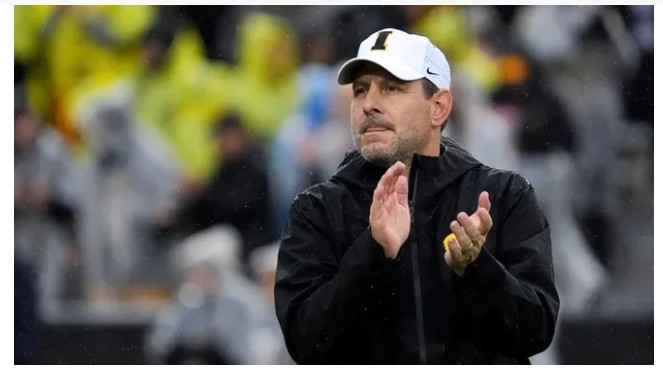
Iowa thought it had momentum. Recruiting insiders leaned their way. Visits had gone well. Then, almost out of nowhere, one of the nation’s most coveted young quarterbacks flipped the script and left the Hawkeyes scrambling for answers.
Jake Nawrot, a towering 6-foot-4, 205-pound quarterback ranked as the No. 2 signal-caller in the 2027 class by Rivals, officially committed to Kentucky on Sunday. The decision came as a surprise to many around college football, especially considering Iowa had been trending as the favorite just weeks earlier.
Nawrot’s pledge also marks a major early recruiting victory for new Kentucky head coach Will Stein, who wasted no time making his presence felt on the trail. For Iowa, it’s a tough miss particularly at a position that remains critical to the program’s long-term trajectory.
Back in January, Iowa extended an offer to Nawrot, quickly identifying him as a priority target in the 2027 cycle. The Hawkeyes followed that up with a visit to Iowa City, where Nawrot had the chance to meet the coaching staff, tour facilities, and get a feel for the program’s culture.
At the time, things appeared to be trending in Iowa’s favor. Recruiting analyst Steve Wiltfong even logged an expert prediction for the Hawkeyes in late February, signaling growing confidence that Kirk Ferentz’s staff would land the blue-chip quarterback.
But recruiting rarely follows a straight line.
Somewhere between that February projection and Sunday’s announcement, the momentum shifted. Kentucky surged into the picture and ultimately sealed the deal. Nawrot’s decision to join the Wildcats signals a significant win for Stein, who is clearly aiming to reshape Kentucky’s offensive identity with high-level quarterback talent.
For Iowa, the loss stings not just because of Nawrot’s ranking, but because of what he represents. Elite quarterbacks have become increasingly essential in today’s college football landscape, especially as offenses continue to evolve and prioritize explosiveness through the air.
Nawrot fits that modern mold. At 6-foot-4 and 205 pounds, he already possesses the size college coaches covet. Add in his arm strength, field vision, and mobility, and it’s easy to see why he became one of the most sought-after players in his class so early in the recruiting cycle.
His commitment to Kentucky also reflects the growing recruiting influence of the SEC, where top prospects are consistently drawn to the conference’s national exposure, elite competition, and NFL pipeline. Even programs outside the traditional SEC powerhouses are finding ways to attract top-tier talent and Kentucky is proving it can compete in that space.
While Iowa has built a reputation for developing fundamentally sound teams and producing NFL-caliber players, recruiting battles like this highlight the challenges the program faces when going head-to-head with SEC schools for elite offensive talent.
Still, it’s not all bad news in Iowa City.
The Hawkeyes coaching staff didn’t waste time pivoting after Nawrot’s recruitment began to shift. Offensive coordinator Tim Lester has already turned his attention to other quarterbacks in the 2027 class, including Brayden Santibanez, a promising signal-caller out of Tennessee.
Santibanez recently received an offer from Iowa, signaling the program’s intent to remain aggressive in its pursuit of top quarterback talent. While he may not carry the same national ranking as Nawrot at least not yet he represents another opportunity for Iowa to secure a cornerstone piece for its future offense.
Recruiting is, after all, about adaptability.
Programs that succeed at the highest level aren’t just the ones that land every top target they’re the ones that respond quickly when things don’t go as planned. Iowa’s ability to regroup and identify alternative options will be critical as it continues building its 2027 class.
There’s also a broader context to consider.
Quarterback recruiting has become increasingly competitive in recent years, with prospects committing earlier and schools investing more resources into evaluations, relationships, and NIL opportunities. Missing on one target doesn’t define a class but it does raise the stakes for the next move.
For Iowa fans, Nawrot’s decision may feel like a missed opportunity, especially given the early optimism surrounding his recruitment. But it’s important to remember that recruiting cycles are long, unpredictable, and often filled with twists and turns.
In fact, many of the most successful programs have built elite rosters not by landing every top-ranked player, but by finding the right fits players who align with their system, culture, and long-term vision.
That’s where Iowa will need to refocus.
The Hawkeyes have consistently leaned on strong defense, disciplined play, and a physical style of football. As they look to evolve offensively, securing the right quarterback becomes even more crucial not just in terms of talent, but in leadership, decision-making, and fit within the scheme.
Nawrot may have been the ideal candidate on paper, but the search doesn’t end here.
If anything, this development adds urgency to Iowa’s recruiting efforts. The staff will need to evaluate quickly, build relationships with new targets, and ensure they don’t fall behind in a class that’s already beginning to take shape nationally.

Meanwhile, Kentucky’s gain could have ripple effects across the recruiting landscape.
Landing a quarterback of Nawrot’s caliber not only strengthens the Wildcats’ future roster but also makes the program more attractive to other offensive recruits. Wide receivers, tight ends, and even offensive linemen often follow elite quarterbacks, creating a domino effect that can elevate an entire class.
That’s the kind of impact Nawrot could have in Lexington.
For now, though, the focus shifts back to Iowa.
The Hawkeyes still have time. The 2027 class is far from complete, and plenty of talent remains on the board. What matters most is how the program responds whether it can turn this setback into an opportunity to recalibrate and come back stronger.
Because in college football recruiting, today’s disappointment can quickly become tomorrow’s breakthrough.
And for Iowa, the next move might be even more important than the one that just slipped away.
