

IOWA CITY — The price of winning in college basketball has never been higher and for Iowa, the new reality of the transfer portal is starting to hit hard.
What used to be a simple recruiting battle has transformed into a high-stakes financial race. Programs are no longer just selling culture, development, and playing time they’re competing in a marketplace where elite talent can command millions. And as Iowa looks to stay competitive, the question isn’t just who they want… it’s who they can afford.
The numbers are staggering. According to insights from college basketball analyst Jeff Goodman, elite transfers are now commanding anywhere from $2.5 million to $5 million depending on position and impact. Wings can cost up to $3 million, guards between $3–$4 million, and dominant big men as much as $5 million. That’s not hypothetical it’s the new going rate.
For Iowa, navigating this reality presents a massive challenge.
The Hawkeyes are operating within a revenue-sharing structure capped at $20.5 million, but beyond that, there are no true limits on what athletes can earn through NIL opportunities. Combine that with unlimited transfer eligibility, and the portal has effectively become a free market fast-moving, unpredictable, and brutally competitive.
It’s a system that rewards aggressive spending.
And that’s where things get complicated for Iowa.
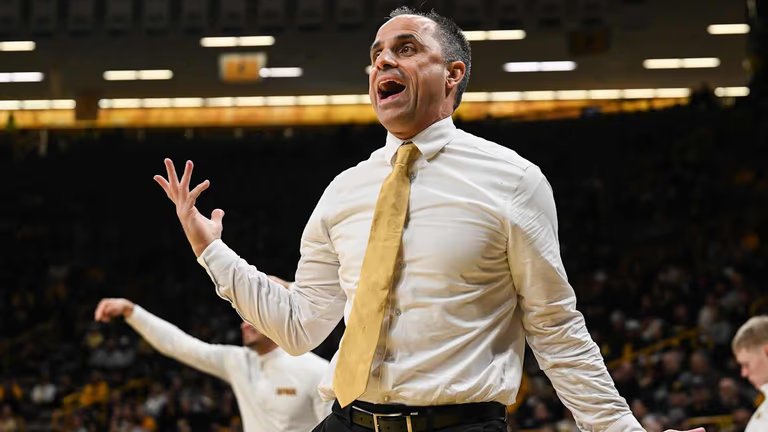
Head coach Ben McCollum is now stepping into this evolving landscape, tasked with rebuilding a roster while balancing financial constraints. It’s not just about identifying talent anymore it’s about determining whether that talent fits within a budget that remains largely undisclosed to the public.
That secrecy adds another layer of intrigue.
Unlike some powerhouse programs that openly flex their financial muscle, Iowa has kept its spending strategy under wraps. There are no clear signals about how far the program is willing or able to go when bidding for top-tier transfers. That uncertainty makes every move harder to predict.
But one thing is clear: standing still isn’t an option.
With more than 1,000 players entering the transfer portal, the competition has become overwhelming. Every major program is searching for immediate impact players, and the best ones don’t come cheap. In many cases, recruiting now resembles professional free agency, complete with bidding wars and last-minute flips.
For a program like Iowa, that raises a critical question how do you compete without overspending?
There’s a fine balance between investing in elite talent and maintaining long-term roster stability. Spend too much on one player, and it could limit depth across the roster. Spend too little, and you risk falling behind programs willing to pay premium prices for proven production.
It’s a delicate equation with no easy answers.
What makes this moment particularly pivotal is timing. Iowa is in the middle of a roster transition, meaning the need for immediate contributors is higher than usual. That urgency can drive up costs even further, especially when multiple programs are targeting the same players.
And in this market, hesitation can be costly.
Top transfers don’t stay available for long. Decisions happen quickly, often driven by financial packages as much as basketball fit. That puts pressure on coaching staffs to act fast and spend wisely.
For McCollum and his staff, it’s a whole new kind of recruiting battle.
Gone are the days when relationships and development alone could seal the deal. Those factors still matter, but they’re now part of a larger equation that includes compensation, exposure, and opportunity. Players are making business decisions, and programs must adapt accordingly.
Still, Iowa’s approach may not be purely about chasing the highest-priced stars.
There’s a growing argument for targeting undervalued players those who may not command multi-million dollar deals but can still contribute at a high level. Finding those hidden gems could be the difference between building a balanced roster and overspending on a few headline names.
It’s a strategy that requires patience and precision.
At the same time, the allure of top-25 caliber transfers is hard to ignore. These are players who can immediately elevate a program, change game plans, and impact win totals. But with price tags reaching into the millions, the risk is just as high as the reward.
And that’s the dilemma Iowa faces right now.
Do you go all-in for a proven star, knowing it could reshape your season? Or do you spread resources across multiple players, hoping depth and chemistry win out?
There’s no guaranteed formula.
What’s certain is that the transfer portal isn’t slowing down. If anything, it’s accelerating. More players are entering, more money is flowing, and more programs are adapting to this new reality.
For Iowa, adaptation isn’t optional it’s essential.
The program’s future could hinge on how well it navigates this financial landscape. Smart investments, strategic recruiting, and a clear vision will all play a role in determining whether the Hawkeyes can remain competitive in an increasingly expensive game.
And while the numbers may seem overwhelming, they also reflect a broader shift in college athletics.
Players now have more freedom than ever before. They can choose where to play, how often to move, and how to maximize their value. That empowerment has reshaped the entire ecosystem, forcing programs to rethink everything from recruiting strategies to roster construction.
It’s a new era and it’s only just beginning.
For fans, it means a different kind of offseason. Instead of waiting for freshmen to develop, attention shifts to portal targets, NIL deals, and roster movement. Every decision carries weight, and every addition or missed opportunity can change the trajectory of a season.
For Iowa, the stakes couldn’t be higher.
The Hawkeyes are stepping into a marketplace where success is measured not just by wins and losses, but by how effectively they can compete off the court. Financial strategy, talent evaluation, and timing all intersect in this new reality.
And as the costs continue to rise, one thing becomes increasingly clear:
Building a winning team now requires more than just great coaching.
It requires smart spending.
