

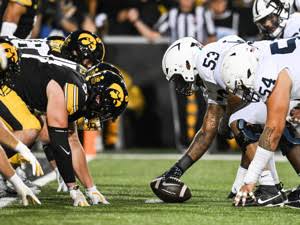
Iowa Football’s Transfer Portal Haul Turns Heads at ESPN: Hawkeyes Build One of 2026’s Most Intriguing Classes
The Iowa Hawkeyes may have built their reputation on patience, development, and long-term roster building through high school recruiting but heading into the 2026 college football season, they are proving that evolution is no longer optional in modern football.
This offseason, Iowa has leaned heavily into the transfer portal, and early reactions suggest it might be one of the smartest strategic shifts in recent program history. According to ESPN analyst Bill Connelly, the Hawkeyes’ 2026 transfer class is not just solid it is one of the most intriguing groupings in the entire country.
For a program led by Kirk Ferentz, known for consistency and development over flash, this new aggressive approach signals a notable shift in philosophy. And based on the talent arriving in Iowa City, it’s easy to see why expectations are rising.
A New Transfer Identity for Iowa Football
Iowa’s offseason was shaped by significant roster turnover. The program lost a large portion of last season’s contributors, including multiple regular starters on both sides of the ball. In fact, only a handful of players who logged consistent starting roles are returning for the new campaign.
That kind of attrition would typically raise concerns about rebuilding. Instead, Iowa responded by attacking the transfer portal with purpose.
What stands out most is where the Hawkeyes focused their attention: the Football Championship Subdivision (FCS). While many top programs prioritize Power Five transfers, Iowa leaned into productive players from smaller programs athletes who may be overlooked but bring proven production and untapped upside.

This approach has already drawn national attention, especially after Iowa’s recent success integrating FCS quarterback Mark Gronowski last season. That experiment appears to have influenced a broader recruiting strategy heading into 2026.
Now, Iowa is doubling down on that model.
Headliners of Iowa’s Transfer Class
At the center of Iowa’s incoming group is running back Lendon Phillips Jr. from South Dakota, a dynamic playmaker who dominated at the FCS level. Phillips accounted for over 2,000 total yards from scrimmage and scored 20 touchdowns, establishing himself as one of the most productive offensive players outside the FBS ranks.
His arrival gives Iowa a powerful, downhill running presence something the Hawkeyes have long valued in their offensive identity. Phillips is expected to immediately compete for a major role in the backfield, bringing both explosiveness and physicality.
On the defensive side, another standout addition is edge rusher Kahmari Brown from Elon. Brown arrives with impressive production: 66 total tackles, 16 tackles for loss, and 12 sacks. Those numbers highlight both his consistency and his ability to disrupt opposing offenses in the backfield.
Brown’s athletic profile fits well within Iowa’s defensive system, which thrives on disciplined, high-effort pass rushers. With several key defensive linemen departing from last year’s roster, Brown could quickly become a foundational piece of the rotation.
In the secondary, Iowa added safety Anthony Hawkins from Villanova, a defensive back known for his all-around playmaking ability. Hawkins posted 59 tackles, two interceptions, and 11 pass breakups, showing he can contribute in coverage and run support.
His versatility gives Iowa flexibility in the defensive backfield, especially in a system that demands intelligent, adaptable safeties.
More Depth Across the Roster
Beyond the headline names, Iowa’s transfer class includes multiple players expected to contribute in rotational or developmental roles immediately.
Wide receiver additions include:
- Tony Diaz (Texas–Rio Grande Valley), a receiver beginning to show potential as a downfield threat capable of stretching defenses vertically.
- Evan James (Furman), another pass-catching option with solid production and room to grow within Iowa’s offensive system.
The Hawkeyes also strengthened the defensive line with:
- Brice Stevenson (Holy Cross)
- Emmanuel Olagbaju (North Dakota)
Both interior linemen bring size and experience, addressing depth concerns following offseason departures.
At safety, Iowa added Xavier Styles from Robert Morris, further reinforcing a secondary that is undergoing significant transition.
One of the most notable aspects of this class is age and eligibility structure. Many of these transfers are not upperclassmen finishing their final seasons. Instead, several arrive with multiple years of eligibility remaining, giving Iowa a chance to develop continuity over time rather than relying solely on short-term rentals.
That long-term upside is a key reason analysts are intrigued by what Ferentz and his staff have assembled.
ESPN’s Perspective: A Calculated Gamble
ESPN’s Bill Connelly highlighted Iowa’s aggressive approach while noting both its promise and its uncertainty. The overarching sentiment is clear: this is a strategic gamble rooted in identifying undervalued talent.
Iowa’s reliance on FCS transfers is not traditional for a program competing in a Power Four environment. However, recent success stories within the program suggest the strategy has merit.
The concern, of course, is translation. Dominance at the FCS level does not always guarantee success against Big Ten competition. Speed, physicality, and complexity all increase significantly.
Still, the upside is undeniable.
Connelly emphasized that Iowa appears to be betting on development curves bringing in players who have already proven production but still have room to grow within a structured system.
In other words, Iowa isn’t just collecting talent. It is betting on coaching, development, and system fit.
Offensive Outlook: New Energy in Key Positions
Perhaps the most impactful addition is Lendon Phillips Jr., whose presence could reshape Iowa’s offensive identity. The Hawkeyes have already leaned heavily on the run game in recent seasons, but Phillips brings a new dimension: consistent breakaway potential.
His ability to generate yards after contact and turn routine carries into explosive gains gives Iowa something it has occasionally lacked game-changing speed in the backfield.
At wide receiver, Iowa is hoping that Tony Diaz can develop into a legitimate vertical threat. If he can command defensive attention downfield, it could open space for Iowa’s traditional short and intermediate passing attack.
Combined, these additions suggest Iowa is not abandoning its identity but refining it.
Defensive Rebuild: Youth, Speed, and Opportunity
Defensively, Iowa faces the challenge of replacing multiple contributors, including impactful players on the edge and interior line.
Kahmari Brown’s arrival is especially important in this context. His production suggests he can immediately contribute as a pass rusher, potentially filling a critical gap left by departing starters.
The addition of multiple defensive linemen also signals a focus on rotation depth. Iowa’s defensive scheme relies heavily on fresh legs and disciplined execution, and this group appears designed to support that structure.
In the secondary, Anthony Hawkins and Xavier Styles give Iowa flexibility and competition for playing time, which could be crucial in developing consistency early in the season.
The Bigger Picture: Iowa’s Evolving Strategy
What makes this transfer class so notable is not just the talent it’s the philosophy behind it.
Iowa has traditionally built through:
- High school recruiting
- Player development over multiple years
- System consistency
Now, the program is blending that identity with modern roster-building tactics, especially in the transfer portal era.
The shift is not a departure from Iowa football it is an adaptation.
And if these transfers perform as expected, Iowa could emerge as one of the most improved and intriguing teams heading into the 2026 season.
Final Takeaway
The Iowa Hawkeyes may not have pursued the flashiest names in the transfer portal, but they may have targeted some of the most strategically valuable ones.
With a mix of proven FCS production, multiple years of eligibility, and system-fit players across both offense and defense, Iowa’s 2026 transfer class has already earned national attention.
Now the real question begins:
Can this calculated gamble turn into on-field success in the Big Ten?
If even a portion of these additions hit their potential, Iowa’s quiet offseason could turn into one of the most impactful roster rebuilds in college football.
