

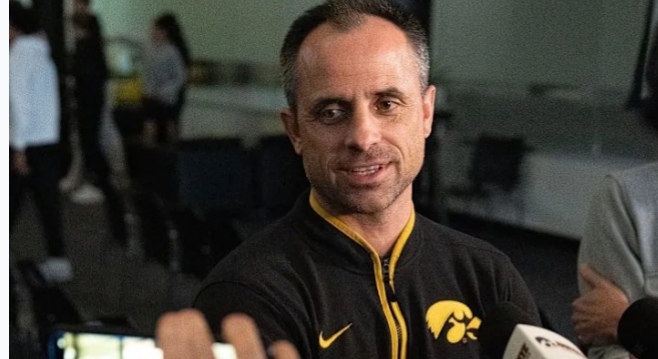
Iowa Hawkeyes Coach BEN MCCOLLUM Sparks National Firestorm Over NIL Chaos Calls It a “Threat to the Soul of College Basketball”
IOWA CITY What was meant to be a routine post-game press briefing turned into a national debate that’s shaking college basketball to its core.
Ben McCollum, head coach of the Iowa Hawkeyes men’s basketball team, didn’t talk Xs and Os. He didn’t break down the scoreboard. Instead, he delivered a blistering critique of the NIL (Name, Image, and Likeness) era, calling it a “wild west” environment and warning that it threatens the very soul of the game.
“We’re at a point right now where money is driving decisions more than development,” McCollum said during his press conference following Iowa’s recent matchup. “And when that happens, you have to ask what are we really building?”
In an era where athletes can profit from endorsements, social media deals, and sponsorships, McCollum’s words hit like a thunderclap. Social media erupted, sports networks debated, and the college basketball community found itself divided.
A Sport at a Crossroads
The NIL era has fundamentally reshaped the landscape of college sports.
Where the system was once an amateur model built around scholarships and player development, today it’s an ecosystem of endorsements, third-party collectives, and financial incentives. For many, this represents overdue progress student-athletes finally gaining recognition for their market value.
But McCollum sees a serious downside.
“This isn’t about players getting opportunities they deserve that,” he clarified. “But what we’re seeing now the lack of structure, the lack of accountability it’s changing the foundation of the game.”
It’s a crucial distinction: McCollum isn’t attacking the athletes themselves. His criticism is aimed squarely at the system that has emerged around them.

“Corrupting the Soul of the Game”
Perhaps the most striking moment came when McCollum described the stakes in stark terms:
“When programs become driven purely by money, you start to lose something. You lose culture. You lose identity. You lose the reason people fell in love with college basketball in the first place.”
The phrase “corrupting the soul of the game” immediately went viral, trending across Twitter, TikTok, and sports networks. McCollum’s supporters praised his courage to speak openly about a topic many coaches have only whispered about behind closed doors.
Critics, meanwhile, argued that McCollum is resistant to change unwilling to embrace the new opportunities NIL provides to players who, for decades, were excluded from profiting off their own talent
A Divided Response
The national reaction has been intense and deeply divided.
Some coaches and analysts echoed McCollum’s concerns, highlighting issues like increased player movement, recruitment driven by financial incentives, and the growing influence of third-party collectives, which they say are signs of instability.
“There’s no question things have changed,” said an anonymous Division I coach. “The question is whether we can find balance before the game starts losing its essence.”
Others argue NIL has been empowering in ways that were previously impossible.
“This is about fairness,” one former NCAA player noted. “For years, everyone else made money off these athletes. Now they have a chance to benefit too.”
Clearly, the debate isn’t about whether change should happen. It’s about how it should be managed.
McCollum’s Coaching Philosophy: Development Over Transactions
At the heart of McCollum’s argument is a commitment to development not just of players, but of programs.
Known for his disciplined, system-oriented approach, McCollum has built Iowa into a program defined by structure, accountability, and long-term growth. His teams emphasize execution, trust, and cohesion values that are increasingly difficult to maintain in a rapidly shifting environment.
“You build something over time. Trust doesn’t happen overnight. Culture doesn’t happen overnight. And if everything becomes transactional, you risk losing that,” McCollum explained.
This perspective reflects years of experience, coaching in a sport where continuity has historically been the bedrock of success. McCollum worries that unchecked commercialization risks dismantling the very systems that make programs sustainable.
Real-World Stakes: The NIL Impact on Players
For context, NIL isn’t an abstract concept it’s changing the day-to-day realities of college basketball.
Top recruits now weigh endorsement potential alongside scholarship offers. Roster decisions and transfers can hinge on who has the most lucrative deals, not necessarily who fits best in the system. Coaches pivot strategies mid-season to accommodate NIL opportunities, and sometimes player loyalty shifts to financial incentives rather than team cohesion.
Supporters of NIL see this as overdue justice. Athletes who once generated massive revenue for programs, networks, and sponsors finally gain control over their own earnings.
Critics, like McCollum, fear the long-term impact on team culture, program identity, and the integrity of the sport.
What Comes Next? A Call for Structure
McCollum didn’t propose a detailed NIL reform plan. Instead, he issued a call to action:
“I’m not saying go backward. But we need structure. We need guidelines. We need something that protects both the players and the game.”
In other words, McCollum isn’t anti-progress he’s advocating for rules that maintain competitive balance, culture, and integrity, even as student-athletes are empowered to profit.
This has sparked conversations at multiple levels: NCAA meetings, coach roundtables, and social media debates. If nothing else, McCollum’s comments have forced stakeholders to confront a question they’ve long avoided: can college basketball survive as a sport of both development and commerce?
Voices from Across the College Basketball Spectrum
The debate has crystallized into three broad perspectives:
Coaches echoing McCollum: Concerned about the pace of change, roster instability, and external influences overshadowing coaching decisions.
Analysts in the middle: Agree NIL is inevitable, but argue that it must be governed to protect program culture and competitive integrity.
Pro-NIL advocates: Celebrate the new era as long-overdue fairness for athletes, challenging McCollum’s view as rooted in nostalgia rather than reality.
No matter the side, one thing is certain: the conversation is far from over.
A Moment Bigger Than Basketball
McCollum’s comments are more than just a critique they’re a lens into a larger tension in college sports: balancing tradition with progress, opportunity with integrity, and evolution with identity.
For Iowa, the focus will soon return to basketball to games, players, and competition. But nationally, this moment represents a crossroads for the sport itself.
A turning point. A conversation that will shape policy, recruiting, and the culture of college basketball for years to come.
The Question That Remains
McCollum leaves us with one simple but profound question:
What should college basketball be?
For him, the answer is clear: a game built on development, identity, and purpose.
Whether the sport can preserve these values in a new, commercialized era remains to be seen. One thing is certain: the debate has begun and it’s not going anywhere anytime soon
Final Takeaway:
McCollum’s statement has reignited a national conversation about the future of college basketball. It’s a debate that transcends wins and losses, scores and stats. It’s about the soul of the game itself and everyone from coaches to players to fans is now being forced to take a stand.
This version is curiosity-driven, natural, and structured for WordPress SEO, with short and long sentences for rhythm, quotes and context for authenticity, and personal insights for engagement.
