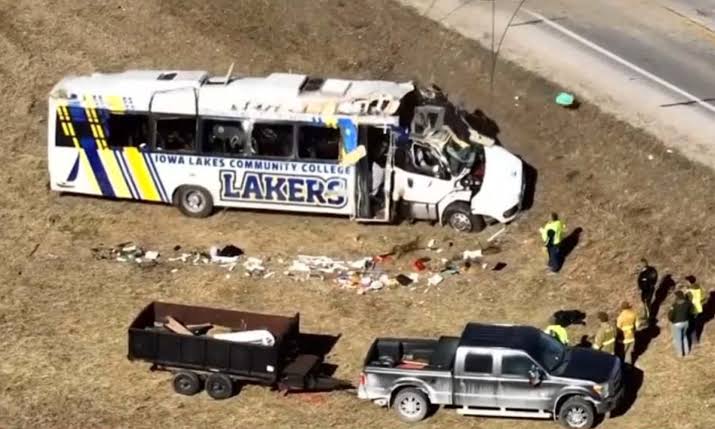
Iowa Lakes baseball bus crash investigation scene with emergency responders
Hospitalized 74-Year-Old Driver in Iowa Lakes Baseball Bus Crash Faces Critical Decline—Will His Condition Change the Investigation and Team Travel Safety Forever?
The Iowa Lakes baseball bus crash continues to send shockwaves through the college sports world as 74-year-old driver Edward Greving remains hospitalized in critical condition. As questions grow louder about accountability, safety protocols, and the long-term impact on team travel, this developing story has become one of the most closely followed incidents in college baseball this season.
The Iowa Lakes baseball bus crash isn’t just another tragic headline. It’s a story unfolding in real time one involving life-threatening injuries, an ongoing state investigation, and a community desperately waiting for answers.
According to officials, Greving, a longtime resident of Estherville, Iowa, has not yet been released from medical care following the crash that left one student-athlete dead and more than 30 others injured. Authorities confirmed that as of the latest update, both one player and the driver remain hospitalized, while other members of the Iowa Lakes Community College baseball program are in various stages of recovery.
Medical personnel have not publicly disclosed the full extent of Greving’s injuries. However, officials acknowledged his condition remains serious. Family members have not issued a statement, and hospital representatives are respecting privacy restrictions. What is clear is that his recovery or lack thereof could have significant implications beyond his personal health.
Iowa Lakes Baseball Bus Crash
The crash occurred when the team bus reportedly failed to negotiate a curve before leaving the roadway and overturning. Investigators from the Iowa State Patrol are continuing to reconstruct the sequence of events.
Early reports indicate weather and road conditions are being examined alongside mechanical assessments of the bus itself. Officials have not yet confirmed whether speed, visibility, or driver health factors contributed to the accident. Toxicology results and mechanical inspections are standard parts of such investigations and may take weeks to finalize.
Meanwhile, the emotional toll on the program is evident. Teammates who walked away with broken bones, concussions, and other injuries now face months of physical therapy. The lone hospitalized student continues to receive treatment, though doctors say the player is stable.
Could the Driver’s Condition Impact the Investigation?
This is the question dominating sports radio, social feeds, and legal circles.
If Greving remains medically unable to provide a formal statement, investigators may have to rely heavily on physical evidence, onboard data (if available), and witness accounts from players and first responders. His medical condition could delay certain aspects of the probe, particularly if cognitive or neurological injuries are involved.
Legal experts note that in serious crash investigations, driver interviews are critical in determining whether there were mechanical failures, medical emergencies, or environmental factors at play. Without that firsthand account, authorities must piece together the narrative through forensic reconstruction.
There’s also the possibility of civil litigation. In tragic team travel accidents, questions often expand beyond individual responsibility to institutional oversight including vehicle maintenance schedules, driver vetting procedures, and travel risk assessments.
What This Means for Team Travel Safety
The ripple effect could extend far beyond Iowa.
College athletic departments across the country routinely log thousands of bus miles each year. Most programs, especially at the junior college and Division II levels, rely on contracted transportation services. Following high-profile crashes in the past decade, governing bodies have reviewed standards related to driver rest requirements, vehicle inspection frequency, and emergency preparedness protocols.
If the findings from the Iowa Lakes baseball bus crash point toward systemic issues, administrators nationwide may face renewed pressure to implement stricter travel guidelines.
That could mean:
Mandatory secondary drivers on long trips
Enhanced medical screenings for older drivers
Real-time vehicle tracking systems
More rigorous weather-related travel postponement policies
For now, no formal policy changes have been announced. But athletic directors are watching closely.
A Community Waiting for Answers
Estherville and surrounding communities have rallied around the injured players and their families. Local businesses have organized fundraisers. Students have worn team colors in solidarity. Baseball programs from across the Midwest have sent messages of support.
Yet beneath the unity lies a quiet anxiety.
Will the driver recover?
Will investigators uncover preventable factors?
Could this tragedy have been avoided?
Those questions linger as medical teams continue their round-the-clock care.
The Road Ahead
The coming weeks will be pivotal. Investigators are expected to release a preliminary crash assessment once key evidence is reviewed. Medical updates on Greving’s condition will also shape the trajectory of the inquiry.
If his health improves and he’s able to speak with authorities, the investigation may gain clarity. If not, officials will depend entirely on reconstruction data and testimony from survivors.
For the baseball program, the season’s competitive goals have understandably taken a backseat. Recovery physical and emotional is now the priority.
And for fans, one thing is certain: the Iowa Lakes baseball bus crash has evolved from a tragic accident into a story that could influence how college teams travel for years to come.