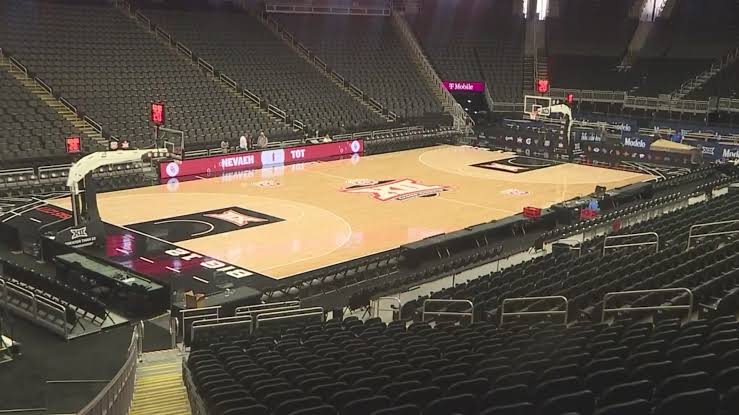
Big 12 LED Court revolution at T-Mobile Center basketball tournament
The JT Toppin injury has sent shockwaves through college basketball, delivering a crushing blow to Texas Tech Red Raiders men’s basketball just as momentum was building. An MRI confirmed the worst fears the junior forward’s season is over after suffering a torn ACL in his right knee during Tuesday night’s road clash against the Arizona State Sun Devils men’s basketball.
What began as a high-intensity non-conference battle quickly turned into a nightmare scenario not just for Toppin, but for a Texas Tech squad with postseason ambitions.
How the Injury Happened
Midway through the second half inside a raucous Tempe arena, Toppin planted his right leg while battling for inside position on a rebound. There was no dramatic collision, no obvious contact just the kind of routine basketball movement athletes perform hundreds of times a season.
But this time, his knee buckled.
Toppin immediately grabbed his leg and collapsed to the hardwood. Trainers sprinted onto the court as teammates formed a protective circle. He needed assistance leaving the floor, unable to put weight on the injured knee an ominous sign veteran basketball watchers recognized instantly.
Within hours, imaging was scheduled. By the following day, confirmation arrived: a torn anterior cruciate ligament.
Season over.
Medical Confirmation & Official Statement
In an official update posted by the program, Texas Tech University athletics officials revealed:
“An MRI has confirmed that Texas Tech junior forward JT Toppin sustained a season-ending torn ACL in his right knee Tuesday night in the game at Arizona State.”
No additional ligament damage was publicly disclosed, but ACL tears alone typically require 6–9 months of rehabilitation sometimes longer depending on recovery progression.
Surgery is expected in the coming weeks.
Why the JT Toppin Injury Hurts So Much
Offensive Impact
Toppin wasn’t just a starter — he was the engine behind Texas Tech’s interior production.
2025–26 Season Stats (at time of injury):
15.8 points per game
8.9 rebounds per game
1.6 blocks per game
54% field-goal shooting
Team-leading offensive rebounds
He ranked among the most efficient forwards in the Big 12 Conference, thriving in pick-and-roll sets and second-chance scoring.
His absence removes:
The team’s best rim finisher
Its most physical rebounder
A defensive anchor in the paint
That’s not plug-and-play production. That’s structural loss.
Defensive Presence
Texas Tech’s defensive scheme relies heavily on switchable forwards who can hedge ball screens and recover to protect the rim.
Toppin excelled there.
He averaged nearly two contested blocks per game and altered countless shots that never showed up in box scores. Opposing guards often avoided driving his side entirely.
Without him, perimeter defenders lose their safety net forcing schematic adjustments that could ripple across the roster.
Locker Room Reaction
Inside the locker room, the mood shifted from frustration over the loss to concern for their teammate.
Senior guard Devan Cambridge spoke briefly postgame:
“You never want to see that happen — especially to JT. He’s the heartbeat of this team. We’re playing for him now.”
Head coach Grant McCasland echoed the sentiment while maintaining competitive focus:
“JT’s toughness defines our program. We’ll support his recovery every step — but our responsibility is to keep competing at the highest level.”
Season Outlook Without Toppin
The Red Raiders entered the stretch run fighting for NCAA Tournament positioning within NCAA Division I basketball.
Now the equation changes dramatically.
Frontcourt Depth Chart Shift
Next-man-up candidates:
Robert Jennings — Athletic but less polished offensively
Warren Washington — Rim protector, limited scoring range
KyeRon Lindsay — Developmental minutes increase likely
None replicate Toppin’s full two-way value.
Expect Texas Tech to:
Slow tempo
Emphasize perimeter shooting
Deploy more zone defensive sets
Film Room Adjustments
Without Toppin’s paint gravity, spacing becomes critical.
Opponents will likely:
Collapse less in help defense
Stay home on shooters
Force Texas Tech into half-court jump shooting
To counter, McCasland may expand small-ball lineups trading size for pace and ball movement.
It’s a tactical pivot born from necessity, not preference.
Rehabilitation Road Ahead
ACL recovery has evolved dramatically over the past decade thanks to surgical advancements and sports science.
Typical timeline:
1. Surgery — Ligament reconstruction
2. 0–6 weeks — Mobility restoration
3. 2–4 months — Strength rebuilding
4. 6–9 months — Basketball activities resume
5. 9–12 months – Full competition clearance
If rehab proceeds without setbacks, Toppin could return before next season’s non-conference slate.
Mental recovery, however, often takes longer than physical healing.
Historical Context: Texas Tech & ACL Comebacks
Texas Tech has seen players rebound from major knee injuries before — some returning stronger due to refined conditioning and skill development during rehab downtime.
Athletic trainers within the program are regarded among the most progressive in collegiate sports medicine, integrating:
Biomechanical analysis
Load management tracking
Neuromuscular retraining
All tools that will shape Toppin’s comeback blueprint.
NBA Draft Implications
Before the injury, scouts viewed Toppin as a fringe early-entry candidate — not a lottery lock, but firmly on draft radars.
Strengths cited:
Elite motor
Rebounding instincts
Interior scoring touch
Defensive versatility
Now, evaluation pauses.
NBA teams will monitor:
Post-surgery mobility
Vertical explosiveness return
Lateral defensive recovery
Many prospects have preserved even improved draft stock after ACL rehabs, but it adds uncertainty to the timeline.
Teammates Rallying Forward
Team leaders have already reframed the season’s mission.
Play for JT.
Practices following the announcement reportedly opened with a team huddle centered on accountability — each player pledging incremental statistical improvement to offset lost production.
Examples discussed internally:
+2 rebounds per forward
+5 combined bench points
Reduced turnovers in transition
It’s math, but it’s also motivation.
Fan & Program Support
Though the injury occurred on the road, support flooded in across digital platforms tied to Texas Tech athletics.
Former players, alumni, and students posted encouragement messages, many highlighting Toppin’s community involvement off the court youth camps, charity appearances, and mentoring freshmen.
His value to the program extends beyond box scores.
What Comes Next for Texas Tech
The remaining schedule doesn’t ease up.
Upcoming conference matchups include ranked opponents battling for tournament seeding games where frontcourt physicality often decides outcomes.
Key tactical priorities moving forward:
Rebounding by committee
Perimeter defensive discipline
Bench scoring consistency
Slower possession control
Margin for error just narrowed considerably.
Final Word
The JT Toppin injury is more than a roster update it’s a defining adversity moment for Texas Tech’s season.
Championship-caliber teams are measured not only by star power but by resilience when stars fall.
Toppin’s road now shifts to surgery tables and rehab facilities instead of hardwood arenas. Yet if his on-court toughness translates to recovery and all signs suggest it will this setback may ultimately become a chapter in a larger comeback story.
For Texas Tech, the mission is clear:
Survive now. Win for JT. And wait for the day their No. 15 runs back through the smoke.