Iowa National Guard Troops Return Home as Families Prepare for Long-Awaited Reunions
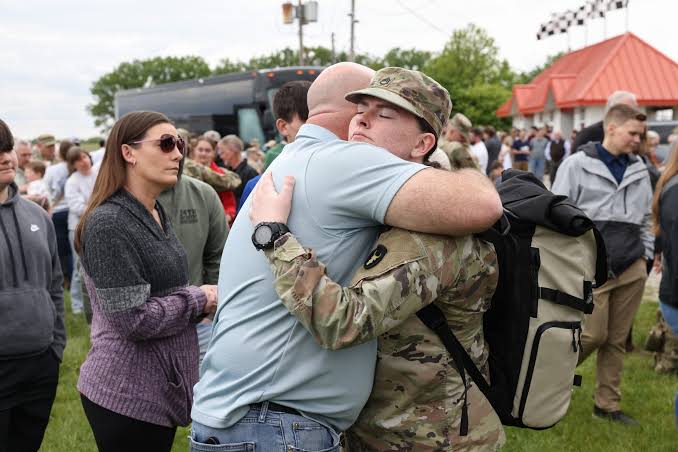
After months of separation, uncertainty, and sacrifice, Iowa National Guard troops return home this week, setting the stage for emotional reunions across the state. For dozens of Iowa families, the countdown has been measured in phone calls, time zones, and crossed-off calendar dates. Now, the waiting is finally ending.
Beyond the uniforms and ceremonies, many of the returning service members are deeply woven into Iowa’s sports communities, coaching youth teams, volunteering at school athletic programs, and supporting the same hometown fields and gyms that bring Iowa fans together every season.
Military officials confirmed that the first group of approximately 250 soldiers is expected to arrive in Iowa within days. Two public welcome-home ceremonies are scheduled for Wednesday, February 11, at the 132d Air Wing at Des Moines International Airport, while an additional group of service members will return to Sioux City later that same day.
For families who have endured months of deployment, Wednesday won’t feel like just another weekday. It will feel like a finish line.
Iowa National Guard Troops Return Home With Public Ceremonies in Des Moines
As Iowa National Guard troops return home, the state is preparing to officially welcome them back in a public show of gratitude. The ceremonies at the 132d Air Wing, located at 3100 McKinley Ave., Des Moines, IA 50321, are scheduled for 3:00 p.m. and 4:30 p.m. and are open to the public.
Community members are encouraged to attend, offering families a visible reminder that their loved ones’ service and sacrifice has not gone unnoticed.
The Des Moines ceremonies will be followed by another arrival in Sioux City, expanding the homecoming beyond central Iowa and reinforcing the statewide scope of the deployment.
For many soldiers, stepping off the plane is only the beginning of the journey back to normal life.
Behind the Applause: Reintegration Starts Immediately
While the welcome-home ceremonies mark a joyful milestone, Guard leadership has been clear: reintegration doesn’t happen overnight.
Lt. Col. Ryan Sextro, Director of Prevention and Resilience Services for the Iowa National Guard, said his team has been preparing for the return long before the first flights were scheduled.
“We are standing by and prepared to address those issues that will pop up,” Sextro said. “We don’t know what those things are, but we have a whole catalog of services that we’re ready to execute to support each and every individual soldier and family.”
Those services are coordinated through the Warrior and Family Services Branch, which has already been actively preparing for the soldiers’ return.
The focus isn’t just on soldiers it extends to spouses, children, and parents who have carried the weight of deployment at home.
Services Ready to Support Returning Soldiers and Families
As Iowa National Guard troops return home, leadership is emphasizing access to practical and emotional support. The Guard’s post-deployment resources include:
Counseling and mental health services, addressing stress, trauma, and emotional adjustment
Financial and housing guidance, particularly for families navigating job transitions
Employment and career transition assistance, helping soldiers reintegrate into civilian workforces
Military leaders acknowledge that soldiers returning from overseas operations often face challenges adjusting to everyday routines. The structure of deployment can give way to the unpredictability of civilian life, a shift that can take time to navigate successfully.
Officials stress that asking for help is not a weakness but a continuation of service in a different form.
A Deployment Marked by Tragedy
This return carries added emotional weight following a deadly ambush in mid-December that claimed the lives of two Iowa National Guard members while deployed in Syria.
Staff Sgt. Edgar Torres-Tovar and Staff Sgt. William Howard were killed in the attack. Three additional soldiers were wounded, a loss that continues to resonate within the Guard community and across Iowa.
Leadership has acknowledged that the tragedy has sharpened the focus on mental health, resilience, and long-term care for returning troops. For some soldiers, the memories of that day will travel home with them.
As a result, Guard officials say awareness around emotional and psychological support is higher than ever.
Families Count the Days—and the Small Moments
For families waiting at home, deployment hasn’t been measured only in months. It’s been measured in missed birthdays, school games watched through screens, and quiet evenings filled with worry.
Parents have balanced work and childcare alone. Children have grown taller. Spouses have learned to manage households independently, knowing reintegration will bring change once again.
When Iowa National Guard troops return home, those routines will shift sometimes smoothly, sometimes not. Leaders emphasize patience, communication, and realistic expectations as families begin that transition together.
Community support, they say, plays a critical role.
Community’s Role Goes Beyond the Ceremony
Guard leadership is encouraging Iowans not just to attend welcome-home events, but to remain engaged in the weeks and months that follow. Simple gestures understanding workplace flexibility, checking in on neighbors, offering practical help can make a meaningful difference.
For communities built around Friday-night lights, weekend tournaments, and packed gymnasiums, the return of these service members means more than filled seats. It means coaches back on sidelines, mentors returning to locker rooms, and volunteers rejoining the heart of local sports culture.
The ceremonies mark the end of a deployment. They do not mark the end of its impact.
As more soldiers return in the coming days, Iowa communities will once again be reminded that service doesn’t happen in isolation. It is shared by families, by teammates, and by the state itself.
For those standing on the tarmac Wednesday afternoon, applause will fill the air. What comes next support, patience, and care will define the homecoming long after the last uniform leaves the runway.