

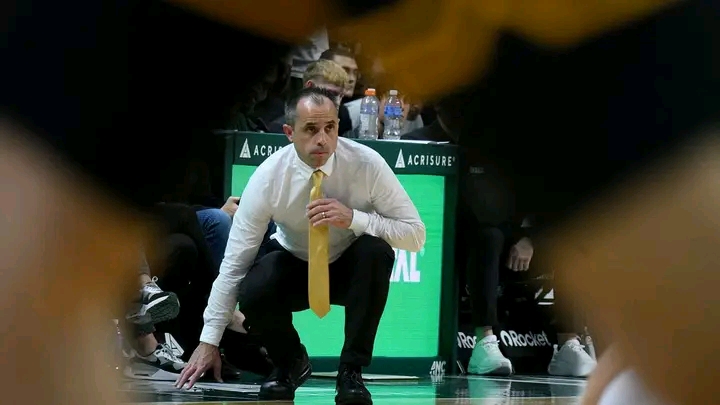
Iowa’s Big Ten debut didn’t go the way Hawkeye supporters envisioned. The Hawkeyes were brought back to earth with a 71-52 road loss to the eighth-ranked Michigan State Spartans at the Breslin Center in East Lansing on Tuesday night, after being undefeated in their first seven games and earning the No. 25 national rating. The final score represented more than just a painful loss. It displayed a squad still discovering itself, still altering lineup chemistry, and yet attempting to develop an offensive identity that matches the grit and consistency that’s defined its defense early this season.
Head coach Ben McCollum didn’t escape the tough questions after the game. Once Iowa’s locker room opened up for media availability, the rotation took center stage immediately notably the second-half absence of senior transfer guard Brendan Hausen. Through seven games, Iowa had established its imprint on the defensive end, frequently vexing opponents with muscular perimeter coverage, active hands in passing lanes, and a clear dedication to keeping the ball out of the paint. The offensive of Michigan State, however, was an entirely different conundrum.
The Spartans weren’t hasty, weren’t careless, and definitely weren’t rattled. They played slow but purposeful basketball, valuing possessions with an almost surgical level of patience. Efficient. disciplined. Poised. They forced Iowa to defend for entire shot clocks, then hurt them late on possessions anyway. It was the kind of offense that gently wears you down the more you fight it. Iowa’s defense had already been tested by the half. It displayed cracks in the second half. Hausen, who scored seven points to lead Iowa in the first half, was benched after the game and never returned.
That choice raised eyebrows. Hausen had been productive when he played, not because Iowa had lost. He shot 2-for-4 from the field. Took smart shots. defeated both deep-range tries. Beyond the points, he also contributes an intangible quality that may have at least tested Michigan State’s defensive strategy: seasoned knowledge, spacing gravity, and a composed, rhythmic style. Therefore, it’s reasonable to wonder why a scorer like that performs well in one half and is completely absent in the next, particularly in a game where Iowa’s attack more closely resembled a stuck engine than a confident one.
McCollum explained it candidly.
“I think we needed more driving [to the paint] and we didn’t have enough driving,” he remarked after being prompted about the rotation. He elaborated on the idea, stating that Hausen didn’t exactly match Iowa’s desired look in that second-half sequence and that they wanted to emphasis getting to the paint consistently. The idea was better rim pressure, more downhill playmaking, more collapse-the-defense basketball. The issue was that even the players that were selected to perform that position were unable to do it well. The plan was sound. The result? Not very much.
McCollum continued, “We’re trying to get to the paint a little more consistently, but we couldn’t get him in the rotation like we wanted to.” “So again, we just have to do a better job next game.” It was the proper answer to the wrong result a truth that only pains more because the repair isn’t a secret. It’s just not happening yet.
The numbers didn’t flatter Iowa, either.
On Tuesday night, Michigan State dominated the interior on both ends. For a club that takes itself in its toughness, the Spartans outscored Iowa 34–18 in the paint. Even more shocking was the rebounding margin. Michigan State nearly doubled Iowa’s overall rebound total by controlling the boards 37–18. That featured 13 offensive rebounds for the Spartans to Iowa’s six, a stat line that alone tells much of the game’s drama. The second-chance opportunities, the kickouts after offensive rebound grabs, the energy points from extended possessions all of it slanted firmly in Michigan State’s favor.
Sure, Hausen could’ve helped. Perhaps he ought to have played more. But the loss was bigger than one rotation option. Iowa had trouble creating effective advantages in the half court, generating consistent rim pressure, and rebounding at the level needed to compete with a varsity-caliber club like the Spartans. Those are broader problems. And greater problems deserve broader solutions. There’s no time to loiter, either. The Big Ten calendar doesn’t relax simply because a game went awry, and Iowa has a limited window of opportunity to turn things around.
Up up comes Iowa’s home opener in conference action, with Maryland heading to Carver-Hawkeye Arena on Saturday, Dec. 6. The Terrapins (6-3) will present a different style, but Iowa’s priorities won’t change. They’ll still need more penetration. More interior scoring balance. And definitely more rebounding urgency. Saturday’s game is scheduled for a 3 p.m. CT tip and will be broadcast on FS1, giving Iowa a chance to reset in front of its home crowd. McCollum said it plainly. The next game must be better for Iowa. And he’s right. Convincing anyone of that is a challenge. The challenge is doing it before the Big Ten grind turns one rough night into a pattern Iowa can’t reverse.
For this crew, it still feels more like a lesson than a warning. But fans, and Iowa themselves, are hoping it stays that way. Because if Iowa’s season is going to be remembered for something more than one rotation decision, it’ll start with how and how swiftly they respond to this one.
