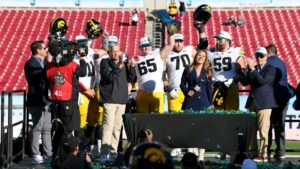
Brice Stevenson, a transfer from Holy Cross, gives Iowa football a much-needed boost up front. After defeating Vanderbilt in an upset bowl victory that helped solidify a 9–4 campaign and gave Iowa Football a boost going into the offseason, the team concluded an incredible 2025 season in fitting fashion.
However, roster turnover became a reality as soon as the dust settled. The Hawkeyes were in a familiar situation in contemporary college football when the transfer portal opened: they were celebrating victory while frantically trying to replenish.
Iowa has lost a few players to graduation and the portal, as was to be expected, and the defensive line is the area where this attrition is most alarming. The departures were particularly devastating for a program whose identity has been based on dominance in the trenches.
Brian Allen Jr. chose to use the transfer portal, while veteran contributors Ethan Hurkett, Aaron Graves, and Max Llewellyn all used up all of their eligibility. The majority of Iowa’s interior production, leadership, and experience came from that group. In other words, the Hawkeyes needed assistance, and they needed it fast.
On Monday morning, Iowa answered the call.
With the announcement of his transfer to Iowa, former Holy Cross standout defensive tackle Brice Stevenson will provide the Hawkeyes with an experienced interior lineman, filling a crucial need going into the 2026 campaign. For an Iowa defense going through a quiet but significant transition, the move represents yet another crucial addition.
After a successful three years with the Crusaders, where he gained playing time right away and gradually established himself as a dependable presence in the middle of the defensive line, Stevenson moves to Iowa City. In 32 career games, including 24 starts, Stevenson recorded 84 total tackles, including 6.5 tackles for loss. His durability and consistency were more evident than his impressive box-score totals.
Even though those figures might not be immediately apparent, they convey a significant message. Stevenson was a reliable, assignment-sound interior defender who held gaps, absorbed blocks, and let players around him make plays. Although it doesn’t always make news, Iowa has traditionally valued players with that kind of role.
Stevenson described his trip to Iowa City without hesitation, according to On3 Sports. He claimed to have “loved” the experience and believed the Hawkeyes gave him the best chance to develop as a player and set himself up for success. The entire visit “blew him away,” he added, praising Iowa’s facilities and coaching staff.
In the age of the transfer portal, Iowa has relied more and more on a clear developmental pitch, which is reflected in those remarks. The Hawkeyes’ history of producing defensive linemen speaks for itself, even though they may not always prevail in recruiting battles with ostentatious NIL deals.
Iowa’s defensive front has long been a pipeline to the NFL, producing players like Adrian Clayborn, A.J. Epenesa, and Lukas Van Ness. Stevenson now has the opportunity to learn in a system that maximizes defensive line talent while testing himself at a higher level of competition.
Additionally, a unit that was starting to appear thin is stabilized by his arrival. Iose Epenesa, Kenneth Merrieweather, Bryce Hawthorne, and Devan Kennedy are among the young defensive linemen from Iowa who are anticipated to play bigger roles in the upcoming campaign. Each had glimmers of promise, but it would have been dangerous to rely only on youth. Stevenson’s experience becomes extremely useful in this situation.
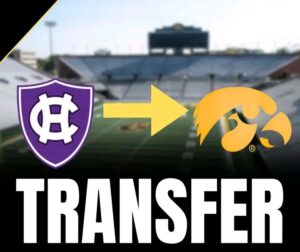
Stevenson, who has played college football for three seasons, offers maturity, physical growth, and game reps that are unmatched in practice. He should strive for significant snaps and offer a reliable rotational option along the interior even if he isn’t scheduled to start every game from day one.
More significantly, his presence allows Iowa flexibility. Younger players can be gradually given more responsibilities by the coaching staff without being forced to take on too much responsibility too quickly. Iowa’s defensive success has long been characterized by this harmony between youth and experience.
Stevenson also exemplifies a more general trend in Iowa’s portal strategy. The Hawkeyes have prioritized fit, both on and off the field, and focused on specific needs rather than chasing volume. Anthony Hawkins, a transfer safety from Villanova, was acquired by Iowa earlier to bolster depth and experience in the secondary. All of those additions point to a program that knows when it needs assistance and isn’t scared to change without losing its identity.
There is still work to be done. The depth of Iowa’s defensive line suffered, and as the portal cycle goes on, there may be more roster movement. However, Brice Stevenson’s addition is a significant step in the right direction and helps close the gap between a successful 2025 season and the 2026 expectations.
Stevenson sees it as a chance to establish himself on a larger platform. For Iowa, it serves as a reminder that astute assessments and well-defined development plans can still prevail in a time of rapid change. Additionally, it gives Hawkeye supporters more reason to think that the defense will continue to be the foundation of the team even as it changes.