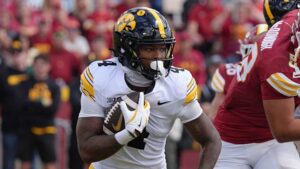
The Hawkeyes have discovered their future kicker, which is more significant than most fans outside of Iowa City realize for a program that has long viewed special teams as a foundation rather than a luxury.
Soon after the 2025 season ended, Iowa’s special teams team suffered a serious setback. LeVar Woods, a longtime special teams coordinator and one of the nation’s top recruiters and coaches, left Iowa to join Michigan State’s new staff under head coach Pat Fitzgerald. A very prosperous period in Iowa City that continuously produced elite specialists and game-changing returns came to an end with Woods’ move to East Lansing.
Woods didn’t leave alone.
Starting punter Rhys Dakin entered his name and followed his former coordinator to Michigan State when the transfer portal opened on January 2. Dakin’s choice was made after Iowa’s special teams suffered yet another significant defeat when kicker Drew Stevens used up his last year of eligibility and moved on. The Hawkeyes lost their placekicker, coordinator, and starting punter in a matter of weeks. These three departures would be concerning for any program, but particularly for one that has made winning the hidden-yardage battle its identity.
For a stretch, it felt like Iowa’s once rock-solid special teams unit was wobbling.
Over the weekend, a gifted FCS kicker filled the void, allaying that worry. After using the transfer portal, former North Dakota State standout Eli Ozick declared his commitment to Iowa, providing the Hawkeyes with a seasoned and reliable option with two years of eligibility left. Ozick’s journey to Iowa City happened swiftly. He went to Iowa men’s basketball’s exciting victory over UCLA to take in the atmosphere surrounding the program, and that visit proved to be all he needed. Ozick only went to one school, in Iowa. Soon after, he decided to continue his career in Iowa City.
That alone says plenty.
Ozick developed a resume during his three years at North Dakota State that precisely matches Iowa’s requirements for the role. He demonstrated respectable range with a career-long make of 54 yards and converted 19 of 23 field goal attempts, good for an outstanding success rate. As a member of North Dakota State’s 2024 FCS national championship squad, he gained experience in high-stress games where every kick matters, which may have been equally significant. That background is significant to Iowa supporters. In Iowa City, kicking isn’t about eye-catching numbers or social media highlights. It’s about being dependable, maintaining composure, and delivering when there is very little room for error. Ozick shows up with evidence that he is capable of doing just that.
It was obvious how urgent Iowa’s search for a kicker was. The Hawkeyes were suddenly lacking at two historically strong specialist positions after Stevens left and Dakin entered the portal. Iowa continuously transformed special teams from a supporting unit to a competitive advantage under Woods’ direction. Uncertainty preceded the 2026 season due to the sudden loss of that infrastructure.
Just Stevens’ departure created a huge void. He finished with a strong 78.6 percent success rate in his final season, making 41 of 42 extra-point attempts and converting 22 of 28 field goals. Return specialist Kaden Wetjen, who finished his Iowa career with 1,039 total return yards and four touchdowns, complemented his consistent output. Collectively, they embodied the most recent generation of exceptional special teams players cultivated under Woods.
Dakin left soon after Woods’ relocation was made official. The Australian gambler, who was first signed by Woods, had a mixed 2025 season. Dakin recorded 43 punts for 1,862 yards and a net average of 40.8 yards, despite never quite matching the legendary former Hawkeye Tory Taylor’s extremely high standards. Although Woods frequently insisted that Iowa supporters hadn’t yet witnessed Dakin’s best, a new beginning eventually made sense for both parties.
Dakin thanked Iowa on social media as he got ready to access the portal on January 1. Soon after, there were rumors that he would meet Woods again at Michigan State, which eventually became official. With two years of eligibility left and a chance to start over in his career, Dakin departs Iowa. Ozick’s dedication keeps Iowa afloat at a crucial juncture.

Securing a dependable kicker with championship experience offers instant relief, even though the Hawkeyes will still need to work out their punting situation and get used to life without Woods. Additionally, it reaffirms a well-known fact about the program: special teams are still very important here.
Iowa continues to win games the old-fashioned way, using discipline, field position, and hard-to-score points in a time when offense-heavy narratives rule the sport. The addition of Ozick does more than simply fill a roster spot. It rebuilds trust in an aspect of the game that has long been essential to Iowa football’s character. Because of this, the Hawkeyes see this commitment as a wise, forward-thinking decision rather than a temporary fix.