Nothing was certain when Logan Jones had to make a choice following the previous season. He could have simply turned the page and moved on after leading one of the top offensive line units in the nation. Long after his last snap, Iowa supporters will be thankful for his decision to return.
Jones’ comeback turned out to be the key component of an Iowa offensive line that not only fulfilled but also historically surpassed expectations. The Hawkeyes had a dominant season that ended with individual and team hardware seldom seen in Iowa City thanks to the veteran center, who became the team’s lifeblood.
Jones had already left his mark on the program’s history by the time the regular season concluded with a decisive victory over rival Nebraska in Lincoln. He led Iowa’s offensive line to the Joe Moore Award, which honors the best offensive line unit in college football, and won the Rimington Trophy, which is given to the best center in the country each year.
For a group that continuously enforced its will in the trenches, it was a fitting conclusion. Only a portion of the story was revealed by those honors. Jones’ preparation, leadership, and consistent presence at every game were what really made an impact. Opponents sensed him, coaches trusted him, and teammates relied on him. This season was about completing what he started, not just building on last year.
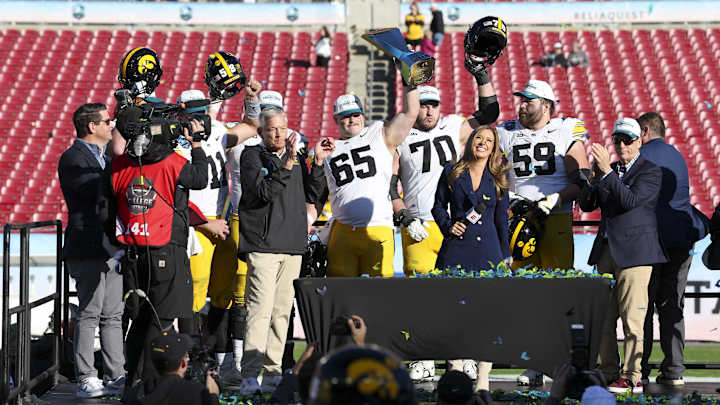
That journey came to an end on December 31, 2025, at Raymond James Stadium in Tampa, Florida, when Iowa defeated No. 14 Vanderbilt handily in the ReliaQuest Bowl to cap off the season. Jones stood with head coach Kirk Ferentz, lineman Logan Jones (number 65), and offensive lineman Beau Stephens (number 70) as the final seconds passed, relishing a moment that had taken years to prepare.
During his postgame media availability following the game, Jones discussed his time with the program; The Hawkeye Report shared some of his reflections. The weight of appreciation and perspective that only come at the end of a long journey was evident in his words.
He described his time in Iowa City as some of the best of his life, calling it “awesome” to end his career that way. There was gratitude for what had been rather than resentment over what was coming to an end. Jones emphasized the importance of the coaching staff, particularly offensive line coach George Barnett and head coach Kirk Ferentz.
He claims that those outside the program are unaware of how excellent they are as mentors and leaders in addition to being brilliant football players. That sentiment reaffirmed what many former Hawkeyes have previously stated: relationships that endure long after the final whistle, trust, and accountability are the cornerstones of Iowa’s culture.
He also spoke positively about the university itself, stating that he has made an effort to savor every second of his stay in Iowa City because everyone associated with the program is “so awesome.” It wasn’t coach jargon. It sounded like someone who was genuinely aware of how uncommon that type of setting is.
Without Jones snapping the ball, Iowa football will look different the following season. His absence will be felt not only on Saturdays but also in weight rooms, meeting rooms, and other settings where leadership is crucial. Programs feel their absence, even though centers don’t always make headlines.
Beyond awards and honors, Jones leaves a lasting legacy. He leaves as an example of what Iowa football wants its linemen to be: tough, selfless, disciplined, and trustworthy. He was a leader who uplifted people around him and accurately represented the program at every stage.
Logan Jones’ legacy is safe as Iowa moves on to the future. He finished his career on his own terms, gave the Hawkeyes everything he had, and left after completing the task for which he had returned. There is no better conclusion for a program that is based on doing things correctly.