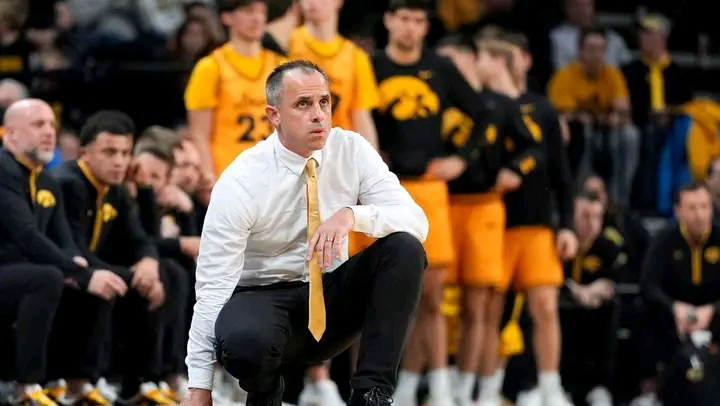
Ben McCollum, the head coach of Iowa basketball, is focusing on developing the 2026 recruiting class as the team continues to gain momentum in the 2025–26 campaign. Speaking at the media availability on Thursday, McCollum outlined the program’s top priorities for talent acquisition, emphasizing that the Hawkeyes must address certain issues if they hope to maintain their high level of competition in the Big Ten and beyond.
Ethan Harris, a four-star power forward, is the only signee in Iowa’s 2026 class. McCollum admitted that there are still holes in the roster that need to be filled, even though Harris is a solid foundation piece. “Yes, indeed. “Yeah, we need a point guard, and then we probably need a big guy,” McCollum stated, emphasizing the roles that will influence Hawkeyes basketball going forward. Although the team already has some versatile forwards—what he called “six-eight guys that can shoot”—he pointed out that the program would benefit from having a larger point guard to run the floor and more size.
A recurrent theme in McCollum’s recruiting talks is this emphasis on size. The coach feels that acquiring players who can fill traditional positional roles will provide a stronger foundation going forward, even though the current roster’s athletic, hybrid-style forwards offer flexibility. “There are some excellent ones there. I believe we’re doing well there. All we need to do now is possibly obtain some size. And on top of that, a larger point guard,” he clarified. Iowa wants to compete not only with skill but also with physicality that can match the more formidable programs in the conference, which is reflected in the emphasis on size.
Additionally, McCollum outlined the options the Hawkeyes will consider to address these needs. The window for traditional high school recruiting is closing now that the early signing period is over. He acknowledged the increasing significance of the transfer portal in contemporary college basketball by saying, “We either do that through high school, if they’re still available, or you’ll have to go through the portal.” Filling roster gaps more quickly can be achieved by balancing high school prospects with seasoned transfers for a program like Iowa, which is gaining momentum and looking to make deeper runs in postseason play.
The portal is now a vital resource in today’s hiring environment. While transfers can have an immediate impact, high school players offer the benefit of long-term development and program fit. McCollum’s readiness to take into account both options shows a practical approach, indicating that Iowa is trying to stay competitive in the here and now in addition to building for the future. The coach’s comments point to a careful, adaptable approach that incorporates player development, scouting, and astute acquisition.
But timing will be crucial. The pool of high school prospects is small now that the early signing period is over, and programs that move fast frequently gain an advantage. McCollum’s remarks highlight how urgent Iowa’s recruiting efforts are, as the team looks for players who can fill particular gaps before other schools close. The quality and impact of Iowa’s upcoming class will probably depend on the combination of speed, insight, and strategic targeting.
McCollum and the Hawkeyes are concentrating on the current task of the season rather than recruiting. With a 1-1 record in Big Ten play and a 9-2 overall record, Iowa is in excellent form, which McCollum hopes to continue as the season goes on. The coaching staff learns more about areas where positional versatility and roster depth may need to be strengthened with every game. This continuous assessment helps the program match future additions with present tactical and strategic requirements and guides recruiting priorities.
In the future, Iowa will play Bucknell at the Casey’s Center in Des Moines, Iowa, on Saturday, December 20. The Big Ten Network will broadcast coverage of the tip-off, which is scheduled for 5 p.m. CT. The impending game serves as a reminder of the significance of strategic roster building while also providing an opportunity to highlight the team’s present strengths. McCollum’s aggressive recruiting strategy aims to maintain Iowa’s competitiveness in the current and upcoming seasons.
McCollum’s recent comments essentially convey a clear vision: the Hawkeyes want to add both experienced transfers and high school signees to their current talent pool in order to combine skill, versatility, and size. After all, recruiting is about more than just filling spots; it’s also about creating a team culture, adding depth, and getting ready for a demanding season. Iowa’s future lies in meticulous planning, quick action, and a focus on both short-term results and long-term expansion.
McCollum is indicating the kind of players who will shape Iowa’s basketball identity going forward by designating a larger point guard and more size as top priorities. The foundation is set with Ethan Harris already on board, but how high the program can go will depend on the next steps. It will be essential to strike a balance between current demands and future possibilities, make use of both high school talent and the transfer portal, and take swift action. Iowa’s 2026 recruiting approach could mean the difference between a successful season and one that defines the program in the highly competitive world of college basketball.
The Hawkeyes’ emphasis on increasing size, preserving adaptability, and developing talent at crucial positions demonstrates a program that is aware of its advantages and disadvantages and is prepared to take measured risks in order to advance. McCollum’s openness gives prospects and supporters alike confidence and excitement: Iowa basketball’s next phase is expected to be competitive, ambitious, and smart.