

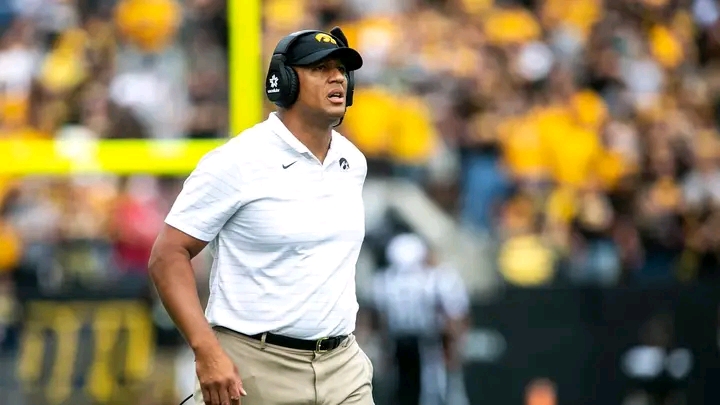
A major shift is underway inside Iowa football, and it has little to do with quarterbacks, recruiting battles, or offensive schemes. Instead, one of the most influential figures behind the Hawkeyes’ success over the past decade is gone, leaving fans and analysts wondering whether one of the program’s greatest strengths can remain intact.
LeVar Woods, Iowa’s longtime special teams coordinator and a former Hawkeye player, recently departed the program to accept a new opportunity at Michigan State. The move brought an end to an Iowa coaching tenure that spanned nearly two decades and left a significant void within Kirk Ferentz’s staff.
While coaching changes happen every offseason across college football, this one feels different.
Woods wasn’t simply another assistant coach. He was widely regarded as one of the nation’s top special teams coordinators, helping transform Iowa’s special teams unit into one of the most respected and feared groups in college football. Under his leadership, the Hawkeyes consistently won the hidden-yardage battle, controlled field position, and delivered game-changing plays when they mattered most.
Those contributions became a defining part of Iowa’s identity.
For years, opponents knew they couldn’t afford mistakes against the Hawkeyes. A booming punt, a perfectly executed coverage unit, or a clutch field goal often shifted momentum in Iowa’s favor. In many close Big Ten battles, special teams proved to be the difference between victory and defeat.
That consistency didn’t happen by accident.
Woods played a major role in developing some of the best specialists in program history. His tenure included standout performers such as All-American kicker Keith Duncan, star punter Tory Taylor, and explosive return specialist Kaden Wetjen. Those players became household names among Iowa fans and helped elevate the program’s reputation nationally.
Perhaps the greatest example of Woods’ influence came through Iowa’s ability to maximize every phase of the game.
While many college football programs focused heavily on offense, the Hawkeyes embraced a more balanced approach. Ferentz’s teams often relied on strong defense, disciplined football, and elite special teams to compete against more talented opponents. Woods helped ensure that strategy consistently produced results.
His departure now raises a critical question heading into the 2026 season.
Can Iowa maintain the same standard without the coach who built it?
The challenge extends beyond replacing a respected coordinator. Iowa is also dealing with significant roster turnover on special teams. Several key contributors who played major roles in recent seasons are no longer with the program, creating additional uncertainty as the Hawkeyes prepare for a new campaign.
Replacing proven performers is never easy.
Players like Kaden Wetjen provided explosive return ability that could instantly change a game. Drew Stevens delivered reliability in the kicking game, while punter Rhys Dakin helped maintain Iowa’s long-standing tradition of excellence at the position. Losing experienced specialists at the same time as a coaching transition creates a difficult situation for any program.
That responsibility now falls to Chris Polizzi, who has stepped into a larger role overseeing Iowa’s special teams operation.
Polizzi inherits a unit with enormous expectations. The standard isn’t merely competence it’s excellence. Iowa fans have grown accustomed to seeing their special teams rank among the nation’s best, and anything less will attract attention.
Fortunately for the Hawkeyes, the foundation remains strong.
One of the biggest reasons Iowa has enjoyed long-term success under Ferentz is the program’s commitment to player development. Year after year, the coaching staff has identified overlooked talent and transformed those players into major contributors. That approach has allowed Iowa to remain competitive despite facing recruiting disadvantages against many conference rivals.
The same philosophy could prove crucial during this transition.
While Woods’ departure undoubtedly creates challenges, Iowa’s culture has been built to withstand change. The program has survived player departures, coordinator changes, and roster turnover before. Ferentz’s ability to maintain stability has been one of the defining characteristics of his tenure.
Still, there is no denying the importance of what Woods accomplished.
Special teams often receive less attention than offense and defense, but Iowa consistently treated that phase of the game as a priority. The results spoke for themselves. Whether through field-position advantages, successful kick coverage, blocked kicks, or timely returns, the Hawkeyes repeatedly gained an edge that opponents struggled to match.
Those hidden advantages frequently translated into victories.
As the 2026 season approaches, observers will be watching closely to see whether Iowa can continue producing the same level of efficiency and impact. Early performances could offer valuable clues about how smoothly the transition is progressing.
The pressure is significant, but so is the opportunity.
If the Hawkeyes maintain their special teams excellence despite losing Woods and several key players, it would reinforce the strength of the program’s culture and developmental system. It would also demonstrate that Iowa’s success was built on more than one coach alone.
However, if performance declines, Woods’ absence will quickly become one of the most discussed storylines surrounding the team.
That’s what makes this transition so fascinating.
For nearly two decades, LeVar Woods helped shape a critical part of Iowa football’s identity. His departure marks the end of an important chapter, but it also signals the beginning of a new one.
Whether the Hawkeyes can continue their special teams dominance without one of the architects behind it remains to be seen. What’s certain is that every punt, kick return, and field-goal attempt this season will be examined more closely than ever before.
And in a program where special teams have often been the hidden key to success, the spotlight has never been brighter.
