

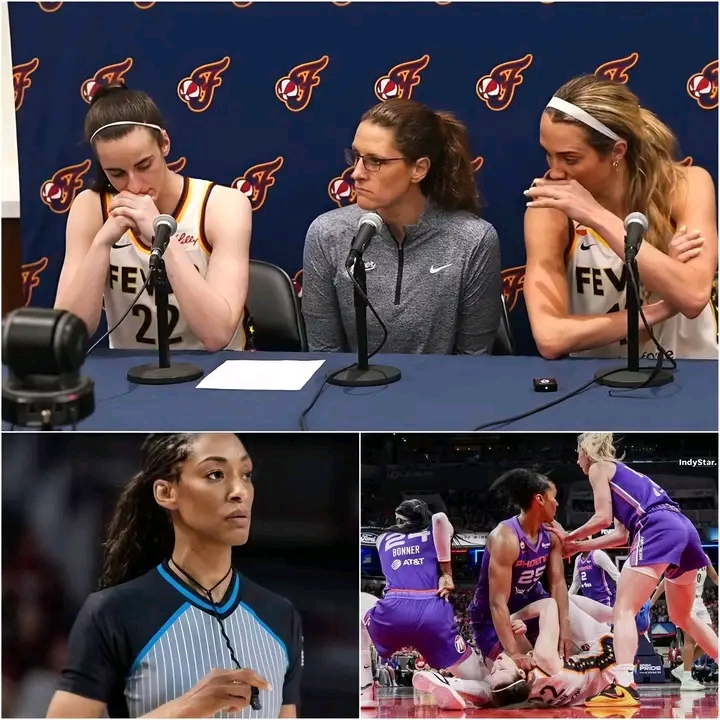
The WNBA has been thrown into yet another firestorm involving Caitlin Clark and this time, the controversy extends far beyond the players on the court.
In the aftermath of the Indiana Fever’s heated showdown against the Phoenix Mercury, reports emerged that veteran referee Angelica Suffren has reportedly been suspended following a highly disputed third-quarter sequence involving Fever superstar Caitlin Clark and Mercury forward Alyssa Thomas. While the league has yet to publicly confirm the details of any disciplinary action, the reported suspension has ignited widespread debate about officiating standards, player safety, and accountability across the WNBA.
The controversy stems from a physical loose-ball sequence midway through the third quarter of Phoenix’s dramatic 111-109 victory over Indiana on Wednesday night. What initially appeared to be a routine scramble for possession quickly escalated into one of the season’s most talked-about moments.
Clark, who once again entered the contest as the focal point of both Indiana’s offense and the opposing defense, found herself at the center of a chaotic sequence that has since dominated sports headlines and social media discussions.
During the play, multiple players dove to the floor battling for possession. Broadcast replays later showed Clark on the hardwood as contact occurred between her and Thomas. Several analysts and commentators reviewing the footage described the interaction as unusually forceful, with some pointing specifically to contact around Clark’s upper body and neck area while she remained on the floor.
Perhaps most surprising to many observers was what didn’t happen.
No foul was called.
Officials allowed play to continue without stopping the game for review, despite immediate reactions from players, broadcasters, and viewers who believed the sequence warranted closer examination under league rules.
Within minutes, social media platforms were flooded with clips of the incident. Fans questioned why officials failed to assess either a personal foul or initiate a flagrant foul review, especially considering the league’s ongoing emphasis on player safety.
The backlash only intensified when reports surfaced suggesting that referee Angelica Suffren had been suspended following the contest.
Although the WNBA has not issued a comprehensive public explanation regarding the reported disciplinary decision, league insiders indicate that missed or unreviewed calls during the controversial third-quarter sequence may have contributed to the action.
If confirmed, the development would represent one of the most significant officiating controversies of the 2026 WNBA season.
The situation has also reignited broader concerns surrounding how games involving Caitlin Clark are officiated.
Since entering the league, Clark has become the WNBA’s biggest television draw, dramatically increasing viewership numbers, attendance figures, and national media attention. But with that spotlight has come increased scrutiny over the physical treatment she receives on the court.
Critics argue that Clark is frequently subjected to exceptionally physical defensive schemes without receiving adequate protection from officials. Supporters of current officiating standards counter that professional basketball is inherently physical and that star players across all eras have endured intense defensive pressure.
Still, many analysts believe the latest incident crossed a line.
Several former players and television commentators noted that while aggressive defense remains a fundamental part of basketball, actions involving players on the floor particularly around the head and neck area require immediate review to ensure player safety is not compromised.
The controversy deepened further when Clark exited the game midway through the third quarter.
Although the Fever did not immediately release detailed information regarding her condition, Clark’s departure dramatically altered the flow of the game. Up until that point, she had played a major role in keeping Indiana within striking distance in a tightly contested matchup.
Without their floor general, the Fever were forced to adjust their offensive structure on the fly.
Indiana continued to battle throughout the closing stages, but the final result was ultimately overshadowed by the officiating controversy and the questions surrounding the incident involving Thomas and Clark.
The latest flashpoint also highlights the increasingly tense rivalry developing between the Fever and the Mercury.
Meetings between the two franchises this season have featured no shortage of physical play, technical fouls, and emotional exchanges. Phoenix’s veteran-led roster has consistently employed aggressive defensive tactics, while Indiana continues to build around Clark’s dynamic playmaking abilities.
As the season progresses, the intensity between the teams appears to be escalating.
League sources indicate that the WNBA’s competition committee is continuing to review the entire sequence. Among the key questions reportedly being examined are whether the contact involving Clark meets the league’s threshold for flagrant or unnecessary roughness, whether officiating decisions affected player safety outcomes, and whether additional disciplinary action could be warranted for either players or members of the officiating crew.
The findings could potentially influence how similar incidents are handled throughout the remainder of the season.
Meanwhile, reports have also circulated suggesting that the Indiana Fever organization and Clark issued a brief but pointed response following the game, expressing frustration with both the missed call and the broader handling of physical play. However, no official statement from the team or league confirming the exact wording has been released.
What is clear is that the controversy has become far bigger than a single possession.
At a time when the WNBA is experiencing unprecedented growth in television ratings, attendance, and global visibility, every major officiating decision now carries enormous weight. The league’s response to this incident may ultimately establish an important precedent regarding player safety and officiating accountability moving forward.
For now, fans, analysts, players, and league officials continue waiting for definitive answers.
One thing, however, is beyond dispute: the Indiana Fever-Phoenix Mercury matchup will be remembered not for its final score, but for the storm it unleashed across the basketball world.
